Nandkumar M. Kamat
The Star of Bethlehem remains a unique focal point in scientific inquiry, occupying a rare intersection of astronomy, history, and ancient observational practices. The question for modern science is not whether the story carries symbolic meaning but whether it preserves the memory of a real astronomical event that occurred in the final years before the Common Era.
Historians broadly agree that Jesus of Nazareth was born before 4 BC, the year King Herod the Great died. Any natural explanation for the Star of Bethlehem must fall between roughly 7 and 4 BC and must have been visible to naked-eye observers across a wide geographic region that included Mesopotamia and the eastern Mediterranean. The description preserved in the Gospel of Matthew is brief, but it contains several observational clues that are highly relevant to the field of astronomy. The object is described as a “star” seen in the east, interpreted as significant by trained observers, and later described as moving in a way that appeared to guide them before coming to rest at a specific location. From a scientific standpoint, this immediately rules out ordinary star formation. Fixed stars do not move perceptibly against the background of the sky over days or weeks. It also rules out short-lived phenomena such as meteors, which appear only for a few seconds.
For centuries, scholars have tested different classes of astronomical objects against these constraints to determine their existence. Planetary conjunctions were among the first serious candidates because they are predictable, rare, and have a long history of being documented. The most famous example is the triple conjunction of Jupiter and Saturn in 7 BC, an event that occurred when the Earth’s motion caused Jupiter to appear to reverse course and pass Saturn three times within a single year. Babylonian astronomers recorded this event with precision, and its occurrence is not disputed today. Despite its historical interest, modern astronomers remain unconvinced that this conjunction explains the Star of Bethlehem. Visually, Jupiter and Saturn do not merge into a single brilliant object. They would have remained distinct points of light separated by a noticeable distance. More importantly, conjunctions do not behave in a way that would allow them to be described as leading observers of the landscape. They rise and set according to predictable patterns and do not “go before” travellers in any meaningful sense.
Another proposed explanation involves a nova or supernova, a stellar explosion capable of producing a bright, new point of light in the sky. Ancient observers could record such events, and Chinese astronomical records contain references to sudden “guest stars.” However, no convincing record of a supernova exists for the relevant period between 7 and 4 BC exists. Even if such an explosion had occurred, it would have appeared fixed against the background stars and therefore would not match the reported behaviour of the Star of Bethlehem.
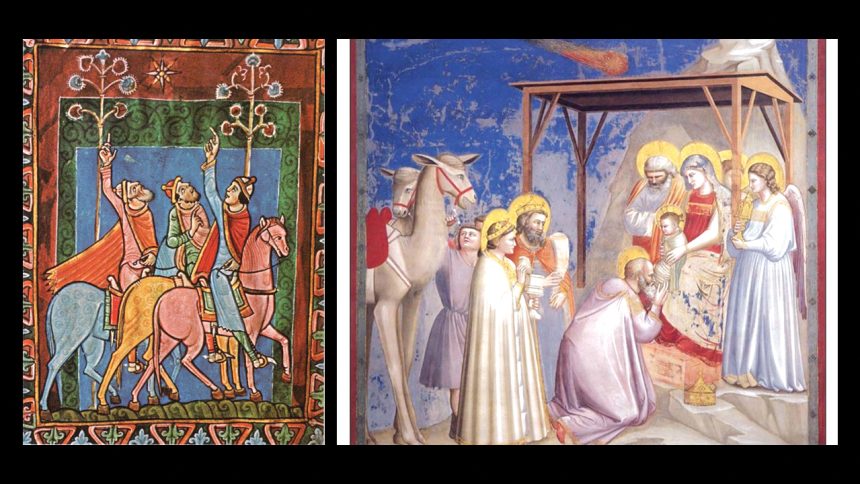
As weaker explanations were gradually eliminated, comets emerged as the most plausible natural candidate. This is not a modern invention, however. As early as the third century, the Christian scholar Origen suggested that the star described in Matthew might have been a comet. What distinguishes modern comet-based explanations is not the idea itself but the quality of the supporting evidence and the use of detailed historical records. The strongest evidence comes from the ancient Chinese astronomical chronicles. Court astronomers in China maintained systematic records of unusual celestial phenomena, such as comets, eclipses, and planetary motions. These records were compiled independently of Biblical traditions and are therefore especially valuable for historical verification. These chronicles describe a bright object that appeared in 5 BC and remained visible for approximately 70 days. The object is described using terminology often translated as a “broom star,” a term commonly used in the literature to refer to comets.
Recent scientific discussions have revived interest in this fifth-century BC comet by examining its properties, considering both ancient records and modern orbital modelling. Among those whose analyses have drawn attention is NASA planetary scientist Mark Matney, who has argued that the Chinese descriptions are consistent with a real comet whose visibility and motion align closely with that of the Gospel account. According to this interpretation, the comet’s sudden appearance, long duration, and slow movement across the sky make it a strong candidate for the phenomenon later described as the Star of Bethlehem. What distinguishes this renewed argument from earlier comet theories is its emphasis on geometry and perspective. A comet moving along a shallow trajectory relative to Earth can appear to slow down dramatically at certain points along its path. When observed over consecutive nights, such an object may seem to “pause” or hover in the sky. This effect becomes particularly pronounced when the comet is near the point in its orbit where its apparent motion changes direction relative to the observer, a phenomenon that is well understood in orbital mechanics. From the standpoint of ancient observers, such behaviour could easily be described in narrative language as a star that “stood still.” This does not require the comet to literally stop moving; only that its apparent motion relative to familiar stars became minimal for a period. Modern astronomy recognises this effect in the apparent motion of planets during retrograde loops, and similar principles apply to comets under specific viewing conditions. The duration of approximately 70 days is also significant. Unlike meteors or brief planetary alignments, a comet visible for several months would have allowed for repeated observations and interpretations. Trained sky watchers in the ancient Near East did not merely glance at the sky; they systematically observed it. An object that persisted night after night would naturally attract attention and invite interpretation within the existing astronomical frameworks. Timing is another crucial factor in this regard. The appearance of the five BC comet falls squarely within the accepted historical window for the birth of Jesus. This alignment is not exact proof, but it satisfies a necessary condition that many other proposed explanations fail to satisfy. The fact that the comet was recorded independently in East Asia strengthens the case that it was a real, observable phenomenon, rather than a later literary invention. The surviving records do not allow astronomers to reconstruct the comet’s precise orbit with complete confidence. Science cannot demonstrate a direct causal link between the appearance of the comet and the actions described in the Gospel narrative.
Modern public interest in the Star of Bethlehem has been renewed in recent years due to bright planetary displays visible in the night sky. The persistence of the Star of Bethlehem question highlights an important aspect of the history of science. Ancient astronomy was neither primitive nor careless. Observers carefully recorded what they saw using the conceptual tools available to them. Their interpretations differ from modern scientific explanations, but their observations are often accurate and reliable. When modern researchers revisit ancient records, they engage in dialogue spanning centuries, testing old observations against new understandings. The renewed attention given to the five BC comets does not settle the debate once and for all, but sharpens it. This demonstrates how advances in orbital mechanics, combined with careful reading of historical texts, can breathe new life into long-standing questions.
The Star of Bethlehem, whether a comet or a remembered phenomenon, stands as a reminder that the night sky has always been a source of curiosity, interpretation, and discovery. Ultimately, this is where new light truly falls. Merry Christmas to all our readers.