Dr. Luis Dias
My first-ever trip to the African continent last year has created a deep impression on me, and makes me long to return and explore further.
We entered Zanibar, a Tanzanian archipelago off the coast of East Africa, however, on a jarring note. Despite having travel insurance for Tanzania, upon arrival late at night into Zanzibar’s Abeid Amani Karume International Airport, we were denied entry until each of us paid an additional steep insurance fee specifically for Zanzibar. Chaos ensued and we were the last to leave the by-then deserted airport after the mandatory fee (of which we had no prior notice) was paid.
We arrived, travel-weary, into Stone Town, a UNESCO World Heritage site renowned for its, labyrinthine alleys, and unique Swahili, Arab, Persian, Indian, and European architectural fusion, the historic heart of Zanzibar City.
The Portuguese presence in Zanzibar was relatively brief (1503-1698), but shares its history with Goa as it was a flourishing centre of the spice trade (still evident today), and of the Indian Ocean slave trade well into the 19th century. The Anglican cathedral of Christ Church in Stone Town was erected at the former site of one of the world’s last and largest open slave markets, shut down by the British in 1873. The altar (a white marble circle surrounded by red to symbolise the blood of the slaves) stands where the main whipping post used to be.
The highest concentration of the remaining famed ‘Zanzibar’ (or ‘Swahili’) doors, made from Indian teak and showing rich traces of the Indian diasporic history, is found in Stone Town.
One modest Zanzibar door, literally a stone’s throw from our hotel resort, lets you step into a different ‘kind of magic’: a museum dedicated to the one and only Freddie Mercury (1946-1991), the first of its kind in the world, inaugurated
in 2019.
Mercury, birth name Farokh Bulsara, was born in Stone Town (on the same day as Parsi Navroz, so his birthday was always celebrated in the fire temple) and spent his early years until the age of eight here before being sent to boarding school (St. Peter’s school) in Panchgani hill station, western India.
You have to be a Freddie Mercury and Queen fan to get the most out of this museum, or else it seems like a maze with walls adorned by pictures and memorabilia, with a lot of accompanying fine print to read. The reason that it is a maze is, there is such a lot of history to cover in a very cramped space.
Fortunately, after the last stragglers had left, I had the whole museum to myself, to wander about at leisure.
The museum has themed sections: Zanzibar’s history in pictures; Farokh Bulsara; Freddie Mercury, and Queen.
A stark picture chronicles an extreme example of British ‘gunboat diplomacy’: the ruins of the palace of the Sultan of Zanzibar after the Anglo-Zanzibar war of 1896, which lasted little over half-an-hour, “the shortest war in world history”. The Sultan’s forces suffered 500 casualties, while only one British sailor was injured.
Another picture showing workers milling about huge ivory tusks (by 1894, 100,000 were exported from Zanzibar alone) grimly underlines the wanton slaughter of elephants to meet European colonial ‘demand’.
The first Zanzibar building to have electricity (and the first in East Africa to have an elevator) was called Beit al-Ajaib (House of Wonders).
From the facsimile of Farokh’s birth certificate, we learn that his father Bomi was a cashier at Zanzibar’s High Court. The caption below a black-and-white photograph of young Farokh and his younger sister Kashmira posing before a low fence tells us it was taken in Bulsara (modern-day Valsad, Gujarat), which gave the family its surname and where they vacationed every four years.
The names of some school friends (Benito de Souza, John Baptist da Silva, Bonza Fernandez) whose written testimonies adorn the walls suggest they may have been of Goan origin.
Pictures from his Panchgani days demonstrate what a good sprinter, boxer, and hockey player he was. He apparently was an excellent boxer, until his mother got wind of it in Zanzibar and wrote a letter asking him to stop. A snapshot from a school play has him suited up with heavily-framed glasses, in the role of a ‘doctor’. His mother recalled, “He liked anything artistic and anything that gave him a chance to pose…He was an all-rounder in studies and sports, anything he turned his attention to, he
succeeded in.”
Here, age 12, he played piano in his first band, ‘The Hectics’, with Farang Irani (bass), Victory Rana (drums), Derrick Branche (guitar), and Bruce Murray (lead vocals, guitar). Murray recalls the band was formed “mainly to impress the girls, and we achieved that objective. The girls really loved us!”
A picture of Farokh and a group of friends lined up on their bicycles at the start of a race in Panchgani was apparently the inspiration for the song ‘Bicycle Race’. He would cycle from Panchgani to Mahabaleshwar and back – about 20 kilometres – “just for fun.” The passion continued when her returned to study at St. Joseph’s Convent School Zanzibar for a year in 1963 before the family moved to England.
I remember being mystified when a school friend first introduced me to Queen’s 1978 song ‘Mustapha.’ It made no sense to me. I learned from the museum that Mercury’s lyrics draw from his Zanzibar childhood and the island’s Islamic heritage. In an interview he called the lyrics “Arabic and Persian gibberish.” He simply used the Arabic/Swahili jargon he picked up as a child here, as also in Bohemian Rhapsody with the word ‘Bismillah.’
Similarly, ‘Seven Seas of Rhye’ (1973) was in Mercury’s words “a figment of my imagination;” ‘Rhye’ was a fantasy world he and Kashmira created as children. The fadeout repetition “Oh I do like to be beside the seaside” are a wistful recollection of good times from his childhood on Zanzibar’s pristine beaches (and still so compared to Goa). According to radio and record producer Phil Swern, Zanzibar was where Mercury escaped to – “in his mind, at least. He always had that to resort to, when reality got
too much.”
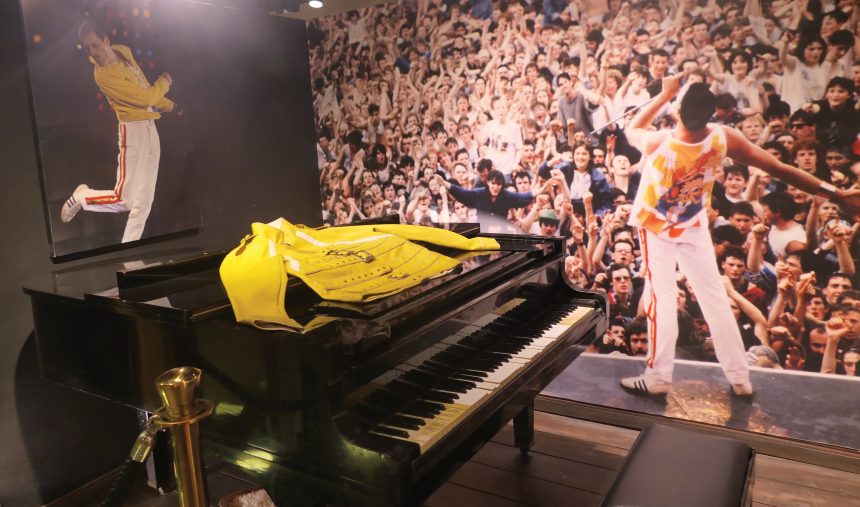
Pictured is the iconic yellow military jacket Mercury debuted on Queen’s whirlwind 1986 ‘Magic Tour’, draped here over a grand piano that has seen better days. The museum also has the red-and-white cotton twill military-inspired jacket designed by Dian Moseley that he also wore on that tour, along with information on the black-and-white and orange-green-white diamond-patterned low-cut Harlequin unitard outfits (inspired by costumes worn by legendary ballet star Vaslav Nijinsky in ‘Carnaval’ 1910 featuring traditional commedia dell’arte characters and designed by Léon Bakst) about which I’ve written in an earlier column.
Toward the exit, there was this Freddie Mercury quote: “When I’m dead, I want to be remembered as a musician of some worth
and substance.”
His birthplace remembers him now with a compact yet lovingly curated museum. That Freddie Mercury was a musician of immeasurable worth and substance is abundantly clear in the large body of work he has left us as his legacy.