

Nandkumar M. Kamat
Many science fiction stories appear to me in my dreams. This is one such story that I immediately wrote down. It is narrated as a time traveller’s tale. It focuses on a woman time traveller from a distant future travelling in the past.
This is how she begins after landing at Khajuraho. “When I stepped out of the chronopod, the first thing I felt was heat rising from the stone. The clearing shimmered under the afternoon sun. Bamboo scaffolds clung to the rising temple like temporary veins. Chisels rang in practiced rhythm. Oxen shifted their weight in the dust. Someone laughed, someone argued about a measurement, someone called for water. And there it was—ascending in tiers of honey-colored sandstone—the temple. I was nineteen.”
“In my century, I studied temporal architecture and ancient aesthetics through simulations so precise they felt real. But I had grown restless staring at reconstructions. I wanted breath, dust, laughter. So, I travelled. I only move backward in time. I adjusted the simple cotton wrap my chronopod had woven for me to match local cloth patterns. I walked toward the sound of hammer and chisel. The site was vibrant, communal. Men and women both worked—hauling stone, smoothing carved surfaces, mixing lime, measuring with knotted cords. No one appeared ornamental. Everyone contributed.”
“On a scaffold, Devika leaned back to assess the curve she had just carved. ‘If you narrow her waist anymore,’ an apprentice called up, ‘she will vanish in a strong wind!’‘Then you must carve her partner stronger,’ Devika replied without looking down. ‘Balance is your responsibility too.’ Laughter rippled across the scaffolding. I smiled. Texts from my era rarely mention laughter.”
“Further along, I slowed. An erotic panel was underway. Two figures entwined in flowing embrace—hips angled; torsos curved in rhythmic counterpoint. But what startled me most was not the carving. A living couple stood beside it, modelling. The woman leaned slightly into her companion; chin lifted with quiet confidence. One arm rested across his shoulder. His hand supported her waist carefully—not possessive, but attentive. They held the pose while a sculptor circled them, studying alignment. ‘Lower the shoulder,’ he murmured. ‘Yes. Let the head incline inward.’ The woman shifted, then laughed. ‘If you stare much longer, my foot will revolt.’ ‘For immortality, you must endure,’ the sculptor said gravely. She rolled her eyes. ‘Then immortality must hurry.’ They relaxed briefly, stretching, then resumed. There was no embarrassment. No whispering. They were collaborators.”
“Then they noticed me watching. ‘You are new,’ she said, stepping toward me. ‘Yes.’ ‘From which village?’ ‘Farther than that,’ I replied carefully. She shrugged. ‘If you can polish, you can stay.’ I knelt beside her before a finished sculpture of a celestial dancer adjusting her anklet. I rubbed the sandstone with a smooth pebble, feeling the day’s stored warmth. ‘Do you never feel shy?’ I asked softly. She looked puzzled. ‘Why?’ ‘The poses.’ She shrugged again. ‘The body is not shameful. It is how we enter the world.’”
“Devika climbed down and joined us, wiping stone dust from her arms. ‘She sketches,’ Devika observed after watching me draw a curve with charcoal. ‘Then she sees,’ the master sculptor said from behind us. He moved with measured calm, eyes bright with quiet authority. ‘You look as though you are carving something inside yourself,’ he told me. ‘In my time,’ I said slowly, ‘people divide body and spirit.’ He tilted his head. ‘Then your time is confused.’ He gestured toward the wall. Musicians, dancers, warriors, lovers—all woven into architectural rhythm. ‘Everything belongs,’ he said. ‘If you deny part of life, you weaken the whole.’”
“The afternoon deepened into gold. Workers coordinated to lift a newly carved slab into place. ‘Left—hold—now lower!’ The slab settled perfectly into its niche. The entwined figures became part of the flowing composition, balanced by dancers on one side and deities on the other. A young apprentice muttered, ‘Warriors are easier to carve.’ ‘War is simple,’ the master replied. ‘Love requires attention.’ The apprentice fell silent.”
“As evening approached, oil lamps were lit along the base of the temple. The sandstone softened under amber light. The erotic figures no longer seemed bold; they seemed tender. The modelling couple resumed their pose for final adjustments. This time, the woman’s expression shifted—half inward, thoughtful. The sculptor captured it delicately. Devika stood beside me. ‘Will you stay?’ she asked. ‘I cannot.’ She studied my face. ‘You speak as if you belong nowhere.’ ‘I belong to time,’ I said before I could stop myself. She laughed lightly. ‘Then time must be lonely.’ Perhaps it was.”
“Workers gathered beneath a makeshift awning to eat. Bread passed from hand to hand. Someone joked about a priest who tripped over scaffolding. Laughter rose again. I sat among them, absorbing the ordinariness. The erotic panels were not scandal; they were craft. Courage carved in stone. Night settled slowly. The temple stood luminous against an indigo sky. The carvings held their rhythm, serene and unapologetic.”
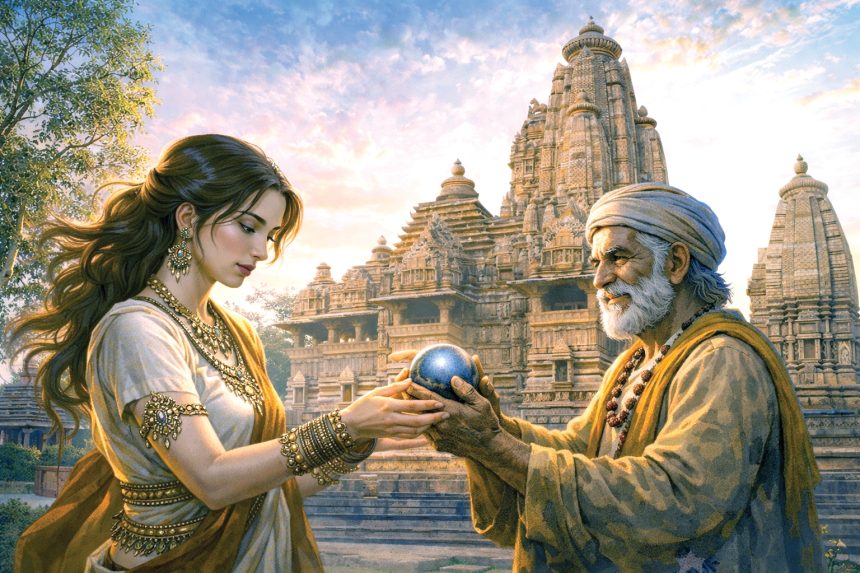
“I knew it was time to leave. But before I walked back toward the forest edge, I drew from my pouch a small object I had carried since departure. It was a sphere—no larger than a fruit, smooth, metallic, faintly luminous even in shadow. The master sculptor noticed. ‘What is this?’ he asked quietly. ‘A gift,’ I said. ‘From far beyond this century.’ He held it, weighing its density. ‘It is not stone.’ ‘No.’ ‘It is not any metal I know.’ ‘No.’ ‘Will it harm?’ ‘It endures,’ I replied. ‘That is all.’ He looked at me for a long moment, as though measuring not the object but my intent. ‘Where?’ he asked. ‘At the highest point,’ I said. ‘Within the amalaka, in a hidden socket. No record.’ He nodded once.”
“Later, under the pretence of adjusting alignment at the summit, he carved a precise cavity into the stone beneath the great ribbed crown. I watched from below as he placed the sphere within and sealed it seamlessly. When the amalaka was finally lifted into position, no trace remained visible. No inscription. No memory. Before I departed, the master stood beside me beneath the quiet night. ‘It will remain,’ he said simply. ‘Yes.’ ‘And no one will know.’ ‘Not yet.’ I stepped into the chronopod. The clearing dissolved into light.”
The story ends here as we move to the present century. In 2025, an international restoration team, under UNESCO oversight, conducted advanced LIDAR scans of the temple’s upper shikhara to assess structural stability. The anomaly appeared as a faint irregularity within the amalaka core—reflectivity inconsistent with that
of sandstone.
At first, it was dismissed as later repair material. But the density readings did not match those of iron, copper, gold, or any documented historical alloy. Careful extraction followed, stone removed layer by layer under strict conservation protocol. The object emerged. A metallic sphere, untouched by corrosion. Non-destructive analysis revealed a composition unlike any known terrestrial alloy. Stable isotopes of superheavy elements were detected—materials theorised but never synthesised in a durable form using known methods. Excitement surged through scientific communities worldwide. No historical record mentioned its placement. The surrounding stone showed uninterrupted aging consistent with 11th-century construction.
The temple stood as it always had—balanced, composed, silent. And somewhere beyond ordinary chronology, a young woman who travelled only into the past carried with her the memory of stone dust, lamplight, laughter—and a gift hidden in plain sight for a future not yet born.

