Dr. Nandkumar M. Kamat
The morning of March 22, 2042, did not arrive in silence. It arrived with a slow, relentless sound—the inward breathing of the sea. Across Goa, the tides of the Arabian Sea had begun to move differently over the past decade. Not violently, not dramatically, but persistently. Each year, the saline front crept a little further inland. Each monsoon failed to push it back fully. Each summer allowed it to advance again. The change had not come like a disaster film.
On the 50th anniversary of World Water Day, Goa gathered to declare that it had adapted. At the northern coast near Anjuna, the Anjuna Mega Desalination Plant rose like a metallic citadel. Its intake structures plunged into a sea that had already crossed invisible boundaries decades ago. In the south, at Chicolna, its twin mirrored the same architecture, the same inevitability. The two plants had been built fast, justified as emergency infrastructure, then praised as symbols of resilience by the very people who once mocked every warning about watershed destruction, sewage discharge, hill cutting, reckless tourism growth, and unregulated groundwater extraction. Each plant: 600 million litres per day. Together: 1200 MLD.
The holographic map projected above the inauguration site showed the truth in layers. The Mandovi still flowed. The Zuari still widened toward the sea. Groundwater maps told the same story. Coastal aquifers were fully saline. Midland aquifers showed progressive intrusion. Even inland wells had begun to fluctuate between fresh and brackish depending on tidal cycles and seasonal recharge. Freshwater existed, but not where people needed it, and not when they needed it. At the same time, in Porvorim, a second stage was set.
Rows of Atmospheric Water Generators stood ready—compact, gleaming, indifferent to rivers, tides, and aquifers. They looked almost harmless, like expensive household appliances displayed at a trade expo. Yet each unit represented the burial of a public system. The state had chosen a dual response. Desalination for irrigation and industry. Atmospheric extraction for homes.
The Chief Minister stood at Anjuna, facing the sea that had rewritten Goa’s geography. “Let us be clear,” he began. “Our rivers have not disappeared. But they are no longer ours.” A murmur passed through the gathering. “The sea has moved in. Tides now carry salinity deep into our river systems. The freshwater zone has been pushed back beyond practical reach. What remains is limited, seasonal, and increasingly unreliable.” Behind him, the desalination plant surged to life. “This,” he said, gesturing to the massive structure, “is how we respond.”
At that moment, both Anjuna and Chicolna reached full operational capacity. Seawater rushed through intake channels, was forced through membranes, and emerged as controlled, standardized freshwater. Pumps groaned. Valves opened. Warning lights became steady green. Pipelines carried the new water inland—toward industrial corridors, agricultural fields, and storage reservoirs designed for a different hydrology. Farmers watched the giant screens closely. For years, they had struggled with unpredictable irrigation—fields turning saline, crops failing, bunds weakened by tidal seepage, soils losing structure. Some had abandoned paddy. Some had shifted to salt-tolerant crops. Now, water would come not from rivers, but from machines. “Assured supply,” one farmer said quietly. “Controlled quality,” another added. No one spoke of the cost. No one spoke of the energy burden. Those questions had already been defeated by necessity.
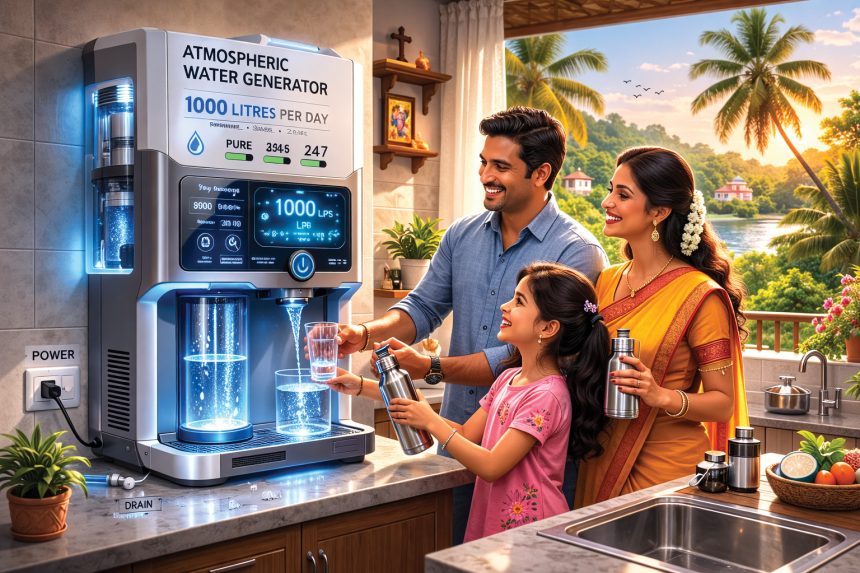
At Porvorim, the second ceremony unfolded. The Minister for Water Resources stood beside an operational AWG unit. Cameras zoomed in as the machine inhaled humid air and exhaled certainty. “For domestic consumers,” he announced, “we move beyond dependence.” Screens displayed the mechanism—air drawn in, condensed, purified, mineral-balanced, stored. “Each household will receive a 1000-litre-per-day Atmospheric Water Generator. Your taps may run, but the source is no longer reliable. This ensures your independence.” The applause here was immediate, almost grateful. Homes had suffered the most. Water supply had become erratic, then rationed, then symbolic. Entire neighbourhoods had spent years listening for tanker horns.
Across Goa, installation teams were already at work. On rooftops. In courtyards. Besides the remnants of old plumbing systems. The taps remained, but they had lost meaning. Children born in the late 2030s regarded them with the same curiosity that earlier generations had reserved for gramophones and kerosene lamps. Inside the exhibition halls, the past was preserved with uncomfortable clarity. Glass cylinders held samples of river water from decades ago. Mandovi, 2020 – potable. Zuari, 2018 – estuarine balance intact. Talpona, 2015 – pristine.
A digital overlay showed the present condition of the same sampling points—salinity rising and falling with tidal cycles, making the water unsuitable for drinking, unstable for treatment, and unpredictable for storage. Nearby, archival videos played: springs running clear in the monsoon, children leaping into village tanks, women washing brass pots at stepped wells, khazan fields shining with sweet water held back from the sea by human skill and community discipline. A child stared at one of the cylinders. “Why didn’t they stop the sea?” she asked. By afternoon, the new systems had begun to define the day.
At Anjuna and Chicolna, desalinated water moved inland through a vast engineered network—feeding irrigation canals that once depended on river flows, supplying industries that could not function on variable-quality water. At Verna, factories that had once shut down during peak salinity months resumed full operations. Cooling towers released steady plumes, no longer constrained by fluctuating intake quality.
In the fields of Sattari and parts of Salcete, irrigation channels glistened again—but the water carried a different signature. Agriculture had not collapsed, but it no longer felt seasonal or intimate. It felt supervised. In homes, AWG units began their quiet work. A low hum spread across neighbourhoods—thousands of machines extracting water from the same air that carried the salt-laden breath of the sea. Inside one home in Mapusa, a man watched the first stream collect in his unit’s tank. “No more waiting for supply,” he said. His daughter checked the interface. “Humidity is high today. Output will be good. ” Water had become a function of atmosphere, not the landscape.
In another house near Margao, an elderly man sat beside an old brass tap deliberately left in place. He turned it gently out of habit. Nothing came. He smiled faintly, not in disappointment, but in recognition of how completely a way of life had ended. Then he filled his glass from the machine and drank without complaint. At the coast, the sea continued its slow advance. Not dramatic. Not catastrophic. Inevitable. Mangroves had shifted. Estuaries had widened. Freshwater pockets had retreated further inland, beyond easy access, beyond infrastructure. As evening fell, the lights of the desalination plants dominated the horizon—two fixed points in a changing geography. Across the state, pipelines pulsed beneath the ground. Above them, AWG units hummed steadily. The rivers still flowed. But they no longer sustained.
The 50th World Water Day ended not with mourning, but with a laser show reflected on steel tanks and a government film celebrating innovation. Goa had adapted. It had secured water for farms, for factories, for families. The sea had entered the land. And the land, in response, had turned to machines. Somewhere upstream, beyond the reach of tides and pipelines, small pockets of freshwater still existed—quiet, limited, untouched. They survived in shaded springs, in forgotten lateritic hollows, in stubborn fragments of the old hydrology. But for most of Goa, water was no longer something that flowed through rivers.