Nandkumar M. Kamat
In December 2019, a cluster of unusual pneumonia cases surfaced in Wuhan, China. Within weeks, the world was watching. Within months, it was locked down. More than six years later, the most consequential scientific investigation of our era has delivered its verdict — careful, evidence-based, and deliberately unsatisfying to anyone hoping for a
clean resolution.
This article is based on ‘COVID’s origins: what we do and don’t know’, published in Nature (Vol. 650, February 26, 2026) by 23 members of the WHO Scientific Advisory Group for the Origins of Novel Pathogens (SAGO)— the body tasked with solving the puzzle of how SARS-CoV-2 first entered the
human population.
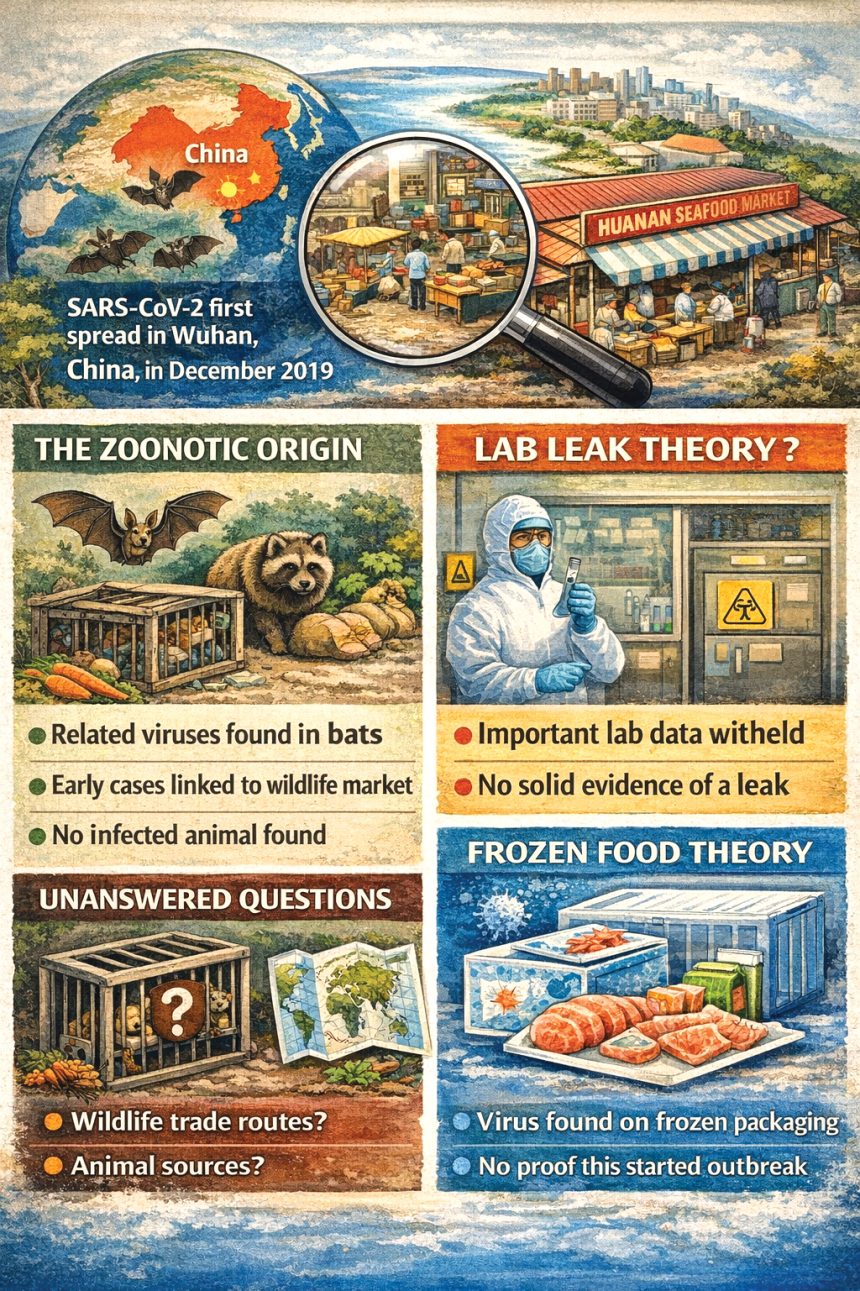
After nearly three and a half years of deliberation, these scientists from 27 countries have concluded that most of the peer-reviewed evidence points to one answer: the virus originated in an animal. But the keyword there is most. And the group is refreshingly clear that without fuller access to data — some of which has been withheld — there can be no absolute certainty about when, where, or how the pandemic began. To understand the SAGO conclusion, we can start with what virologists have known for years: bats are extraordinary coronavirus reservoirs. Horseshoe bats across China and Southeast Asia carry hundreds of coronavirus variants that the world has never heard of. Two of them bear a striking resemblance to SARS-CoV-2. RaTG13, found in a Chinese bat in 2013, shares 96.1% of its genetic sequence with the pandemic virus. BANAL-52, discovered in Laos in 2020, is even closer at 96.8%. Neither is a direct ancestor — three–four percent genetic difference is enormous at the molecular level, representing decades of evolutionary distance — but they tell us that nature already contained the raw ingredients.
Coronaviruses also evolve through a process called recombination, in which two viruses infecting the same host cell swap segments of genetic code, like shuffling a deck of cards. The result can be a new virus that combines features from its parents. SARS-CoV-2 belongs to a viral subgroup, the sarbecoviruses, whose members routinely carry mosaic genomes shaped by exactly these events. Complex new features, in other words, don’t require a laboratory.
Then there is the epidemiological fingerprint. More than 60% of the earliest confirmed COVID-19 cases in December 2019 had a direct or indirect link to a single location: the Huanan Seafood Market in Wuhan. Environmental swabs taken from the market in January 2020 — after it had been closed and before it was sterilised — revealed something telling: two distinct genetic lineages of SARS-CoV-2 were already circulating. Two lineages, not one. That pattern is characteristic of a virus that has been quietly evolving and spreading before anyone noticed — consistent with natural spillover, inconsistent with a single recent lab leak. Genetic analysis of those same environmental samples also found traces of raccoon dogs, palm civets, and bamboo rats — all species known to be susceptible to early SARS-CoV-2 strains. Any of these animals could have served as an intermediate host, bridging the evolutionary gap between horseshoe bats and humans in the close, chaotic quarters of a wildlife market.
Despite all the evidence pointing to a zoonotic origin, the picture has a glaring hole: not a single animal in China has ever been officially tested positive for SARS-CoV-2. Given that hundreds of animals around the world — tigers, mink, white-tailed deer, domestic cats — were infected once the virus became widespread, the absence of any positive animal in China is, at minimum, surprising. It doesn’t disprove zoonotic spillover. But it leaves an evidentiary void that scientists cannot ignore. The upstream supply chains of the Huanan market remain largely uncharted. Where did the raccoon dogs come from? What breeding farms, wildlife traders, or forested regions supplied the market in late 2019? These threads have never been fully pulled.
Meanwhile, another hypothesis — that the virus accidentally escaped from a laboratory in Wuhan — has proven impossible to fully investigate, not because the evidence points toward it, but because the evidence needed to rule it out definitively has not been made available. SAGO repeatedly requested the Chinese government for health records of laboratory staff, biosafety inspection reports, and audit documents from relevant facilities, including the Wuhan Institute of Virology. Those requests went unanswered. China maintains it has shared all relevant information. Most scientific reviews and government intelligence assessments find no concrete evidence of a lab breach. But those same intelligence reports — from the U.S., Germany, and others — assign only “low” or “moderate” confidence to their conclusions, and some appear to reflect political considerations as much as scientific ones. Suspicion is not evidence. But neither is a locked door a vindication. The most extreme hypothesis — that SARS-CoV-2 was deliberately engineered — has been extensively reviewed and found wanting.
A widely circulated theory focused on DEFUSE, a 2018 grant proposal submitted by EcoHealth Alliance, a U.S.-based research non-profit, to the U.S. Department of Defense, which described coronavirus vaccine research in collaboration with the Wuhan Institute of Virology. The theory goes: American researchers used reverse genetics to construct SARS-CoV-2, which then escaped from a Chinese lab. SAGO took this seriously enough to analyse it in detail. Their conclusion: the genetic elements described in DEFUSE belong to a completely different viral clade than SARS-CoV-2. The grant was never funded. The recombinant proteins described in the proposal cannot replicate or spread. And the genomic architecture of SARS-CoV-2 bears no meaningful resemblance to the chimeric vaccine backbone outlined in those grant documents.
One specific feature of SARS-CoV-2 has fuelled persistent engineering suspicions: a polybasic furin cleavage site, a molecular tool that helps the virus enter human cells, which is absent in close bat coronavirus relatives. Couldn’t this be evidence of tinkering? Possibly — but furin cleavage motifs are found naturally across the broader coronavirus family, including in human coronaviruses like HKU1 and OC43. Recombination with other viral lineages could plausibly produce exactly this feature. The presence of an unusual element is not, by itself, evidence of deliberate insertion.
SARS-CoV-2 is estimated to have killed more than seven million people by the end of 2025 and cost the global economy up to $16 trillion. The search for its origin is not about punishing anyone. It is about understanding the mechanism well enough to prevent the next pandemic. If the virus emerged from wildlife trade — through bats infecting intermediate animals that were sold in crowded, poorly regulated markets — then the intervention strategies are clear: stricter wildlife trade regulation, enhanced ecological surveillance, and better market hygiene.
If a laboratory biosafety failure occurred anywhere in the world, a different set of interventions would follow: transparent international inspection frameworks, enforceable biosafety standards, and mandatory reporting systems for near-miss incidents. Both paths are achievable — but they require exactly the kind of political cooperation that has so far been conspicuously absent.
SAGO’s verdict is neither a declaration nor a defeat. It is the honest output of rigorous science operating under significant constraints. The leading hypothesis — zoonotic spillover, probably involving the Huanan market — is supported by substantial evidence. The lab-leak hypothesis remains unproven but cannot be fully closed while key data remain locked away.
The lesson of COVID-19’s origin is already visible in the evidence assembled so far: in a world where humans, wildlife, and viruses interact at an unprecedented scale, the next spillover is not a matter of if, but when. The question is whether we will have done the work to understand the last one before it arrives.
Rigorous science demands transparency. And transparency, right now, remains the
missing piece.