

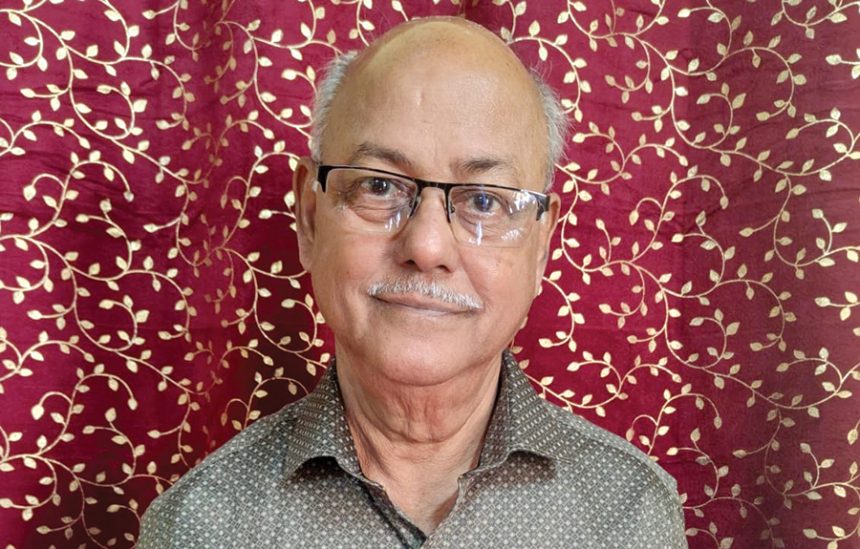
Former teacher and poet Cosme Lobo’s debut book explores the village’s history, culture, festivals and notable personalities
RAMANDEEP KAUR | NT KURIOCITY
Amid rapid changes, Parra’s Cosme Lobo has written about the village’s history, culture and traditions in his debut book, ‘Parra: The Quintessential Goan Village’, which was released recently. The first comprehensive work on Parra’s heritage, it is published by Goa,1556 (goa1556.in) and includes a foreword by Parra parish priest Fr Pedro da Gama.
A retired English and Mathematics teacher, Lobo began his journey at Sacred Heart High School, Parra, first as a bright student and later as a teacher. Known for his participation in academic competitions, he was entrusted with taking classes even before completing his SSC. After graduation, he taught at Sacred Heart and later at Vidya Prasarak High School, Morjim, before joining the Diocesan Society, where he continued teaching until his retirement in 2012.
The idea for the book came from a simple request. “Last year, a history student asked me for information about St Anne’s Church for her project. When her work was appreciated, I thought, if my efforts could help one student, why not gather more information that could help many? That is how this book was born,” Lobo recalls. Having served the church from a young age as an altar server, catechist, youth leader and member of the Fabrica and Parish Council, he was able to share detailed knowledge about Parra’s heritage.
A poet at heart, Lobo has previously compiled his poems in English and Konkani to raise funds for schools and contributed regularly to publications. “Poetry has always been close to my heart but this is my first full-length book documenting the history of my village,” he says.
For research, Lobo interacted with elderly villagers, sports personalities and their families, accessed school records, and consulted books on freedom fighters and tiatrists. He shares, “I wanted to understand both the past and present of Parra and capture stories that might otherwise be forgotten.”
The book takes readers through Parra’s winding lanes, old fields, temples, chapels and the St Anne’s Church built in 1649. It also explores Parra, Verla and Canca, the three aldeias once called PVC, showing the village’s long tradition of religious harmony, including early worship sites like the Deusan and the dome-shaped chapel of the Holy Cross, where Hindus and Christians still gather to offer prayers. Other temples include those dedicated to Lord Bodgeshwar, Sateri Verlekarin Devi, Shree Nagnath Mahadev Prasanna, Shree Vishwati Vishweshwar Shivshankar Devasthan and Shree Varad Siddhivinayak Mandir, which is famous for its Sarvajanik (community) Ganesh Festival.
Lobo also documents fading traditions such as Moteti hymns during Lent, Saint John celebrations with well-jumping and gumot music and mattov weddings under palm-thatched pandals. “Television and mobile phones have reduced social interaction. Slowly, the traditions close to our hearts are disappearing. I hope this book reminds people of our past glory,” he says.
He stresses the importance of farmers, toddy tappers, musicians and sportspersons in shaping Parra’s identity. “They were the backbone of Parra’s economy but today they are almost forgotten. Music and sports are in our blood; my father was a musician and now my children continue the tradition,” he says, recalling that his house was once home to musicians and tiatrists who gathered to practise and writing about them brought back many memories.
Notable athletes documented in the book include Marcus Pacheco, Francis da Gama, Visitacao Lobo and Dominic Lobo.
On the role of the Comunidades, Lobo adds, “They managed fields, cashew groves, bunds, retaining walls and water bodies. But after the Land to the Tiller Act, their income stopped and these institutions are now in decline.”
Reflecting on the village’s social media fame, he adds, “The Madanni road has made Parra popular but tourists block roads for photo shoots and the village is losing its old charm.” He wants visitors to see Parra as a peaceful farming village, rich in palm trees, watermelon fields and traditional crafts like mollam making, rather than just as a backdrop for pictures.
The book also talks about Sacred Heart High School, Parra and St Joseph High School, Arpora, among Goa’s earliest English-medium schools. “These schools helped generations to face challenges, find work beyond Goa and excel in sports,” he says. “Today’s trendsetters show young people the different paths that they can take and inspire them to set their own goals.” Among current Parra personalities mentioned are coconut shell artists, a reviver of the mollam craft, a Hollywood actor and a young aircraft pilot.
Looking ahead, he plans to compile and publish another collection of his poems. “If everything goes well, I shall put them all together in a book,” he adds.

