

NT Reporter
Vasco
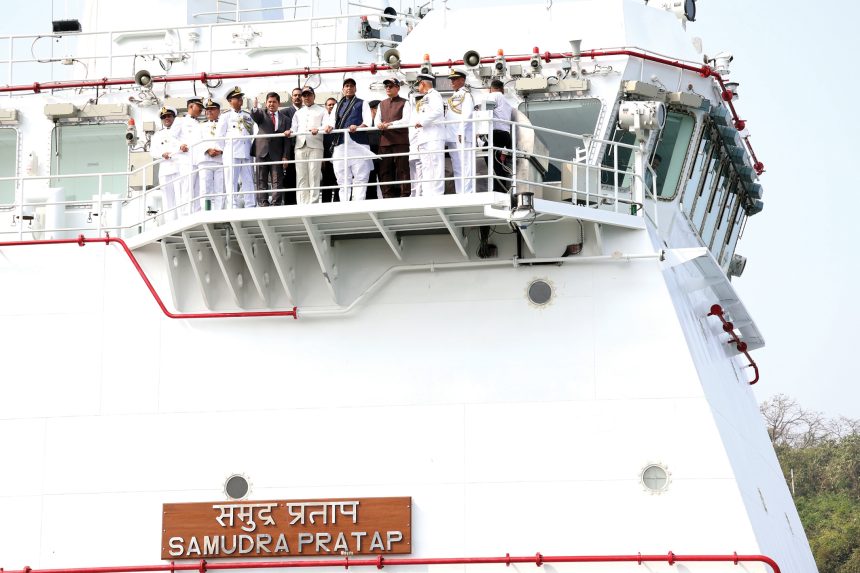
Defence Minister Rajnath Singh commissioned Indian Coast Guard Ship (ICGS) Samudra Pratap, India’s first indigenously designed pollution control vessel, built by Goa Shipyard Limited (GSL), at Vasco on Monday.
It is the first of two such vessels being built by GSL and is the largest ship in the Indian Coast Guard (ICG) fleet so far.
The vessel will be based at Kochi under the operational control of the Coast Guard Region (West).
With over 60 per cent indigenous content, ICGS Samudra Pratap will strengthen the Coast Guard’s capabilities in pollution control, firefighting, maritime safety, environmental protection, coastal patrol, and extended surveillance across India’s maritime zones.
Singh said the vessel reflects the maturity of India’s defence industrial ecosystem and noted that efforts are under way to increase indigenous content in ships to 90 per cent. He said the ship, though designed primarily for pollution control, integrates multiple capabilities on a single platform to support coastal patrol and maritime safety.
He said the ICG plays a multidimensional role ranging from marine pollution response and coastal cleanliness to search and rescue and maritime law enforcement. He stated that the Coast Guard’s functioning conveys a clear message that any misadventure along India’s maritime borders will be responded to firmly.
Referring to climate change and environmental challenges, Singh said marine environment protection is a responsibility and noted that India is among a select group of countries with advanced capabilities in oil spill response,
firefighting, and salvage operations.
He said the vessel will support timely control of pollution incidents and help protect marine ecosystems and coastal livelihoods.
On maritime security, Singh said India contributes to peace and stability in the Indo-Pacific region and reiterated the government’s commitment to strengthening the maritime sector. He said the ICG must evolve from a platform-centric force to an intelligence-driven and integration-centric force, supported through acquisitions, infrastructure, and manpower development. He also stressed the need for specialised career streams in areas such as maritime law enforcement, environmental protection, and maritime cyber security.
For the first time, a frontline Coast Guard ship will have two women officers. Singh acknowledged the ICG’s move towards a gender-neutral work environment and said women officers are being deployed across operational and technical roles.
He also highlighted ICG’s role in promoting self-reliance, stating that the manufacturing, servicing, and repair of Coast Guard ships and aircraft are being carried out domestically under the Make in India and Atmanirbhar Bharat initiatives.
Chief Minister Pramod Sawant, Defence Secretary Rajesh Kumar Singh, Director General ICG Paramesh Sivamani, GSL Chairman and Managing Director Brajesh Kumar Upadhyay, and senior central and state officials were present.

