Samrudhdi Kerkar
There are some places that have the power to soothe your soul. Among it is one such place called Nirankarachi Rai from Maloli of Sattari. It is a sacred grove, dedicated to Niranka, the formless divine, and unseen yet omnipresent, flowing through every leaf, root, and breath.
Each time I step into this grove, I am enveloped in a divine energy.
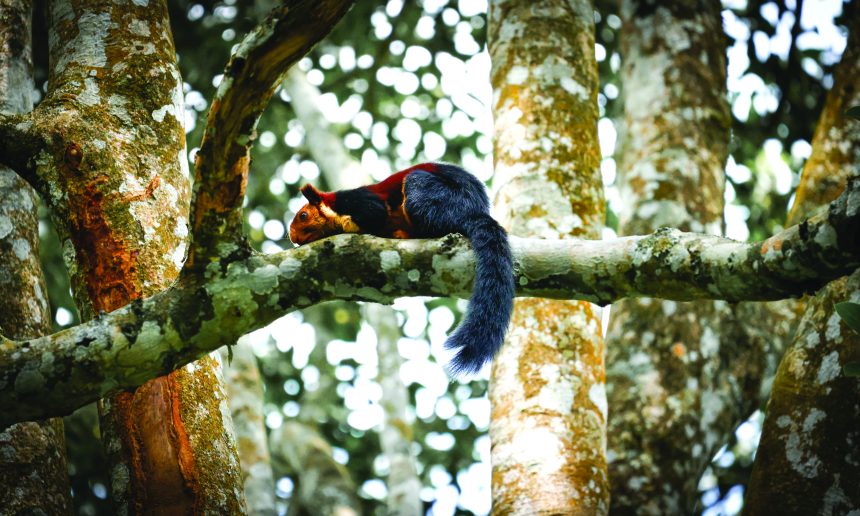
Upon entering the grove, often the Malabar giant squirrel (Shekro) makes its presence felt with sharp chuk chuk calls and effortless leaping on branches.
Many people come here to fetch the tranquil water of the spring that originates within this grove. It is believed to possess medicinal value, especially for treating eye-related ailments. Besides its medicinal and spiritual significance, this water is also used by the farmers of Maloli and Nanode villages through traditional methods of irrigation for agriculture and horticulture.
During the monsoon, the forest absorbs excess water, replenishing the groundwater, only to release it gently into streams during the drier months. Thus, the land remains cool, damp, and alive throughout the year. This unique adaptation of the roots allows the trees to breathe within the compact, marshy soil, keeping them strong, tall, and swaying gently to the song of the wind. Such forests are among the rarest ecosystems on Earth.
The streams flowing through the grove and the ever-damp foliage create a perfect habitat for snakes, especially vipers. Birds like hornbills, magpie robins, drongos, and leafbirds add their gentle background music to the serene forest landscape.
And then appears the show-stealer of the grove: the Malabar tree nymph, the state butterfly of Goa. Unlike the usual flutter, this butterfly glides and soars softly in the air. True to its name, it feels like a delicate nymph descending from the heavens, with its pale white, paper-light wings dotted with tiny black specks. One can witness its entire life cycle unfolding within this sacred space.
This small patch of forest is a haven for countless tiny creatures. But its role does not stop there. It breathes for us quietly absorbing carbon dioxide, cleansing the air, cooling the earth, and holding together the fragile balance that sustains life. However, during my last visit, a gentle sadness crept in. As I saw bits of garbage drifting in the flowing streams, some even stuck within the breathing roots of the trees. Seeing waste tangled in roots, in a space so sacred and alive, the sight was disheartening.
There was a time when this grove stretched across nearly four hectares. Today, only about one and a half hectares remain, slowly giving way to agriculture, horticulture, and rubber plantations. The change has been gradual, almost unnoticed, yet its weight is heavy. Perhaps all it asks of us is a little more care, a little more humility, and the willingness to protect those that only give without asking for anything in return.