Goa now has a Textile Recovery Facility that collects, sorts, and repurposes textile waste
RAMANDEEP KAUR | NT BUZZ
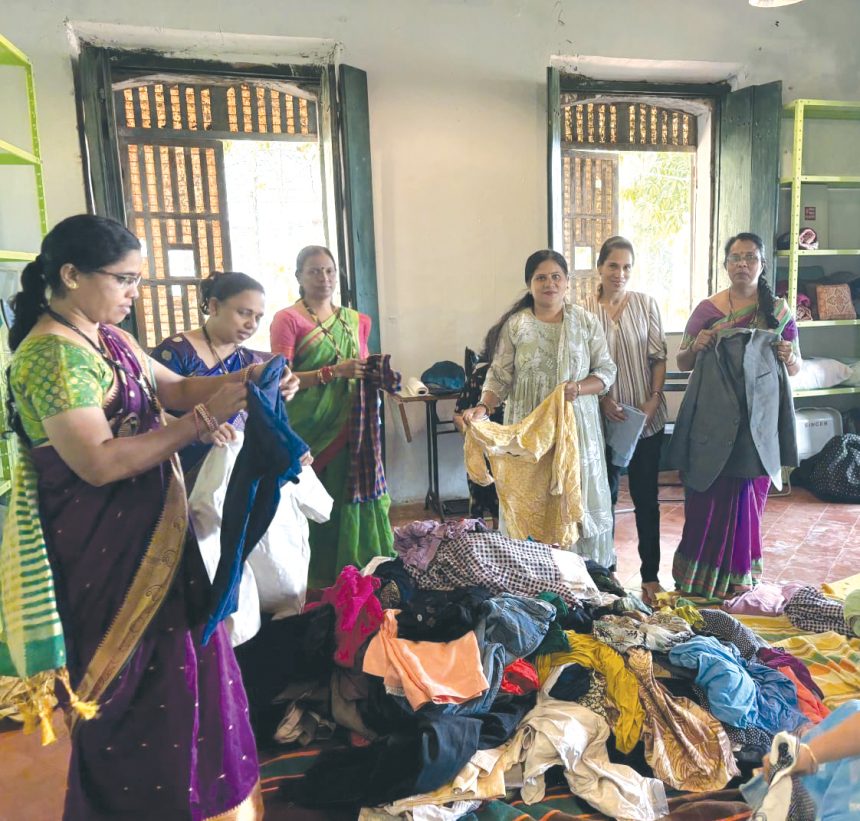
At a heritage house in Salvador do Mundo, wild sunflowers line the road and a lake sits in the distance. Inside, donated clothes fill one room, while another has organised garments and upcycled products.
This is the setting for the Sensible Earth: The Centre for Sustainability, a volunteer organisation that recently launched the state’s first Textile Recovery Facility (TRF).
The Centre was founded by former tech entrepreneur Sanjiv Khandelwal, who describes the facility as a way to address his “karma” after years of being a “serious extractor” of resources like fossil fuels and electricity. “My goal is to leave the planet with more resources than we consume during our lifetime,” explains Khandelwal.
While Goa has Material Recovery Facilities (MRFs) for paper, glass and hard plastics, Khandelwal says textiles have been completely ignored, even though they are among the top contributors to landfills like Sonsodo. “This is a critical oversight because 70% of textiles contain plastic materials like polyester and Polyethylene terephthalate (PET), similar to those used for water bottles,” he notes.
These fabrics, as they break down, contribute to a growing global microplastic crisis. Khandelwal warns that microplastics are now found in everything we consume. “Infants are now entering the world with microplastics already in their bodies,” he says. “According to the Central Pollution Control Board (CPCB) annual report for 2019-20, Goa generated roughly 12 kg of plastic waste per person annually, the highest per capita rate in the country.”
To tackle this problem, the TRF functions like a sophisticated “sieve”, processing Goa’s textile waste through multiple streams. High-quality garments are set aside for thrifting, while moderate-quality fabrics are repurposed into products such as jewellery, dog leashes, toys and traditional Goan Goderi (patchwork).
For textiles that are completely unusable, Sensible Earth has partnered with plants in North India to convert the cloth back into fibre and thread for new fabric.
Khandelwal references the history of Ludhiana, Punjab, once the global capital of the “shordi” textile recycling industry. He notes that the rise of mixed fabrics containing spandex has made recycling harder but adds, “TRF aims to restore that circular economy for the modern age.”
The facility is an expansion of the #MakaNakaPlastic (‘Say No to Plastic’) campaign launched five years ago, which aims to reduce single-use plastic by turning preloved fabric into reusable bags. So far, the initiative has rescued 1.75 lakh garments from landfills and produced over two lakh cloth bags. Khandelwal estimates this has helped Goans refuse plastic bags at least 60
lakh times.
The TRF employs 120 women across 40 villages in seven clusters and expects to process at least five tonnes of textile waste per month. “Plans are underway to establish additional facilities in South Goa and near the Karnataka border.”