

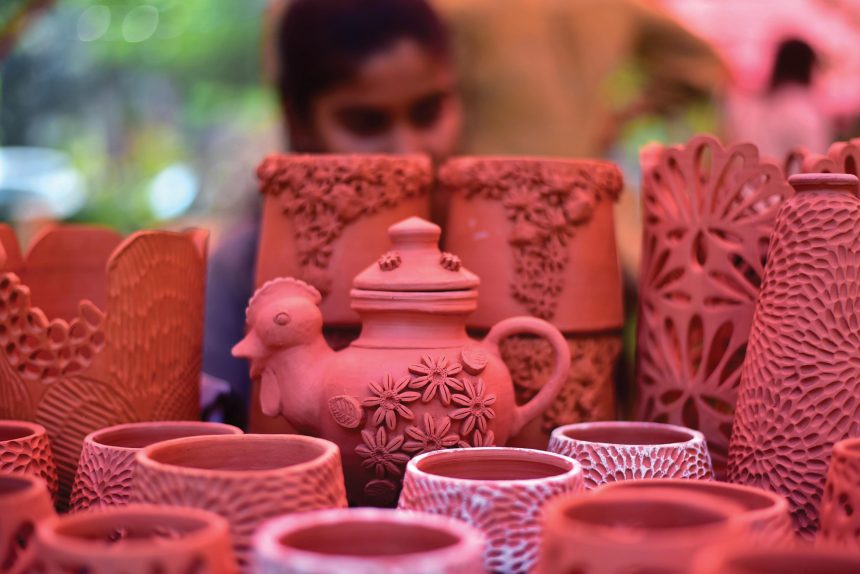
Goa’s pottery tradition lives on through artisans preserving old techniques and studio potters shaping new designs
RAMANDEEP KAUR | NT NETWORK
In Goa, clay tells stories of the past and the present. In village workshops, artisans keep age-old techniques alive, while studio potters experiment with new shapes and designs. Even as modern materials take over and fewer young people join the craft, pottery continues to hold its place across the state.
Generations of clay
At 77, Sales Sequeira from Kumbhar Vaddo, Socorro, Porvorim, still moulds clay with the same dedication as his ancestors. He makes all kinds of pottery, including ‘budkulo’ for rice, ‘kudne’ for curry, and other cooking and water storage items.
Sequeira recalls that Goan kitchens were once filled with earthenware. “Even plant pots were made of mud. Today, it’s mostly steel, plastic and cookers,” he says.
He adds that younger generations are not taking up pottery. “Youngsters have gone abroad for work and don’t want to continue this craft. Despite my age and health, I still work, sometimes with help from other artisans.”
Skilled potters, who once made large storage pots or ‘modki’, are also rare, he says. “People used to be hardworking but that skill is disappearing.”
John Paul Valles, a fourth-generation potter, also from Kumbhar Vaddo, Socorro, Porvorim, runs the workshop Mr. Potter.
“The younger generation isn’t as interested, though my daughter creates decorative pieces like wall hangings. I focus on traditional items such as storage containers, cooking utensils, vases and terracotta pots,” he says, adding the tandoor ‘bhatti’ as one of his specialties.
He states that there is more demand for earthenware now, as people prefer it for health reasons, but not many artisans are left.
Sourcing clay is another challenge. “We collect it locally in March and April but due to construction near the fields, waterlogging prevents the soil from drying properly. That makes it difficult. We store clay when we can or buy it from outside if needed,” he explains, adding that local clay is preferred for cooking vessels.
A legacy carved in clay
The pottery tradition of Goa is a vital part of the state’s history and culture and dates back thousands of years, with the earliest evidence found in potsherds from underground caves in Chicalim, Mormugao taluka, says historian and heritage activist Prajal Sakharadande. He adds that these archaeological finds, now preserved in the Goa State Museum, are among the oldest indicators of human settlement along the Zuari River.
The people behind the pots
Tribal communities like the Kunbis, Gawadas, Velips, and Kharvis have used clay pots for cooking and storing food since ancient times. In the old gaunkari system, a community of potters called Kumbhars evolved based on their skill in the craft, says Sakharadande, who is also an associate professor and head of the History Department at Dhempe College of Arts and Science, Miramar. “They made a wide variety of everyday pots and were called ‘kulacharins’ or ‘acharis’ of the kuls, the old tribal communities,” he says.
Goa’s red, laterite-rich soil, he states, was perfect for making a variety of traditional pots and vessels: the ‘budkulo’ for rice, ‘kulnem’ or ‘kuinem’ for curry, ‘modki’ for water, ‘maiti’ for ‘ukdyatandalachi pez’ (rice gruel) and the thali, an earthen plate.
Among the most unique is the ‘gurguletta’, a traditional earthen water canteen that keeps water naturally cool. “It evolved from the ‘maat’, used before the Portuguese period, with the rooster-shaped spout added later, inspired by the symbol of Portugal’s port city of Porto,” says Sakharadande. The name comes from the gurgling sound made when water is poured.
Home, rituals and trade
Pottery was once a major source of income, says Goan heritage promoter Sanjeev Sardesai. “Easy to handle and made from locally available clay, these utensils were staples in Goan homes,” he recalls.
Founder and curator of the Goa Chitra Museum, Benaulim, Victor Hugo Gomes explains the many roles pottery once played. “Most pots were for cooking, storing water, serving meals and fermenting food. Some were for rituals, like temple lamps and ceremonial vessels. Pottery was also an important local trade commodity, exchanged between potter villages and agricultural or coastal settlements.”
Over time, however, the rise of copper, steel, aluminium and later plastic changed household preferences. These modern materials were stronger and more durable, which led many younger potter families to pursue education and alternative careers. “As a result, the ancient art of pottery began to fade,” says Sardesai.
Today, while the use of clay pots in kitchens has declined, pottery continues to be made for decorative items, vases and souvenirs. Sardesai says, “Only a few artisans carry on the craft, often struggling to earn a living through village fairs and markets.”
The Goa Handicrafts Corporation and State Craftsmen Training Centres are helping by connecting traditional potters with young entrepreneurs and tourists. “Many resorts and beach shacks in Goa now use traditional pots for cooking and serving food, which is renewing interest in this craft,” shares Sardesai.
Showcasing centuries of craft
The Goa Chitra Museum shows the rich history of Goan pottery, with clay pots and vessels used in homes, temples and farms for centuries.
Gomes says the collection is arranged by region and purpose. “We separate pottery from North and South Goa because styles, forms and finishes are different. Items are also grouped by use, for cooking, storing water, rice, chillies, tamarind, dried prawns, bowls, oil containers, ritual lamps and ceremonial pots as well as pottery used in distilling, toddy tapping and baking,” he explains, adding that many of these forms predate Portuguese rule and were used well into the mid-20th century.
Most pieces, he informs, come from traditional potter communities like the Kumbhars and from pottery centres such as Socorro, Anjuna, Verna, Cuncolim, Zambaulim and Agonda. “These villages supplied pottery to homes, markets, festivals and feasts.” The museum also displays decorative slip-cast pottery and musical instruments made by local potters.
What pottery tells us
Gomes explains that pottery shows how people lived, worked and cared for the environment. “Potters worked under the gaunkari system, taking clay responsibly from paddy fields and restoring the land afterward,” he says, adding that unlike modern development, which can harm the land, traditional potters kept a balance with nature. “They cleaned waterways and returned soil to fields.”
The shapes and marks on the pots reveal daily life. Soot marks reveal cooking on wood fires, repaired cracks indicate care and thrift and special lamps and decorated pots show rituals and identity. He adds, “These items tell the story of a simple, sustainable way of life, where things were made to last, to be reused and respected.”
Preserving and promoting pottery
Pottery is fragile, especially in Goa’s humid, monsoon-heavy climate. “Moisture, pests, fungal growth, and salt damage are constant threats. Many pieces arrive already broken or repaired. Caring for them requires controlled environments, careful handling and ongoing effort, something small museums often struggle with,” says Gomes.
He says hands-on learning is the best way to connect young people with pottery. Workshops with traditional potters show it can be a viable, modern livelihood. “When young people see pottery as a living craft, they take interest naturally,” he adds, noting that potters need support, including access to clay, shared kilns, fair markets and respect for their skills.
“Policies should adapt to their rhythm,” says Gomes. “Wheel-thrown pottery begins before sunrise and cannot be rushed. Government schemes must reach potters at their workplaces. When support fits their schedule, this craft can survive instead of fading away.”
UNESCO has launched a global campaign to protect traditional arts at risk of disappearing. Sardesai believes Goa stands to benefit in many ways: promoting the state’s distinctive pottery designs could set a benchmark in handicrafts, create jobs for local youth and preserve an age-old tradition.
The first step, he says, is to document and register potters and their techniques. “Pottery has great potential. With creativity and enterprise, it can reconnect young people to their roots.”
Sakharadande also urges Goans to support local potters. “You can find them at the Friday Market in Mapusa or at weekly markets in Banastarim, Sanquelim, Quepem and Bicholim. Their work makes thoughtful gifts and souvenirs and buying from them helps preserve our heritage.”
From terracotta to porcelain
Beyond the traditional terracotta pottery, Goa has seen many artists choosing contemporary pottery as their art of choice.
Founder of Thomas the Potter, Fontainhas, Thomas Louis for instance works with different types of clay, including terracotta, stoneware, porcelain and bone china. “Pottery is vast,” he says.
When he arrived in Goa 15 years ago, he reveals, the ceramics pottery scene was still small. “There were hardly two or three of us working in pottery,” he recalls. “Now, many of my students have started their own studios and work independently and it’s becoming a growing hub for ceramics.”
Most of the stoneware clay he uses is sourced from different parts of the country. “Earlier, getting materials was a challenge. You had to go to the source. Today, everything’s online. It’s ridiculously easy to get any ceramic material or equipment.”
The rise of social media has also changed the way potters connect with audiences. “Marketing used to be tough but with Instagram and other platforms, it’s become much easier,” he says. “The real challenge now is for young potters to push their capabilities. Some are doing great work and I hope more will follow.”
He sells most of his work through his studio, with a smaller share available online. “Local customers are the main buyers and demand has grown steadily as more people discover studio ceramics,” he says.
Over the years, he has collaborated with artisans across India. “I also work with local artists, designers and architects, depending on the project,” he says. One of his most memorable collaborations was the Mapusa Mogi project, a large-scale effort with artists like Orijit Sen and Shalu Sharma. “Working together allows us to take on bigger projects and bring in diverse perspectives,” he adds.
Although he’s currently taking a break from workshops due to travel, Louis continues to mentor young potters. “I’ve taught people of all ages and provide guidance and advice. The younger generation is very engaged and exploring what pottery can be.”
For those considering pottery, he advises, “It’s harder than it looks. It can be calming and creative; however, it also takes a lot of physical effort. What matters most is your skill and what you create.”
The clay experience
Another potter who has been promoting a love for clay is Nikita Singh Rathore. After a decade in the corporate world following her MBA from IIM Lucknow, Rathore left her job to train for three years in pottery studios across the Indian Himalayas and Nepal. A year ago, she founded NISO Pottery Studio, Benaulim.
The studio has pottery experience sessions, five-day retreats and intensive training programmes, along with an in-house production line. It specialises in handmade functional tableware made without moulds, many of which are hand-painted.
“At our studio, we aim to revive the ancient art of pottery and create a space where locals and tourists can appreciate handcrafted ceramics. The designs are inspired by Goa’s nature and local culture, with a modern touch to traditional pottery,” says Rathore, adding that the studio mainly uses stoneware clay prepared in-house from black cotton soil sourced in Madhya Pradesh and mixed with sand from Benaulim Beach. “The clay is reused as much as possible to reduce waste.”
Goa’s pottery scene, she notes, is active, with a mix of traditional artisans and studio potters. “The craft is important because it cannot be replicated by machines and encourages hands-on, mindful work,” says Rathore.
The studio attracts locals and tourists from India and abroad. “Our tableware is exported to boutique design studios and restaurants in Australia and England and is also available for purchase at the studio,” she says, adding that online sales in India are expected to begin later this year.
Running a pottery studio, she admits, is demanding and expensive. Her advice to aspiring full-time potters: “Only pursue it if you’re truly committed and passionate.”
Self-taught artist Shaili Sutaria meanwhile runs Luneclay Ceramics, a studio and art school in Assagao, which she founded in 2020. The studio hosts workshops and classes for artists and students.
Sutaria who has been working with ceramics, wood, seashells and other natural materials since 2015 is inspired by the natural world. Her works include sea creatures, coral, mushrooms and forests and aims to connect people with nature. Her recent collections, including ‘The Deep Ocean’, capture the colours and textures of Goa’s monsoons and the landscapes of Himachal.
In Arossim, Simonie Rego, who started pottery during the COVID-19 lockdown, runs Centre Punch Studio. “I began with traditional pottery and still make a few classic pieces, like the ‘gurguletta’,” she says. “But now I focus on hand-cut, open-form designs.”
Rego also teaches pottery to school groups and hobbyists, covering hand-building, slab work, coiling, and wheel techniques.
She acknowledges the challenges of sourcing raw materials and helping people appreciate the value of handmade work. “Studio pottery is slow and entirely manual, with no moulds or machines. However, awareness is growing and more people are beginning to value the process.”

