

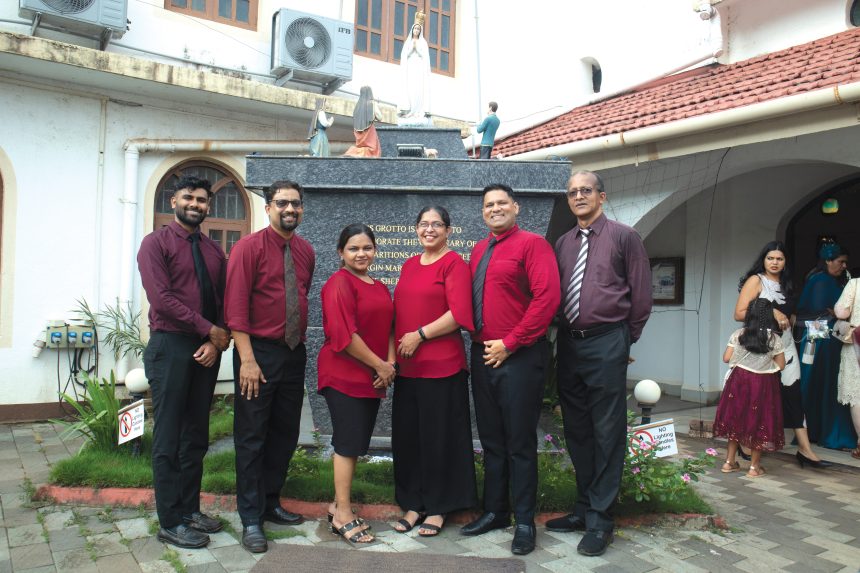
With the wedding season in full swing in the state,
NT NETWORK explores how the melodious voices behind the nuptials are keeping pace with the times
CHRISTINE MACHADO
As you step into the church on your wedding day, the choir’s music sets a serene and sacred tone for the ceremony. Long a cherished part of the Big Day, choirs have evolved over the years to meet changing tastes and expectations.
Changing times
“Gone are the days of big choirs. With everything becoming more expensive, people are choosing smaller choirs today,” says Pierre Fernandes of The Jubilations, a choir group in action since the “early 90s.
Fernandes’ father was part of the Philharmonics, headed by Fr. Lourdinho Baretto, which performed in Rome for a Papal Mass. When he returned to Goa, he decided to start a choir, as there were very few at the time. Over the years, Fernandes, who joined the choir around 1999, has seen big changes in music.
“We have many youngsters joining now and better equipment and sound systems,” he says.
Jason Quadros of the Divine Harmony Choral Ensemble agrees, noting improvements in harmonies and instrumental performance. While his choir was formed in 2015, Quadros has been part of other choirs since 1996. “In the last 30 years, I’ve seen many more choirs form, both within parishes and professionally. The younger generation is also more interested in understanding the role of music during liturgical services,”
he adds.
The sound of today
Evelina Barreto of the choir Sanctus notes a growing demand for cellists, double bass players, or a fuller string section to create a richer sound. “There is also a rise in destination weddings and we have performed for couples of many nationalities,” she says.
She adds that the choir’s main goal is “to enhance the emotion and sanctity of the ceremony through our music.” To achieve this, they coordinate with the planner and sound team for timing, cues and setup and assess the venue’s acoustics to plan positioning
and clarity.
Choosing the right hymns
Hymn selection is crucial. “We have a set of hymns that we pitch to the couple, mostly lively ones that people know and enjoy,” says Charles Martin of St. Elizabeth Choir Goa, a group started by his brother and in operation for over 15 years. The hymns are chosen with the Mass liturgy in mind and after the
priest’s approval.
Choirs prefer that the couple is actively involved. “Sometimes couples rely on the choir or relatives to sort out the Mass aspects. We encourage them to choose all their hymns, as the nuptials are the most important part of the wedding,” says Fernandes, who usually sits with couples to help them select. “We also share links with them if they are from out of town,”
he adds.
A challenge, says Barreto, is when couples request non-liturgical songs or hymns that don’t align with Catholic guidelines.
Bejamin Monserrate of the Tehillah Ensemble, formed in 2024, agrees. “Many people are unclear about the difference between hymns and songs and what is appropriate for a church setting. We work closely with each couple to select hymns that reflect their wedding theme and follow the liturgy. If a request falls outside the norms, we ask the couple to get prior approval from their parish priest,” he explains.
Quadros adds that while people often pick their favourite hymns, each hymn has its own theme and purpose. “Hymns may suit different seasons of the liturgical calendar, like Advent, Easter or Lent or specific Sacraments. So, selections are made according to the nuptial theme and readings, mostly focusing on love,” he says. For Konkani hymns, newer tunes have been released for the same lyrics from the book ‘Gaionacho Jhelo’, while English hymns are usually chosen from the book ‘With Joyful Lips’. Newer hymns are under consideration by priests.
Behind the scenes
Beyond hymn selection, choirs face logistical challenges, including pricing. “Earlier, there were very few choirs but now, with more groups entering the scene, competition has increased. If I quote a price, another group may charge Rs. 500 or Rs. 1,000 less,” says Martin. To stay competitive, choirs need to offer couples a unique experience.
Fernandes adds that couples are sometimes hesitant to spend as much on a choir as on a wedding band. “But a lot goes into preparing for a wedding from the choir’s side. We need time to practice, travel with our equipment and often bring our own sound system, since the church system isn’t always reliable,”
he explains.
Setting up also requires the church to be open well before the ceremony. “Our setup takes about half an hour, then another half hour to run through the hymns and warm up. But usually the church opens only 30 minutes before Mass. Then we have to rush and sometimes get blamed for being late,” Fernandes says. Miscommunications about timing changes can also add to the chaos. “Things can get hectic but we’ve never disappointed anyone,” he adds.
Weddings can be full of surprises, states Nayden D’Silva of EUPHONIX choir. “No matter how much we rehearse, there are variables beyond our control, like acoustics, timing shifts or last-minute changes. Being flexible helps us handle every curveball,” he says.
Digital presence
EUPHONIX has been performing for six years and actively promotes itself on social media. Indeed, in today’s digital era, choirs too have had to adapt to online platforms.
“We realised early on that our target audience was online and that we didn’t have to rely solely on word of mouth. Instagram has always been our main source of enquiries,” says D’Silva, adding that it’s great to see other choirs building their online presence and adapting to modern marketing.
Baretto adds that a strong social-media presence improves the choir’s professional image and functions as a digital archive documenting its growth and work.
Martin says that while they were slow to join social media, having videos online helps clients, especially from the U.K. and U.S., get a sense of the choir before contacting them.
However, Fernandes is cautious about sharing too many videos. “There have been instances where people, having heard our choir is recommended by top musicians in Goa, ask for videos. I wonder why that’s necessary. Online videos can also be edited and the actual sound may differ. I suggest clients attend a Mass and hear us live before deciding,” he says.
With couples wanting special touches for their ceremonies, choirs have received creative requests. “Some have requested innovative entrances or exits, from violin serenades at the first look to leaving the church to UEFA Champions League or Formula 1 themes. Family members sometimes want to ‘jam’ with the choir during Mass. We handle such moments with kindness and humour, explaining what can or cannot be accommodated,” says D’Silva, adding that the priest’s guidelines shape the repertoire.
But there have been memorable experiences. “At beach weddings, singing with a golden sunset as the backdrop is magical. The waves and wind become part of the music; it feels like a movie,” he says.
For Sanctus, Baretto recalls a memorable wedding at Igreja de Senhora de Belem, Chandor: “We were surrounded by a beautiful community representing 23 nationalities. It showed the joy of one faith and one church, transcending all boundaries.”
These experiences, along with a passion for choir singing, keep choirs going. Martin says, “I usually don’t take leave from work during the year, saving it only for the peak wedding season from December to January.”
The appreciation received after performances also brings great joy. “Towards the end of the Mass, while the couple signs the register, we often perform solos or duets. Many times, we’ve received standing ovations. People also come up after the Mass to compliment us. Some have even requested us to perform outside Goa but peak season makes it difficult,” says Fernandes.
D’Silva recalls two particularly memorable moments. “Once, the entire congregation spontaneously clapped after Mass. Another time, a priest thanked us during his homily for creating a spiritually uplifting atmosphere,” he says. “Moments like these are humbling and remind us that all credit goes to God for blessing us with the gift of music.”

