

Iran vows revenge as Khamenei killed in Israel, US strikes
Dubai: Iran vowed revenge on Sunday after the killing of its supreme leader and traded strikes with Israel as part of a widening war prompted by a surprise US and Israeli bombardment a day earlier.
Iranian Supreme Leader Ayatollah Ali Khamenei died following a major attack by Israel and the United States, Iranian state media confirmed early Sunday. United States’ President Donald Trump previously announced the death, saying it gave Iranians their “greatest chance” to “take back” their country.
Iranian state television and the state-run IRNA news agency did not report a cause of death for the 86-year-old.
Iran’s President Masoud Pezeshkian said in a pre-recorded message aired on state television that a new leadership council had begun its work, and Iran’s Foreign Minister Abbas Araghchi said a new supreme leader would be chosen in “one or two days”.
Blasts in Tehran sent a huge plume of smoke into the sky in an area where there are government buildings.
According to the Iranian authorities, more than 200 people have been killed since the start of the US and Israeli strikes that killed Ayatollah Ali Khamenei and other senior leaders.
Earlier, Iran fired missiles at an ever-widening list of targets in Israel and Gulf Arab states in retaliation while Israel pledged “non-stop” strikes against Iran’s leaders and military.
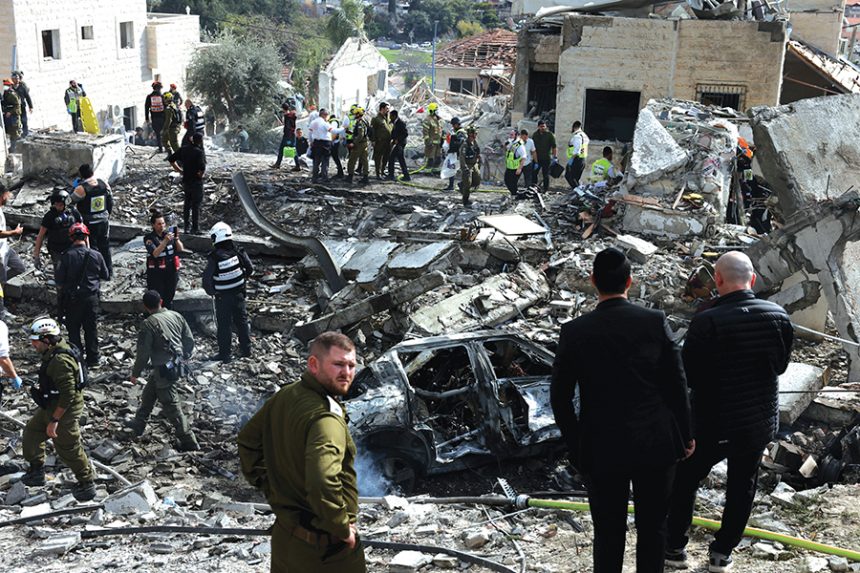
In Israel, loud explosions caused by missile impacts or interceptions could be heard in Tel Aviv. Israel’s rescue services said eight people were killed and 28 wounded in a strike that hit a synagogue in the central town of Beit Shemesh, bringing the overall death toll in the country to 10.
The US military said three service members have been killed and five others seriously wounded since the operations began. They are the first known American casualties from the fighting.
Iranian state media said the death toll from a strike on a girls’ school in the country’s south has climbed to 165. The Israeli military said it was not aware of any strikes in that area, and the US military said it was looking into the reports. The state-run IRNA news agency quoted a local prosecutor as saying another 96 people were wounded in the strike.
The strikes and counterattacks underscored how the killing of Khamenei, and US President Donald Trump’s calls for the overthrow of the decades-old Islamic Republic, carried the potential for a prolonged conflict that could envelop the Middle East.
It is the second time in eight months that the US and Israel have teamed up to use military force against Iran, and a startling show of military might for an American president who swept into office on an “America First” platform and vowed to keep out of “forever wars”.
In the 12-day war in June, Israeli and American strikes greatly weakened Iran’s air defences, military leadership and nuclear program. But the killing of Khamenei, who had ruled Iran for more than three decades, creates a leadership vacuum, increasing the risk of regional instability.
“You have crossed our red line and must pay the price,” Iran’s parliamentary speaker, Mohammad Bagher Qalibaf, said in a televised address on Sunday. “We will deliver such devastating blows that you yourselves will be driven to beg.”
Trump warned that any retaliation would only lead to further escalation.
In a sign of how the attack could stoke regional unrest, hundreds of people stormed the US Consulate in Pakistan’s port city of Karachi on Sunday. Police and paramilitary forces used batons and fired tear gas to disperse the crowd, and at least nine people were killed in the clashes, authorities said.
As US and Israeli strikes have pounded Iran, the Islamic Republic has retaliated with missiles and drone attacks on Israel and nearby Arab Gulf countries hosting US forces.
The air war could rattle global markets, particularly if Iran makes the Strait of Hormuz unsafe for commercial traffic. Around 20% of the world’s traded oil passes through the vital waterway, and oil prices are already set for swings.
Hundreds of Indians trapped in Dubai, other hub airports
New Delhi: As flight operations to and from West Asia remain disrupted after the US and Israel’s attack on Iran, hundreds of Indians have been left stranded in Dubai and other key hub airports, with many of them taking to social media to appeal to the Indian government for assistance.
Olympic medallist P V Sindhu, JD(S) MLC from Karnataka S L Bhojegowda and his family, Bengali actor Subhashree Ganguly along with her son, tourists and student groups are among those held up in Dubai.
More than 700 people from Madhya Pradesh, including two former MLAs, are stranded in the United Arab Emirates due to flight cancellations, an office-bearer of a travel agents’ outfit said on Sunday.
They had travelled to the UAE for tourism and business purposes, Amol Kataria, chairman of the Travel Agents Federation of India’s MP unit, said.
Kataria said former MLA and BJP leader Sanjay Shukla is among those stranded in Dubai.
“Due to the current international situation, our return to India today could not take place, as Dubai airport was temporarily closed. We are receiving full cooperation from the Dubai administration and the Government of India. We will return to Indore as soon as the situation normalises,” Shukla’s post on social media said. He said that his elder son is also with him.
Following the attack by the US and Israel, Iran launched retaliatory military strikes targeting Israel and American military bases across the region, including the United Arab Emirates, Qatar, Kuwait, Bahrain and Jordan.
‘No immediate oil disruption for India’
New Delhi: India is unlikely to face any immediate physical disruption in oil supplies despite escalating tensions around Iran and the Strait of Hormuz, but higher crude prices and broader macroeconomic pressures are expected in the near term, officials and analysts said.
Indian refiners currently hold sufficient crude inventories to meet at least 10 days of requirements, with fuel stocks covering another 5-7 days, cushioning the impact of any short-duration disruption.
Even as rapidly unfolding developments in West Asia raise geopolitical uncertainty, contingency plans – including tapping diversified suppliers in US, West Africa, Latin America and even Russia as well as strategic reserves – are in place, they said.
The Strait of Hormuz, one of the world’s most critical energy chokepoints, handles nearly 20% of global petroleum liquids and about a fifth of global LNG shipments. About 2.5-2.7 million barrels per day, or roughly 50% of India’s crude imports, transit through the route, largely sourced from Iraq, Saudi Arabia, the UAE and Kuwait.
Close to 60% of India’s LNG imports and almost all of its LPG shipments also pass through the Strait, underscoring its importance to India’s energy security.
While a short-lived disruption may have limited supply impact, the immediate fallout is expected to be reflected in oil prices.

