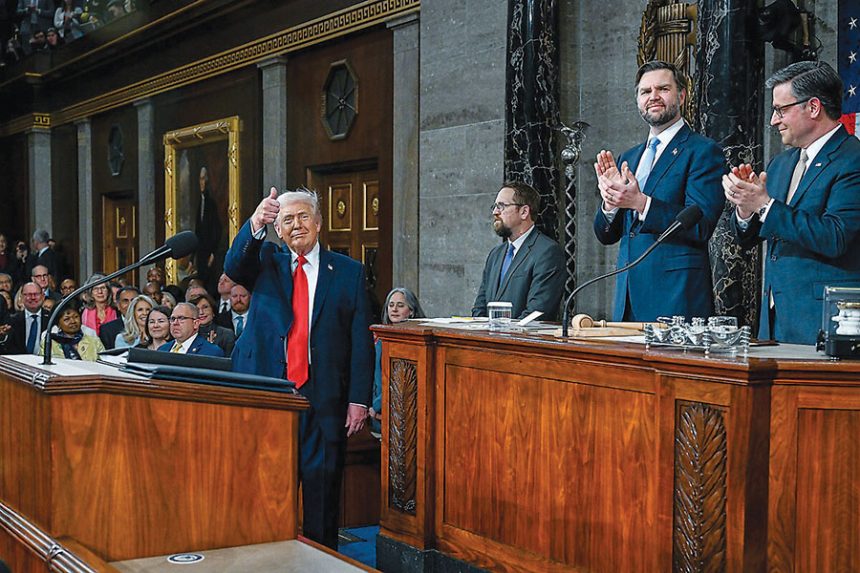
Washington: President Donald Trump declared during Tuesday’s marathon State of the Union that “we’re winning so much,” saying he’d sparked a jobs and manufacturing boom at home while imposing a new world order abroad – hoping that offering a long list of his accomplishments can counter approval ratings that have been falling.
His main objective was convincing increasingly wary Americans that the economy is stronger than many believe, and that they should vote for more of the same by backing Republicans during November’s midterm elections. In the process, he shattered his own record, going longer than the 100-minute speech he gave before a joint session of Congress last year.
Trump tried at points to appeal to bipartisan patriotic sentiments, introducing a series of surprise guests that included US military heroes; a former political prisoner released after his administration toppled Venezuelan President Nicolas Maduro; and the Olympic gold-medal-winning US men’s hockey team.
“In fact, we’re winning so much that we really don’t know what to do about it. People are asking me, ‘Please, please, please, Mister President, we’re winning too much,” Trump said.
before introducing the team.
The hockey players, wearing their medals and sweaters that said “USA” in large letters, drew a bipartisan standing ovation. Trump pointed to the Democratic side of the chamber and quipped, “That’s the first time I’ve ever seen them get up.”
In another made-for-TV moment, Trump announced he would be awarding the Presidential Medal of Freedom, America’s highest civilian honour, to the hockey team’s goaltender, Connor Hellebuyck. Trump made a similar surprise announcement in 2020, bestowing the award on conservative radio host Rush Limbaugh during the speech.
Trump championed his immigration crackdowns and his push to preserve widespread tariffs that the Supreme Court just struck down. He drew applause only from Democrats while describing the high court’s overturning of his policies, which he called “an unfortunate ruling”, while insisting “everything was working well” before it came down.
The president vowed to plough ahead, using “alternative” laws to impose the taxes on imports and telling lawmakers, “Congressional action will not be necessary.” He also made a bold prediction, suggesting that someday tariffs would “substantially replace” the modern income tax system. Trump argued that the tariffs are paid by foreign countries. Despite evidence that the costs are borne by American consumers and businesses.
“It’s saving our country,” Trump said of tariffs.
The Supreme Court justices in attendance were the same who came to Trump’s address to a joint session of Congress last March: Chief Justice John Roberts, as well as Justices Brett Kavanaugh, Amy Coney Barrett and Elena Kagan. Trump greeted the justices after previously slamming Coney Barrett for siding with the majority against his tariffs, despite his appointing her to the high court in his first term.
Democrats also stood for Trump vowing to crack down on insider trading by lawmakers, prompting Trump to offer, “I’m very impressed.” Not everybody applauded, though. Rep. Mark Takano, a California Democrat, yelled, “How about you first!” Rep. Rashida Tlaib, a Michigan Democrat, called out, “You’re the most corrupt president!”
When some heckling continued, Trump proclaimed, “You should be ashamed of yourselves.” Later, he pointed at Democrats and proclaimed, “These people are crazy,” adding, “Democrats are destroying our country.”
Democratic Representative Al Green was escorted from the chamber after he unfurled a sign of protest that read “Black People Aren’t Apes!” The sign appeared to be a reference to a racist video the president posted that depicted former President Barack Obama and First Lady Michelle Obama as primates in a jungle. Green was also removed during Trump’s address last year.
Before he began speaking, Senate Democrats blocked a bill to restore funding to the Department of Homeland Security, pressing for new limits on immigration enforcement that Republicans have opposed.
In response, Trump invited lawmakers from both parties to “protect American citizens, not illegal aliens” and championed proposals to limit mail-in ballots and tighten voter identification rules. He then devoted large swaths of his speech to warning about the dangers of immigrants and bestowed the Purple Heart on Andrew Wolfe, a National Guard member who was shot while deployed on the streets of the nation’s capital and made his first public appearance since then during the speech.
Trump didn’t say that much about efforts to bring down the cost of living, despite polling showing that his handling of the economy and kitchen table issues has increasingly become a liability. Such concerns about the high costs of living helped propel Democratic wins around the country on Election Day last November.
There are also persistent fears that tariffs stoking higher prices could eventually hurt the economy and job creation. Economic growth slowed in the last three months of last year. It is potentially politically perilous ahead of November elections that could deliver congressional wins to Democrats, just as 2018’s blue wave created a strong check to his administration during his first term.
On Tuesday, Trump blamed his predecessor, former President Joe Biden, along with Democratic lawmakers in the chamber, saying they were responsible for rising prices and health care costs, two issues his political opponents have repeatedly raised against him.
“You caused that problem,” Trump said of affordability concerns. He added a moment later, “They knew their statements were a dirty, rotten lie.”
As is typical, Trump also had some notable off-script moments. Referencing prescription drug prices, Trump said, “So in my first year of the second term – should be my third term – but strange things happen,” prompting at least one chant in the chamber of “Four more years!”
The president also put forward a new plan to give a modest boost to help some Americans save for retirement if they do not have a retirement account through their workplace, in which their employer matches contributions to the fund.