AP
Beirut
With airstrikes rocking Beirut and Israeli troops advancing against Hezbollah, Lebanon’s government has broken a taboo by proposing the first direct talks with Israel in decades. But Lebanese officials say they want the fighting to end first – and it might be too late for that.
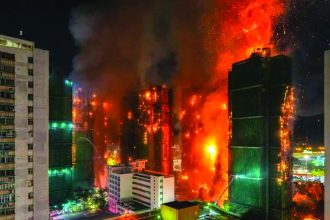
Hezbollah’s decision to enter the wider Iran war by firing rockets at Israel has led to the heavy Israeli bombardment of southern Lebanon and Beirut’s southern suburbs, killing some 850 Lebanese and driving over a million people from their homes.
The Iran-backed Hezbollah views the latest war as an existential struggle, and Israel is threatening a wider ground invasion, the seizure of territory and the destruction of Lebanon’s civilian infrastructure.
The United States, which has mediated during past flare-ups, has so shown no interest in doing so this time around.
Last week, Lebanese President Joseph Aoun offered to hold direct negotiations with Israel for the first time since the 1982 Israeli invasion during Lebanon’s civil war.
Aoun also asked for a boost in funding for Lebanese troops and reaffirmed his commitment to disarm Hezbollah, a longstanding Israeli and US demand.
But Lebanon wants the fighting to end before any talks with Israel, according to three Lebanese diplomatic and government officials familiar with the matter. They spoke on condition of anonymity as they were not authorised to speak to the press.
Israeli officials did not respond to requests for comment about the offer of talks. But Israeli Foreign Minister Gideon Saar, during a visit to an Israeli town hit by an Iranian missile, denied any talks were planned.
A new approach to a weakened Hezbollah
The agreement that ended Lebanon’s 1975-1990 civil war called for the disarmament of all armed groups, but Hezbollah alone kept its weapons, saying they were needed to protect Lebanon from Israel, which occupied the country’s south until 2000.
Successive Lebanese governments, even those dominated by Hezbollah’s political rivals, refused to directly confront the group, which was widely seen as more powerful than Lebanon’s armed forces. There were fears that any attempt to disarm Hezbollah by force could rekindle the civil war.