

AP
Washington
Senate Republicans voted down an effort Wednesday to halt President Donald Trump’s war against Iran, demonstrating early support for a conflict that has rapidly spread across the Middle East with no clear US exit strategy.
The legislation, known as a war powers resolution, failed on a 47-53 vote tally. The vote fell mostly along party lines, though Republican Sen Rand Paul of Kentucky voted in favour and Democratic Sen John Fetterman of Pennsylvania voted against.
The war powers resolution gave lawmakers an opportunity to demand congressional approval before any further attacks are carried out. The vote forced them to take a stand on a war shaping the fate of US military members, countless other lives and the future of
the region.
Underscoring the gravity of the moment, Democratic senators filled the Senate chamber and sat at their desks as the voting got underway. Typically, senators step into the chamber to cast their vote,
then leave.
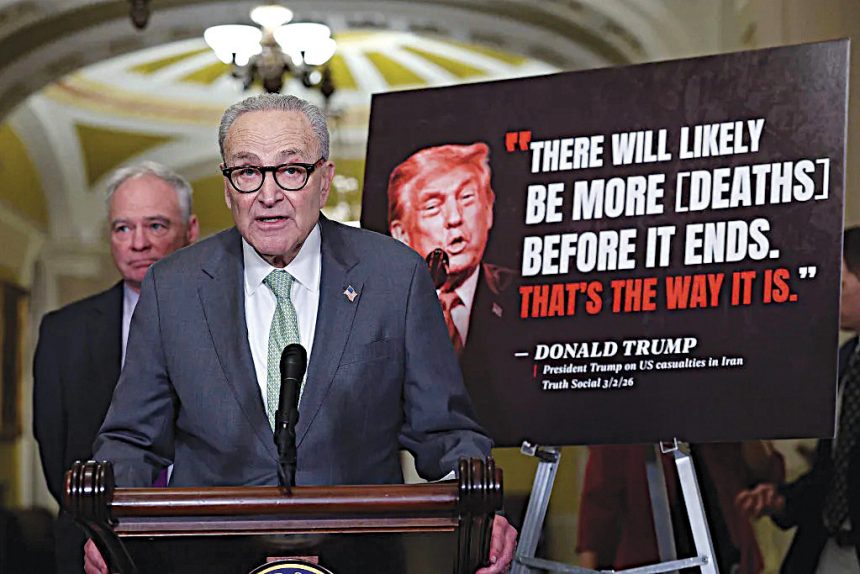
“Today every senator – every single one – will pick a side,” Senate Democratic Leader Chuck Schumer said before the vote. “Do you stand with the American people who are exhausted with forever wars in the Middle East or stand with Donald Trump and Pete Hegseth as they bumble us headfirst into another war?”
Sen John Barrasso, second in Senate Republican leadership, said during the debate that GOP senators were sending a message that Democrats are wrong for forcing a vote on the war powers resolution.
“Democrats would rather obstruct Donald Trump than obliterate Iran’s national nuclear programme,” he added.
After launching a surprise attack against Iran on Saturday, Trump has scrambled to win support for a conflict that Americans of all political persuasions were already wary of entering. Trump administration officials have been a frequent presence on Capitol Hill this week as they try to reassure lawmakers that they have the situation under control.
Defence Secretary Pete Hegseth said Wednesday that the war could extend eight weeks, a longer time frame than has previously been floated by the Trump administration. He also acknowledged that Iran is still able to carry out missile attacks even as the US tries to control the
country’s airspace.
US service members “remain in harm’s way, and we must be clear-eyed that the risk is still high,” Gen Dan Caine, chairman of the Joint Chiefs of Staff, said at the same press conference.
Six US military members were killed over the weekend in a drone
strike in Kuwait.
Republican Sen Joni Ernst of Iowa acknowledged the human costs of the war in her floor speech. One of the soldiers killed Sunday was from Iowa and a National Guard unit from her state was also attacked in Syria in December, resulting in the deaths of two other soldiers.
“But now is our opportunity to bring an end to the decades of chaos,” said Ernst, who herself served as an officer in the Iowa National Guard for two decades.
“The sooner the better,” she added.
Trump has also not ruled out deploying US ground troops. He has said he is hoping to end the bombing campaign within a few weeks, but his goals for the war have shifted from regime change to stopping Iran from developing nuclear capabilities to crippling its navy and missile programs.
“We should be careful about opening a door into chaos in the Middle East when we cannot see the other side of it,” Democratic Sen Chris Coons of Delaware said in a solemn floor speech after the vote concluded.
He said he was praying for “grace to find a path forward together where more do not needlessly join those who have already fallen in this new war in the Middle East.”
The votes in Congress this week represented potentially consequential markers of just where lawmakers stand on the war as they look ahead to midterm elections and the consequences of the conflict.
“Nobody gets to hide and give the president an easy pass or an end-run around the Constitution,” said Sen Tim Kaine, the Virginia Democrat leading the war powers resolution.
Republican leaders have successfully, though narrowly, defeated a series of war powers resolutions pertaining to several other conflicts that Trump has entered or threatened to enter. This one, however, was different.
Unlike Trump’s military campaigns against alleged drug boats or even Venezuelan leader Nicolas Maduro, the attack on Iran represents an open-ended conflict that is already ricocheting across the region. Several senators who have voted for previous war powers resolutions noted that they opposed this one because it applied to a conflict that is already raging.
“Passing this resolution now would send the wrong message to Iran and to our troops,” said GOP Sen Susan Collins of Maine. “At this juncture, providing unequivocal support to our service members is critically important, as is ongoing consultation by the administration with Congress.”
On the other side of the Capitol, an intense debate over the war unfolded before a vote on Thursday. The House first debated a resolution presented by GOP leadership affirming that Iran is the world’s largest state sponsor of terrorism.

