

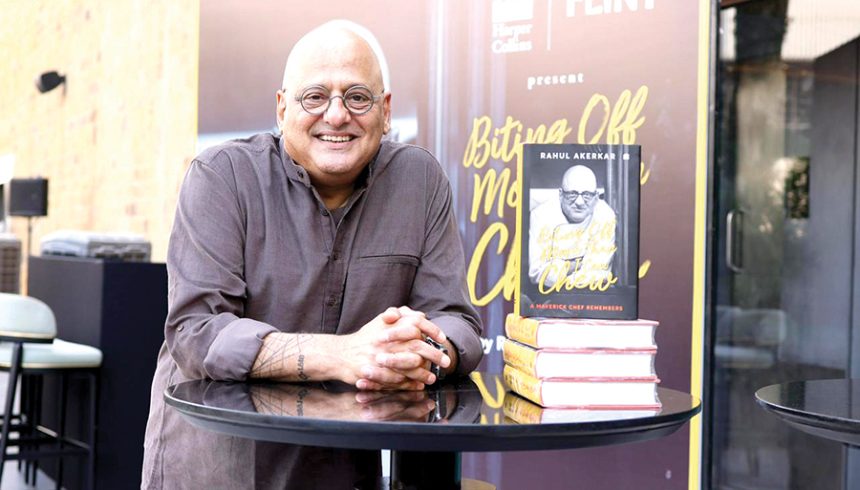
From New York kitchens to Mumbai icons, Rahul Akerkar reveals in his memoir the choices and chaos behind his culinary journey
VINIKA VISWAMBHARAN
Behind every restaurant and every signature dish is a story of choices, risks and detours. Chef Rahul Akerkar tells his in ‘Biting Off More Than I Can Chew’.
“I wasn’t interested in writing a victory lap,” he says. “I wanted to understand the decisions, good, bad and questionable, that led me here.”
Over three decades, Akerkar has built restaurants across Mumbai and beyond. He describes his journey not as a steady climb but as a series of instinctive leaps, often made before he fully grasped their consequences. “I’ve spent most of my life in kitchens, opening restaurants, dismantling them, starting again and sometimes getting it right,” he says
His portfolio includes Under The Over, Indigo, Indigo Deli, Qualia, and now Ode, Waarsa and Flint. While these names are usually linked to the rise of modern Indian dining, he insists, “When we started, it was really just instinct, curiosity and a willingness to take risks.”
Many ventures began without the capital, team or experience he needed. At the time, those choices didn’t feel like mistakes. “In all the chaos, it feels like you’re just solving problems,” he recalls. “Later, you see how much was held together by instinct, stubbornness and a refusal to let things fail.”
The title captures a pattern he came to recognise: “Taking on more than I’m ready for, more than I understand, more than is sensible,” he says.
The narrative moves from his childhood to his years in New York kitchens, then back to Mumbai, where much of his work took shape. The book grew not from a milestone but from a pause, as the COVID-19 pandemic slowed his pace. “Life slowed down to a point where I was engulfed by stillness,” he says, which allowed him to look back without the pressure of running a business. What he found was not always comfortable. “How much of what I thought was confidence was actually improvisation,” he reflects, “and how many decisions came from uncertainty rather than clarity.” Writing became a way to think about those moments more closely and changed how he reads his past.
Akerkar notes that when you’re in the middle of things, everything feels urgent and final. “Looking back, you realise it was more complicated than it seemed and memory reshapes those events. You connect dots that didn’t exist at the time. You assign meaning to accidents.”
This gap between experience and memory runs through the book. “It’s not really a ‘chef’s story’,” he says. “It’s about risk, ambition, failure and the decisions you make when trying to build something that doesn’t yet exist.” He returned to working without a clear plan. “Most of the meaningful things I’ve done came from saying yes before I fully knew how,” he admits.
Writing also reshaped his view of success, making him aware of both its demands and hidden costs. “Success, as it’s usually defined, is quite external. The book forced me to look at the internal cost of chasing it,” he says. He doesn’t try to resolve that tension: “I’m not sure I have a cleaner definition now but I’m more aware of what it takes and what it quietly takes away.”

