

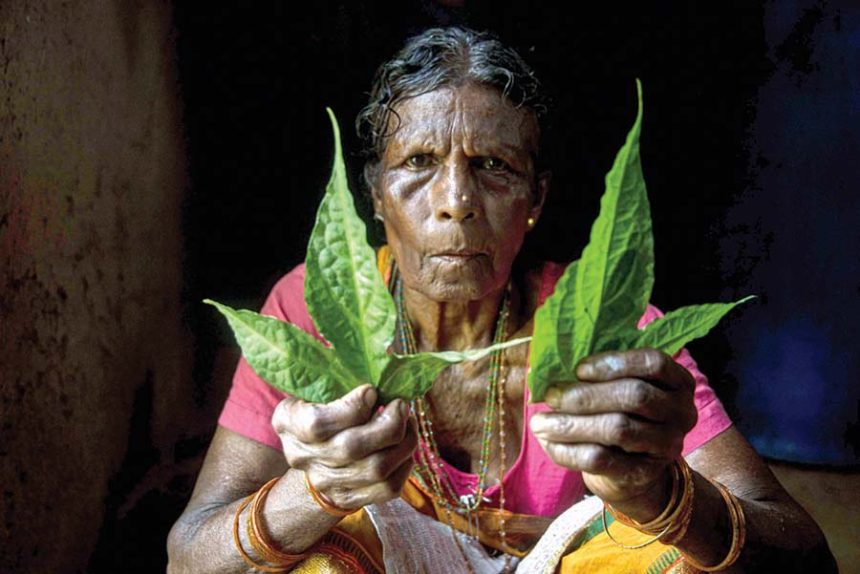
The upcoming ‘Show of Strength’ has 30 women artists and their artworks, all exploring women’s strength in different forms
KALYANI JHA | NT BUZZ
Strength takes many forms. The exhibition ‘Show of Strength’ at Aguada Port & Jail Complex lets visitors see it through the work of 30 women artists.
The works include painting, sculpture, mixed media, installation and textile art. They explore personal history, connections with Goa’s culture and nature, ecological concerns and wider global issues.
“This women-centred exhibition looks at restrictions, space, endurance, voice and freedom of expression. Having the room, both mental and physical, to focus on one’s art is itself a liberating and powerful act,” says curator Samira Sheth.
Sonia Sabharwal Rodrigues
For Rodrigues, strength begins with faith and the inner power of belief. Her central work, ‘Pray for Us’, draws on today’s world and the healing force of prayer.
“The image of what is happening in the world and the show of strength was prayers. One of my works shows a woman with a rosary, showing how prayer can heal,” she says.
Her second piece is inspired by Goddess Annapurna, a form of Parvati, in front of whom even Shiva bows. “That is also the strength of a woman. She can provide, even to the most powerful and inspire humility in front of feminine nurturing,” explains Sabharwal. Another work ‘Kokam’ draws on the colours and shapes of the Goan fruit to celebrate nature and its life-giving energy.
Savia Viegas
She turns to quilts, not just as objects but as symbols of care, survival and continuity. Her works show women as the silent sustainers of families. “Women have always held pieces together to create something beautiful that provides warmth and comfort,” says Viegas about her acrylic-on-paper work. Her pieces are shaped by global events and personal reflection.
“As a woman and mother, I think about these issues. We must emphasise the role of women who carry strong human values,” she says. Through six acrylic works, she builds a narrative of nurturing, where women are creators and protectors of life.
Chaitali Morajkar
She makes her art with tempera on fiberglass. Her circular forms are inspired by traditional Goan kundnem pots and show the emotional and physical burdens women carry.
“There is so much a woman carries, emotionally and physically and yet she emerges strong and positive,” she says. Her works are simple in message but resonant. “The works speak directly to viewers. You feel a positive vibe and that was my intention.” The female form is at the center, with symbols around it that quietly show strength.
Assavri Kulkarni
Photographer and author, Kulkarni focuses on the forest communities of Goa, using photography and installation to present memory, ecology and women’s lives.
“These are portraits of weathered, wrinkled women. The textures tell stories of time and history,” she says. Her installations include a sensory element where viewers can touch materials, engaging directly with textures and memories. Using chillies, herbs and everyday objects, she highlights ecological loss and cultural memory.
Her photographic work centres on women from communities such as the Kunbis, Vaibhs and Dhangars. “What I experience, the smells, textures, patterns, I want my viewers to feel too,” explains Kulkarni. “We make ordinary things look ordinary but I try to show the extraordinary in them.”
“In its quiet depth, the exhibition reminds us that strength does not always shout. Sometimes it is stitched, painted, remembered and felt,” she says.
“The strength of the work for me lies in the quietness, to notice, to feel, to question,” she Yolanda De Sousa Kammermeier
Her four works, ‘Eyewash’, ‘Basta’, ‘Fate Matter’ and ‘The Last Hippy’, reflect contemporary life.
“The works show reality in the 21st century. Even as women prove their capabilities, the belief that ‘it’s a man’s world’ persists,” she says. Eyewash critiques performative empowerment. “Women don’t need speeches. They need to be seen and accepted as equals. The best person should win, not just men by default,” she explains.
‘The Last Hippy’ expresses her belief in the flower generation and their idea of equality. “My creative process is instinctive. When I feel strongly, I express it directly on canvas,” she adds.
“As an artist, I respond visually, like a musician through lyrics or a poet through words. The medium depends on my mood; here, it is painting.”
(The exhibition will have a preview on March 22 and will be open to the public from March 23 to April 30, between 10 a.m. and 6 p.m. at Aguada Port & Jail Complex, Sinquerim. Entry is free and included with the site ticket.)

