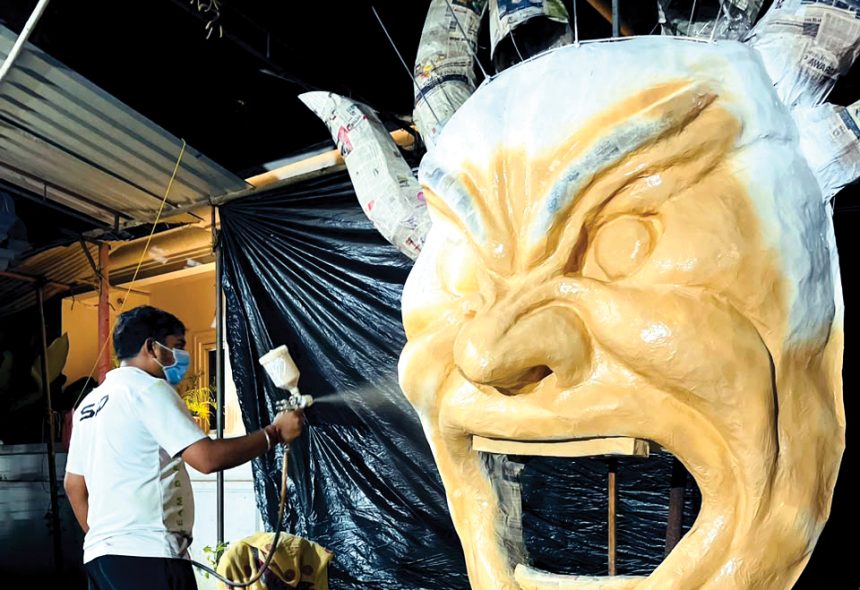
As Narkasur celebrations evolve, local groups bring their own creativity to Goa’s enduring Diwali tradition
VINIKA VISWAMBHARAN | NT BUZZ
As the humid Goan air cools in the lead-up to Diwali, a quiet metamorphosis takes over the streets. Local youth clubs step into a nocturnal world of welding torches, papier-mâché paste, and towering ambition as they prepare the traditional Narkasur effigy; a meticulous, generational craft deeply woven into the region’s cultural fabric that goes far beyond a mere seasonal pastime.
For groups like the Lovely Boys of Dempo Ward, Tonca, building these colossal figures is a legacy that spans over five decades.
Over the decades, the materials used to construct these mythical demons have transformed dramatically. “Previously, we used wood or bamboo canes to build the skeleton, while craft or kite paper stuck with a mixture of special flour paste was used for the body. We still use the paste but now we have started using iron rods for the skeleton, while newspapers and coconut fibre are used for the body,” says club representative Mathew Ribeiro.
This shift from natural materials to robust metal scaffolding has allowed groups to scale up their creations. Modern effigies routinely tower between six and 50 feet, stretching across one to two floors of vertical space. “Our Narkasurs used to be of smaller height, usually pot-bellied and had more human-like features with thick moustaches and long hair,” says Ribeiro. “Now with the recent young craze, they have abs and Western monster features like fangs and tails.”
The Podxiro Youth Club near NTS gate from Bogmalo has witnessed a parallel evolution over their 15-year history. “The shape of the body would be made with bamboo ropes tied around the structure. But with the recent rod-skeletons, the structural durability ensures our effigies can withstand both Goa’s coastal winds and logistical hurdles during transportation to get it burned,” says Sagar Shirodkar, a member. He also notes that for convenience, they obtain a readymade metal skeleton for the effigy, which they either reuse the next year or sell it to buy a new one.
SS Boys of St Inez meanwhile used to use grass from the fields and mud for the Narkasurs. “But since there are hardly any fields left in our area, we had to move on to modern materials,” says member Shayou Deeja.
Shiva Kalsanwar of the Kings of Tonca Boys, Tonca-Panaji, whose group has been active for over two decades, reflects on similar shifts in material sourcing. “We used to make our faces using tambdi maati. But now that quality is not available nearby. Hence, we have started welding the structures for the past six years.”
Building a towering Narkasur is no casual undertaking as it requires meticulous planning, substantial financial pooling, and strict adherence to municipal guidelines. Kalsanwar notes that total expenditure can easily cross Rs. 1,60,000 when factoring in sound systems and lighting.
For funds, clubs rely heavily on self-reliance, community pooling, and localised support. “We ourselves contribute if it’s possible, since most of us are employed now. Whoever wishes to donate comes to us of their own accord,” says Kalsanwar.
Meanwhile, larger operations like the Defense Boys in Headland Sada, Mormugao are funded through local sponsorships, local business contributions, and backing from regional legislative figures. These groups operate with corporate-level precision. Sairaj Volvoikar, a member, mentions that this year’s design will feature a ‘Jungli’ theme. “This time, we started right after Dussehra,” says Volvoikar. “Usually, we get around 25 days, but this time we had only around 18, but we were able to finish our work on time despite it.”
However, scaling up brings unique challenges, especially when dealing with Goa’s recent unpredictable late-season rains. Both Defence Boys and Kings of Tonca Boys had to previously implement emergency weatherproofing to protect their delicate paper and paintwork. Volvoikar of the Defence Boys explains how their temporary Navratri setup saved the day. “We already had our matoli shed roof set up from Navratri, so we kept our Narkasur under it and also tied tarpaulin sheets all around so no water could get in.” Kalsanwar similarly adds, “Even when sudden unseasonal showers came, we covered the entire effigy with heavy-duty plastic tarpaulins immediately. We stayed up to make sure no moisture reached the frame.”
Navigating narrow Goan lanes presents another operational hurdle. “We follow police protocol with respect to sound system and traffic order rules, as well as other permissions. If there is a traffic jam, we sort it out,” explains Ribeiro. Deeja of SS Boys shares similar regulatory changes over time. “Earlier we could keep our music on all night, but now we have to adhere to the 10 p.m. deadline for music systems, amongst other regulations that are maintained.”
Despite the logistical maze, civic cooperation remains remarkably high. Ribeiro mentions how municipal authorities frequently assist with trimming obstructive foliage, while local law enforcement coordinates with youth leaders to keep celebrations peaceful and orderly. Kalsanwar also highlights concerns over public disorder during the celebrations. “It would be great if the police helped us in this regard as non-residents of the area who cause such chaos won’t listen to us,” he says. “They come to celebrate, which is great, but then they drink, litter, break bottles, and start fights which are very difficult to control if it gets out of hand. We’re all here to celebrate, but we also should be mindful.”
Beyond the craft and spectacle, the tradition finds its strength in the people it brings together, with youth clubs drawing members from diverse backgrounds into a shared effort. “Although Narkasur is part of a Hindu festival, people from different religious communities come together and participate in making the effigies,” notes Sagar. This sentiment is echoed across multiple clubs where neighbourhood bonds transcend religious boundaries.
Members also emphasise the vital role of youth participation in keeping the craft vibrant. Ribeiro reflects, “When we were younger, we would jump at the first chance of making Narkasurs, because that’s how we had fun. Now with smartphones and other modern distractions, participation has decreased, but it’s never null. We still have great response from the youth who bring in new ideas.”
Sagar notes that some of the money collected is used as incentives to encourage younger members to join in. “We provide them with refreshments or jokingly lure them with juice or snacks for them to come, and we all have a grand time later.” Deeja agrees that fresh perspectives are crucial. “We try to incorporate new creative ideas especially with our increasing youth participation. We should try to come up with innovative ways to keep tradition alive despite obstacles!”
Before the final moments arrive, some clubs observe unique traditions to mark the end of the effigy’s cycle. Describing a beloved local custom, Anish Shirodkar from the Defence Boys shares, “One of our rituals before burning would be to let the kids beat the effigy with sticks, while we dismantle the body for easier and safer burning.”
When the effigies are finally brought down in the early hours before Diwali, these communities take with them the accumulated sweat, laughter, and unity of a community that refuses to let its heritage fade. According to Volvoikar, the real reward is simple, “We enjoy making Narkasur and we are proud of our creations. We let go of our bad actions and bad energies behind and start afresh on a cleaner slate!”