Contrary to the popular belief among fishermen and farmers in the riverine areas of Chorao that otters are pests responsible for declining fish catches, research suggests otherwise. According to a wildlife conservationist and biologist at the Chorao-based Wild Otters Research Centre Killian Hughes, extensive studies have shown that otters predominantly consume less remunerative and invasive species such as tilapia fish species.
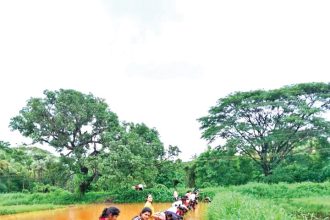
A khazan walk which was conducted by Hughes as part of the Heritage First Festival, explained that these findings are based on detailed analysis of otter scat collected from the Chorao habitat.
“Otters are frequently poached from the wild and sold in Southeast Asian markets. Their claws and teeth are removed, and they are kept in so-called ‘otter cafés’ as attractions or sold online as pets,” he said.
During the walk, Hughes emphasised that habitat loss remains a significant threat to wildlife. He explained that mangroves and khazan areas support otters at every stage of their life cycle. “There is a natal den where pups are born and kept until they open their eyes. They are then moved to another den, where they begin swimming lessons, like the one we see here,” he said, pointing to an empty otter den along the bund.
Speaking further about the ecological importance of mangroves, Hughes described them as major storage sinks; not just for carbon, but also for toxic substances. He added that studies have shown mangroves can survive even when up to 40 per cent of their surface area is covered in plastic, demonstrating their remarkable resilience.
Hughes concluded by stressing the global importance of mangroves to fisheries. “If mangroves around the world were destroyed, 70 to 75 per cent of the commercial fishing industry would collapse overnight. In a place like Goa, that would lead to immediate chaos. Mangroves are absolutely vital—not just for wildlife, but for our economy and environment as a whole.”