The work by the Catalyst and Engage grantees at the ongoing Goa Open Arts Festival at the Old GMC Complex, Panaji, has a mix of theatre, mixed media, film, and ceramics, through which they tell stories that push boundaries
KALYANI JHA | NT BUZZ
Since its inception, the Catalyst and Engage Grants have supported experimental, interdisciplinary, and community-rooted artistic practices across Goa. For its sixth edition, five artists along with ThinkArts were selected as recipients for these grants. Their work is now being exhibited at the ongoing Goa Open Arts Festival 2026 at the Old GMC Complex, Panaji.
Dnyanesh Moghe
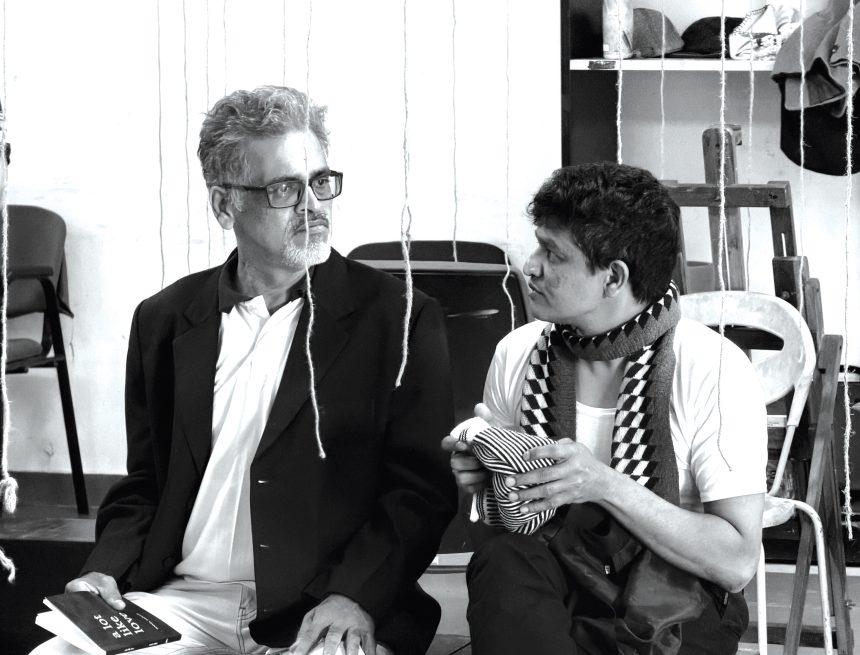
Dnyanesh Moghe’s theatre piece ‘Vamona Navelcar – A Volcano on the Inside’ is an original English play based on the life and artistic journey of renowned Goan artist Vamona Sinai Navelcar. The play explores his personal struggles, creative resilience, and the socio-cultural contexts that shaped his practice. Originally conceptualised by playwright Isabel de Santa Rita Vas and later developed by Moghe, the work combines archival research and creative storytelling to document both the historical and emotional landscapes of art-making in Goa.
“Isabel personally knew Navelcar and was contemplating writing a play based on his life. We asked her permission to present the play, which she graciously agreed to. It is a moment of joy to perform a play on the life of an important but overlooked artist from Goa,” says Moghe, who used additional information from the book written by Ann Ketterigham on the life of Navelcar to give the script a broader form. “Actors Ryan Semelhago and Nalini Elvino Souza spent a lot of time with Navelcar himself, so we often discuss Navelcar’s personality during rehearsals,” he shares, adding that he plans to present the play at other places too later.
Rajaram Naik
‘WE The People of Mayanagari’ by Rajaram Naik has been in the works for seven years. This exhibit reflects on the shifting landscape of Dashavatar Jatra, a centuries-old folk theatre tradition as it negotiates survival within contemporary cultural economies.
“This is one part of my ongoing practice where I have focused on the Rakshas character. I have used this confusion, and an enquiry of ‘Is Rakshas really a destroyer or protector? and who is a Rakshas today?’” he says.
In Dasavatar, he continues, there is one character called Shankasur, which means doubt. “The focus is on the fact that there is nothing fully evil or good. I have tried to connect mythology and the current scenario in society too,” explains Naik.
ThinkArts
The Engage grantee, ThinkArts has developed a participatory art project titled ‘Notes from the Neighborhood’. This project encourages teenagers from Goa to explore their immediate surroundings and in doing so deepen the experience of where they live. The exhibition presents young people’s discoveries shared through stories, memories, photographs, drawings, and collages, and extends an invitation to viewers to reflect on and contribute their own notes from their neighbourhoods.
“The core idea behind ‘Notes from the Neighbourhood’ is a curiosity about where you live and the ability to form a connection with your surroundings. We offered guiding prompts, encouraging them to notice details, talk to people, reflect on memory, history, change, and everyday life. The framework provided direction, but the discoveries were entirely personal. The intention was to keep the process open and accessible, so that each participant could arrive at their own understanding of what ‘neighbourhood’ meant to them, rather than working toward a predefined outcome,” says Antara, one of the curators of the project.
Exhibiting the project at Goa Open Arts, says Antara, feels especially meaningful because the festival’s core values of community, creative discourse, and experimentation deeply resonate with what the project is about. “We hope this project deepens young people’s relationship with the places they inhabit, helping them see their neighbourhoods not as ordinary backdrops, but as living spaces full of stories, histories and human connections. We would also love to see schools adopting these ideas within their own learning environments, encouraging similar place-based, creative explorations as part of regular practice,” she says.
Rini Joseph
Rini Joseph’ installation titled ‘Praanikoodu/ Hive’ opens up as an insect nest. It displays terracotta and stoneware alien-like creepy crawlies moving through the installation, along with text.
“‘Praanikoodul/Hive’ is the outcome of my ongoing relationship with community and ecosystems within our society. Given my displaced identity and being a minority in most rooms I occupy, there have been ongoing reflections on the roles one has to play in our environment. This project is a sort of prayer, for a personal and social structure that loves, collaborates, thrives – all while being highly efficient,” shares Joseph.
The artist researched extensively for this project, studying hives and colonies of insects, and studying clay and all its metamorphic, transmutative qualities. “I also read up on indigenous futurism, something I have been trying to imagine and understand in my practice. An essay that stayed with me, and provided a lot of clarity was Donna Haraway’s ‘The Cyborg Manifesto’,” she explains.
Joseph states that this is the first time that she has showcased her work at such a scale and feels like a massive achievement. “To show this in Goa, where I live and work, where so many wonderful people I know get to witness my work, is an honour,” says Joseph, adding that going forward she wants to add more audio visual elements
to it.
Ritika Singh
‘To Be Held, Someday’ is Ritika Singh’s personal exploration of longing, emotional inheritance, and care, rooted in relationship with her mother.
Rather than offering resolution, it creates a space for recognition — inviting viewers to reflect on what they carry from their own relationships and what it means to be held, by others or by oneself.
This is Singh’s first exhibition and her first time working within a support structure of the Catalyst grant at Goa Open Arts. “I wanted create something deeply personal and this is something that I’ve been quietly processing for years, but never really given it a form. With the mentorship of Prashant Panjiar (GOA cofounder) and the guidance that came with the grant, I was able to shape the feelings into a visual language and create a structured body of work,” she says.
Singh’s conversations with her mother, her childhood, her struggles, her joys, family photographs and archives, her grief, her strength, etc. are some of the first-hand experience and research that went in this project.
“I also found myself in conversations with others noticing how many mother and daughter relationships carry similar patterns of emotional inheritance. These conversations really helped me recognise that the personal can also be collective,” she says. She does however admit that navigating through the vulnerability, revisiting intimate memories and holding space for both her mother’s and her own emotions was very difficult and at times overwhelming. “Translating those feelings into a visual language without reducing their complexity required a lot of time and care and honesty,”
says Singh.
Soham Bhende
Soham Bhende, a recent graduate of the National Institute of Design has chosen to focus his project on the village of Kurdi, which surfaces only once a year for about a month or so. His eight-minute film titled ‘A room for a body’ was part of the research he did for his graduation project.
“While working on my graduation film, I encountered many things during my research that I had done across six months which couldn’t end up in the final film. So, I decided to do another film,” he says.
Spanning eight minutes ‘A room for a body’ unfolds through a video projection accompanied by a sculptural piece centered on the village’s mother goddess. The video gathers fragments that endure through voices, silences, rituals, and dreams. While some remember with longing, others choose not to return, even in memory. It considers how nostalgia is shaped by one’s position within the village, and how displacement unsettled older structures such as the ‘bhatkar’ system.
“In the film, I’ve deconstructed what space and a place is and what makes a space a place. I have also focused on the Konkani word ‘Kood’ which means ‘room’ and ‘a body’ at the same time. I am looking at how Kurdi village is both -the one where people have been displaced and one which is underwater,” he shares.