Memory, culture, and colour converge in Dinesh Vaman Revankar’s exhibition on view at Ujwal Art Gallery, Vagator
NAGUESH RAO SARDESSAI
A mature and evocative body of work by artist Dinesh Vaman Revankar is on view at Ujwal Art Gallery, Vagator.
The exhibition showcases paintings shaped by decades of artistic practice across India and East Africa, reflecting a life lived in close dialogue with culture, design, and human emotion.
An alumnus of the Sir J.J. College of Applied Art, Mumbai, Revankar brings to the canvas a rare synthesis of disciplined design training and the lyrical freedom of fine art. His works demonstrate a command over form, colour harmony, and compositional balance.
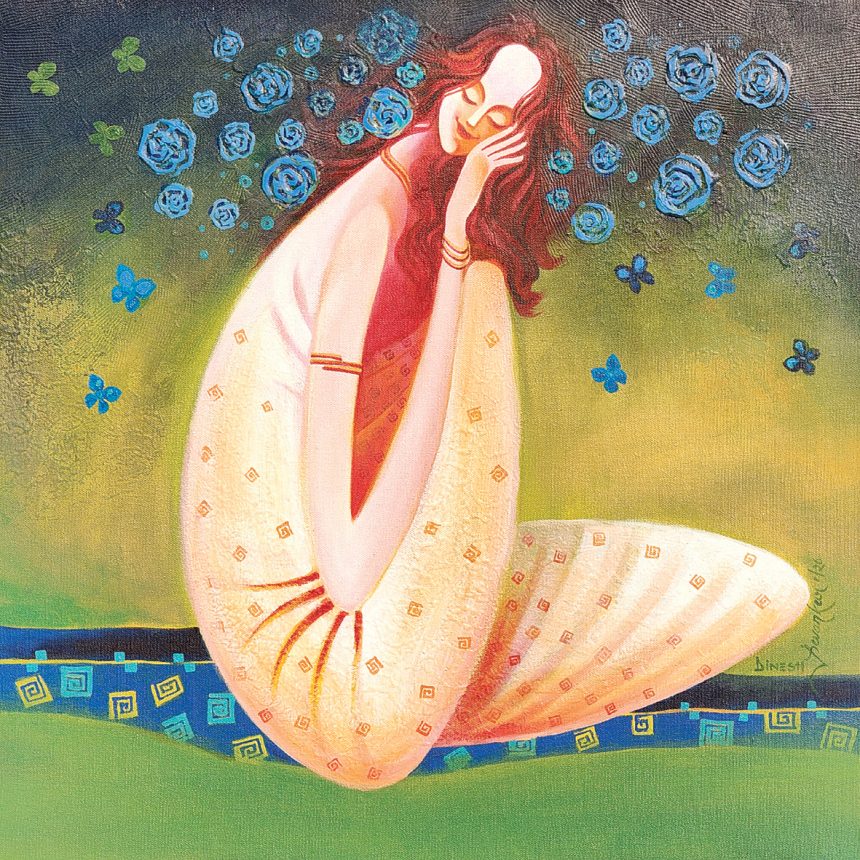
The exhibition foregrounds the human figure as its central motif. In one striking canvas, a contemplative woman, draped in soft whites and rose hues, sits in quiet introspection, surrounded by floating blue blossoms and butterflies. The painting merges stylisation with emotional immediacy; the figure appears both grounded and ethereal, suggesting inner serenity amidst the flux of life. Revankar’s use of gentle gradients and patterned textures reveals his applied art background, while the symbolic flora evoke memory, femininity, and renewal.
Another work, dominated by warm reds and ambers, portrays a seated woman in profile holding delicate white flowers. The palette intensifies the psychological atmosphere, turning the background into an emotional field rather than mere space. Here, Revankar demonstrates how colour can function as narrative—crimson tones suggesting longing, resilience, or silent strength. The minimalism of the setting enhances the quiet dignity of the subject.
A tender maternal composition stands out for its devotional quality. Bathed in golden-orange light, a mother cradles her child in an embrace that transcends time and geography. The flowing drapery and softened contours lend the work a near-iconic stillness. The piece resonates with universal themes of protection and nurture, yet it is rooted in subcontinental visual memory, recalling classical Indian aesthetics without imitating them.
In a departure from Indian figurative sensibilities, Revankar also explores African identity through a powerful portrait of a young woman adorned in vibrant patterned textiles. The painting celebrates the strength and grace of African femininity, with luminous skin tones and bold geometry conveying cultural pride.
Perhaps the most conceptually layered work in the exhibition is a symbolic figure seated against a parched, cracked landscape. The body appears latticed, almost skeletal, as though carved from the earth itself. At its centre, a small green sapling emerges, cradled gently in the figure’s hands. The imagery is unmistakably ecological: fragility and hope coexisting in a time of environmental distress. The circular backdrop of intertwined branches frames the figure like a halo, transforming the scene into a meditation on regeneration. In this canvas, Revankar reminds viewers that art can be both aesthetic and urgent.
Across the exhibition, one observes the artist’s confident play of colour—vibrant yet controlled, expressive yet harmonious. Patterns and motifs subtly repeat, creating continuity without monotony. His figures are stylised but never distant; they communicate directly with the viewer, inviting introspection.
Critically, Revankar’s work resists overt dramatisation. Instead, it relies on quiet intensity. The discipline of applied art ensures structural clarity, while years of creative exploration grant emotional depth. This balance is what makes the exhibition compelling: it is neither purely decorative nor abstractly cerebral. It is, rather, art shaped by life itself.
(The exhibition remains open until March 3.)