

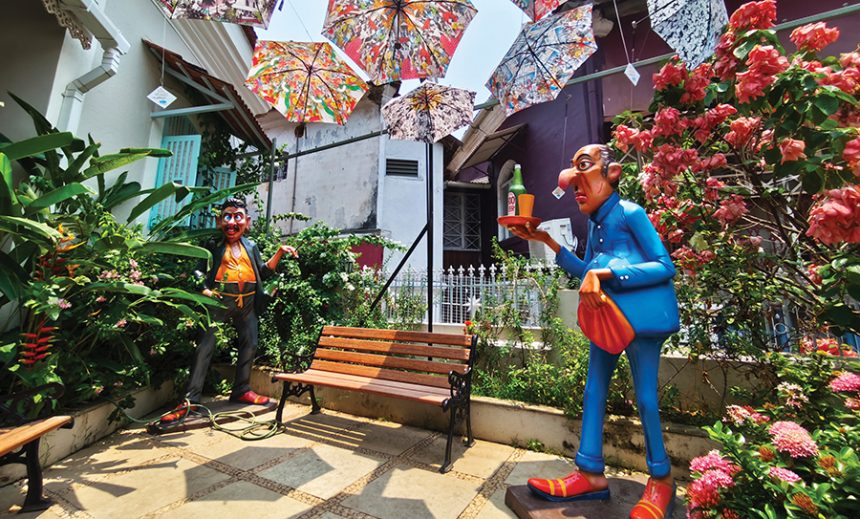
In celebration of artist Mário de Miranda’s birth centenary, May 2, a new gallery in Fontainhas transforms a house once featured in his own illustration into an immersive space while sustaining his legacy
VINIKA VISWAMBHARAN
In the narrow, winding lanes of Fontainhas, a familiar yet reimagined world has quietly opened its doors. To mark the birth centenary of Mário de Miranda, a new gallery has been set up in a house that feels as though it has stepped straight out of one of his own cartoons. In fact, one of his works titled ‘Street in Fontainhas’ features this very house, now transformed into the gallery, gently blurring the line between the world he once drew and the one that now holds his work.
Statues of Miranda’s iconic characters greet visitors at the entrance, while umbrellas printed with his cartoons hang overhead, gently swaying and casting playful shadows. Inside, the gallery unfolds as an immersive and tactile extension of his visual language.
“This is the sixth gallery of Mário and it’s built for his centenary so it’s a special one for us,” says curator, architect Gerard da Cunha, who has been closely involved in shaping these spaces since 2012.
Unlike earlier galleries, this one has been conceived as a complete environment from the outset. “All the other galleries are purely commercial spaces,” he explains. “This one would be more experiential. So I had the opportunity to plan it properly. There is more discipline and thought put into this space.”
Miranda’s drawings, once confined to paper, now find themselves translated into objects that invite touch and interaction. “Mário drew so much,” notes da Cunha. “So we took some of his sketches, like the drunkard, the priest, the bread man, and we got them sculpted. We made 39 of them.” These figures, are cast in fibreglass and hand painted. “The artists who do this are the same people who paint Ganesh idols. When they are not working on that, they work with us.”
This blending of artistic traditions reflects the gallery’s wider philosophy. It is not just about preserving Miranda’s work but about reinterpreting it for contemporary audiences. This approach comes through most vividly in an installation da Cunha calls “Mário Magic”, where a well known work by Miranda is transformed into something kinetic and almost theatrical. One such piece is based on ‘Naked Faces at a Striptease’, a drawing that plays on his signature wit, where the humour lies not in the act itself but in the exaggerated expressions of the audience. “We’ve taken that picture and cut it into 100 parts per square foot,” explains da Cunha. “Then each tiny piece is fixed individually onto a nail on a tray structure.” The result is not a static image but a fragmented surface composed of hundreds of small reflective sequins that respond to the slightest breeze, begins to shimmer and reassemble itself in motion to create an almost life-like effect. This echoes the energy of Miranda’s original drawing, where crowded scenes and layered expressions create a sense of movement on paper. “The faces are naked, not the people,” says da Cunha. “That’s the joke.”
Elsewhere, familiar scenes from Miranda’s work appear across canvases, tiles, trays and textiles.
From crockery and coasters to notebooks and scarves, the range is expansive. Yet nothing feels arbitrary. Each object draws from the dense detail of Miranda’s illustrations. “His pictures are so detailed,” says da Cunha. “You can extract something small and it still stands on its own.”
Beyond galleries, it serves a larger purpose rooted in sustainability and continuity. According to da Cunha, it came from a need to build a network that could support production, workshops and livelihoods, all while also ensuring that Miranda’s legacy continues to support his family, with whom da Cunha shares a personal connection.
Although the gallery itself opened two months ago, it now sits within a broader programme of celebrations. Among them is an official event at Kala Academy, organised by the Directorate of Museums where da Cunha will speak on ‘The Life of Mario’ at the Black Box. An exhibition and continuous film screening, ‘Masterpieces of Mário de Miranda’, will also be held at the Art Gallery of Kala Academy on May 2 and 3, 10.30 a.m. to 7.30 p.m.

