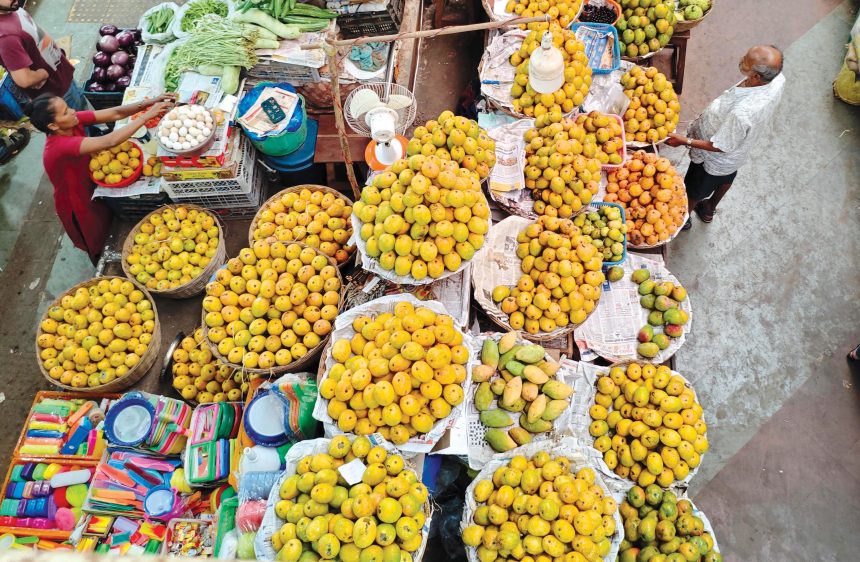
Rooted in centuries of Portuguese grafting tradition and recognised today through GI tags, Goa’s mango sector now faces pressures from climate change, land loss and shifting consumer tastes
RAMANDEEP KAUR & KALYANI JHA
Asweet summer staple, mangoes are eagerly awaited in the state. As they arrive in markets and homes, they quickly become part of daily meals. From being eaten fresh to finding a place in drinks and traditional preparations, they are a familiar part of how the season is experienced.
Long-revered as the ‘King of Fruits’, mangoes originated in the Indo-Burma (Myanmar) region, though their large-scale cultivation in India expanded under the Mughals, particularly across the Gangetic plains (now UP, Bihar and West Bengal).
“In Goa, varietal development is linked to work done during Portuguese rule. Jesuit priests applied grafting techniques that were already used in European fruits such as apples to mango trees. This made it possible to reproduce specific trees consistently, resulting in distinct named varieties over time,” says horticulture consultant and mentor, Miguel de Braganza.
According to him, many of these were named after individuals or families, often those who had adopted Portuguese surnames. This resulted in names such as Alphonso, Monserrate, Furtado, Costa and Colaco.
Some names were based on fruit characteristics. Malcorada referred to unevenly coloured fruit and Bemcurada to well-ripened, sweet fruit. “Over time, these names shifted in local usage. Malcurada became Mankurad, while Monserrate came to be known as Mussorat or Mussorad,” he shares.
He notes that mangoes are used in three distinct ways in Goa. These include raw fruit for pickles, ripe fruit eaten as table produce and processed fruit used in jams, squash, ‘aamras’ and sweet-sour curries.
Documenting local varieties
While Goa once had a wide range of native mango varieties, many are now difficult to find in the field. Earlier documentation by retired assistant director of agriculture, Goa, the late Fernando do Rego and others listed 77 native mango varieties in the state.
Of these, 44 are currently maintained in the field germplasm bank at ICAR-CCARI, Old Goa, as per former principal scientist at the institute, Dr. A.R. Desai.
He says the remaining varieties could not be traced over time due to ageing trees, lack of upkeep in orchards and conversion of agricultural land for development.
In addition, about 10 pickling mango varieties have also been identified and are being conserved. A joint effort with the Goa State Biodiversity Board is underway to update the existing documentation.
Between 1990 and 1995, scientist (horticulture) at ICAR-Goa P. A. Mathew, documented mango varieties of Goan origin in detail and co-authored the book ‘Mangoes of Goan Origin’ with the findings.
At ICAR-CCARI, work focuses on selecting local mango varieties, managing diseases and conserving mango diversity, covering both table and pickling types. Researchers are also evaluating late-season varieties such as Hilario (Mang Hilar/Mangilal) for selection potential, along with studies on pickling mango types.
Among Goa’s many varieties, three have Geographical Indication (GI) tags. Mankurad received the tag in 2023, while Manga Hilario and Mussorat (Monserrate) were granted theirs in December 2025.
Mankurad: the clear favourite?
Rohan Joshi, who has been growing mangoes on his farm in Bicholim for over two decades, acknowledges that Mankurad is the favourite among Goans. While he also grows Alphonso, Ratna, Malgis, Kesar, Amrapali and Mallika varieties, Mankurad is the primary variety on his farm. “Mankurad sells like hotcakes,” he says.
Avinash Joseph Almeida agrees. Having recently begun mango cultivation on a property he acquired in Fatorda as part of an initiative he calls ‘The Eden Project’, he currently has three mango varieties: Mankurad, Banganpalli and Hapus (Alphonso). “Mankurad is very popular here and sells fast. The sweet, slightly tangy taste is what people like and prices can reach up to Rs. 1,500 per dozen,” he says, adding that The Eden Project focuses on small-scale farming and sustainability. “It aims to bring food ownership back to people and keep prices competitive rather than follow market rates.”
Dr. Desai attributes Mankurad’s appeal to its fruit traits. “Mankurad has a strong aroma and flavour, slightly fibrous pulp near the stone and a balanced sugar-acid taste,” he says.
He adds that Alphonso, while commercially valued for its keeping quality, is affected by spongy tissue disorder that is not visible externally. “It also develops a reddish blush on the shoulders during ripening. Mankurad, in contrast, ripens to a uniform yellow colour.”
A selected farmer variety, Cardozo Mankurad, has also been released by the Central Variety Release Committee for Goa and Konkan. This variety is aromatic, crimson-red, has a fibre-free pulp, is regular bearing and has a shelf life of about a week.
Weather impact
Mango production in Goa is affected by weather conditions during flowering. Dr. Desai notes that the crop is sensitive to temperature changes and unseasonal rains in December and January. Extended rainfall and cloudy conditions usually trigger powdery mildew (fungus) and increase pest activity, including mango hoppers. In some seasons, even with good flowering, fruit set remains low.
“This year, fruit set was poor despite good flowering due to a higher proportion of male flowers, high temperatures of 35–38°C and drying of the stigma, which affected pollination,” he says. He adds that mango requires dry conditions for flowering. When rain extends into October–December, it disrupts this cycle, delaying flowering and reducing yields.
Fruit fly and worms
The worms seen in mangoes are caused by fruit fly infestation. Dr. Desai says the problem increases when rains continue during fruit maturity and harvest.
Fruit flies, he says, multiply faster in late-season conditions, especially when fallen or rotting fruits are present in orchards. “This raises infestation pressure in the following crop stages.” He explains that even early varieties like Mankurad and Alphonso have shown higher fruit fly damage in recent years when flowering is delayed. “Mid and late varieties such as Salcete Mussarat and Hilario are more exposed if not protected,” he says.
The mango market
Even with the high demand for Mankurad, mango farmers in Goa face challenges related to market volatility. Joshi says, “When there’s an oversupply of mangoes, prices drop and we end up selling at a loss.”
Another major hurdle is the short shelf life of some varieties like Malgis and Fernand, which spoil quickly. “These are used for niche products like jams and pickles but traditional preservation methods are fading,” says Joshi, noting that lack of knowledge transfer has contributed to the decline of these lesser-known varieties.
A missing link
One more challenge is the absence of processing facilities in Goa. Joshi says that unlike in neighbouring coastal Maharashtra, where mangoes are made into juices, squash and pohi (dried mango), Goa doesn’t have this kind of infrastructure. “Without it, it’s hard to preserve mangoes for longer. If we had processing industries, mangoes could be kept and sold throughout the year. But without that, we’re stuck selling at whatever price the market sets, which is often a loss.”
Wildlife, especially monkeys, further exacerbates the problem, as they can destroy entire crops, says Joshi, adding that there are also challenges with labour availability.
Space and patience
An agriculture consultant from St. Cruz, James D’Cruz, points out two important challenges in mango farming: space and patience. “It takes three to five years for a mango tree to bear fruit and people today don’t want to wait that long,” he says. Land scarcity is another concern. “There’s barely any land left so people are planting just one tree in their backyard or even growing them in pots on their terraces,” he adds. However, D’Cruz encourages those with available land to grow different mango varieties.
Almeida, who is still early in his mango farming journey, agrees. “If you plant saplings, it’ll take about six years for them to bear fruit,” he says, adding that even grafted trees take about four years to start flowering. He recommends planting other crops alongside mangoes. “Mango farming takes time to yield returns, so it’s smart to have short-term crops that can generate income in the meantime,” he explains.
“Mango trees typically live for 30 to 50 years and as long as they are well-maintained, they continue to thrive,” says Joshi, adding that he hasn’t seen any varieties disappearing, at least not yet. However, he says that some niche varieties, such as Kardo’s Mankurad and Shorav Mankurad, could eventually fade due to their limited cultivation areas.
Changing tastes
Consumer tastes are evolving, with younger consumers preferring mangoes with fewer fibres. Alphonso has gained popularity for its smooth, fiberless texture. “Alphonso is becoming a favourite over Mankurad, which has traditionally been the top pick,” says Joshi.
Almeida agrees with this shift but says traditional mangoes still find buyers. “There will always be buyers for the classics but the issue is availability. As land for cultivation shrinks, it’s getting harder to keep these varieties in production,” he adds.
This is evident in the gradual decline of older varieties. Nestor Rangel, a mango farmer from St. Cruz with a farm in Dongurlu, Sattari, says varieties such as Oudgo, Severine and Sakri are no longer cultivated. “People don’t know how to care for these varieties and there’s a lack of planting material,” he explains. His farm, established in 2009, now hosts over 70 mango varieties. However, Mankurad and Hilario continue to be top sellers, while others struggle with limited output.
D’Cruz adds that younger generations are often unfamiliar with the upkeep of older trees, leading to neglect. “Without proper care, these old trees are dying off, affected by stem borers,” he says.
He also points to the San Antonio variety, a small mango known for its sweetness when eaten semi-ripe. “It’s not widely known, but it’s even better than Totapuri. Some people are trying to propagate it but it’s at risk of fading away.”
Preserving the sweet heritage
Despite these challenges, there is hope for mango farming in Goa, supported by institutions like the ICAR–Central Coastal Agricultural Research Institute. D’Cruz credits ICAR for helping local farmers by providing affordable grafts and introducing new mango varieties better suited to Goa’s climate. This could make mango farming more economically viable.
“The Konkan Fruit Research Centre, Vengurla, has also been incredibly helpful, providing high-quality grafts at a fraction of the cost,” says D’Cruz. “You can get grafts from ICAR for just 100 rupees, compared to 500 rupees from other sources.” He also mentions the Malika variety, recognised for its sweet taste and thin seed. “When properly ripened on the tree, Malika is one of the tastiest mangoes. It’s one of my favourites among the newer varieties that have come out,” he adds.