BJP set for historic power debut amid symbolism and suspense
Kolkata: Governor RN Ravi has dissolved the West Bengal State Legislative Assembly with effect from May 7 after completion of its term, according to an official notification.
The current Assembly was constituted in May 2021 after the Trinamool Congress, under the leadership of Mamata Banerjee, returned to power for the third consecutive term in the state.
The dissolution marks the formal completion of the tenure of the outgoing Assembly, following the recently concluded two-phase elections.
The notification was issued by the Department of Parliamentary Affairs.
With the dissolution of the Assembly, the state cabinet also ceased to exist, effectively bringing Mamata Banerjee’s tenure as Chief Minister to an end.
However, deviating from practice, Banerjee has refused to resign after her party, the TMC, was defeated by the BJP in the Assembly elections, alleging unfair means during the poll process. Banerjee has maintained that she and her party were defeated through “manipulation”.
Article 174 of the Constitution empowers the Governor to summon the Assembly under specific provisions. It governs the sessions, prorogation, and dissolution of state legislatures.
The BJP won 207 seats to secure more than a two-thirds majority in the 294-member Assembly, ending the TMC’s uninterrupted 15-year rule in the state.
The Mamata Banerjee-led party was reduced to 80 seats.
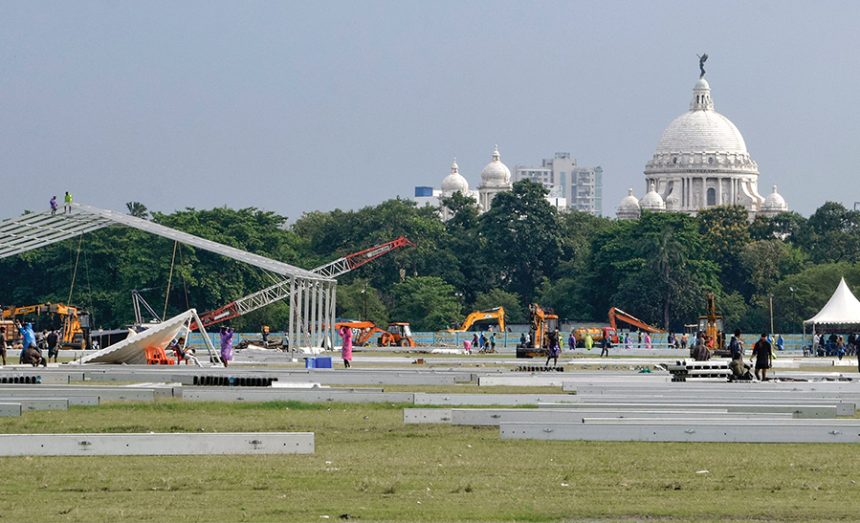
BJP workers will gather under the sprawling skies of Brigade Parade Ground in the heart of the city on May 9 to witness the swearing-in of the party’s first government in West Bengal. The moment will carry far more than the symbolism of an electoral victory.
For the saffron camp, it will mark the culmination of a political journey that began on the margins of Bengal’s ideological landscape and travelled through years of organisational expansion, cultural repositioning, defections, polarising campaigns and bruising street battles to finally arrive at the centre of power in a state long considered resistant to the BJP’s politics.
The ceremony, scheduled at 10 am, is expected to be attended by Prime Minister Narendra Modi, Union Home Minister Amit Shah.
It will be attended by chief ministers of BJP-ruled states. The ceremony will also unfold amid intense speculation over who will take oath as Bengal’s next chief minister.
While the BJP leadership has remained silent, Suvendu Adhikari has emerged as the central figure in the post-election political churn after scripting two of the most consequential victories of the election – retaining Nandigram and defeating Mamata Banerjee in Bhabanipur, the constituency seen as the TMC supremo’s political fortress.
The rise of Adhikari carries with it layers of political irony unique to Bengal politics.
The man who once stood beside Banerjee during the Nandigram land agitation that dismantled the Left Front’s 34-year rule is now positioned at the centre of the BJP’s own ‘poribartan’ moment against the very party he helped build.
For many in the BJP, that political arc has become emblematic of the changing grammar of Bengal politics itself.
Standing in Nandigram on Wednesday, Adhikari – often referring to the constituency as his political ‘bhadrasan’ or citadel – acknowledged the emotional and political pull between the two constituencies that now define his career.
“I was part of the 2011 ‘poribartan’, and now I am part of the real change,” he told supporters, while announcing that he would vacate one of the two seats within 10 days after consultations with the party leadership.
Apart from Adhikari, names such as state BJP president Samik Bhattacharya, Union minister Sukanta Majumdar and former Rajya Sabha MP Swapan Dasgupta have surfaced in political discussions.
But party insiders indicated that the leadership remains inclined towards projecting a ‘bhumiputra’ face rooted in Bengal’s linguistic and cultural ethos – a formulation repeatedly invoked by Shah during the campaign to counter the TMC’s charge that the BJP represented an “outsider” political culture.
That cultural messaging is visible in the timing of the swearing-in ceremony itself.
The oath-taking will be held on the 25th day of Baisakh, observed across Bengal as Rabindra Jayanti, the birth anniversary of Rabindranath Tagore.
According to BJP leaders, the choice is aimed at embedding the party’s historic rise within Bengal’s cultural consciousness while countering the perception battle that has long dogged the BJP in the state.
Bengal gripped by fear as Rath probe points to contract killing
Kolkata: West Bengal sank into a miasma of fear and despair in the face of political violence yet again on Thursday, following uncharacteristically peaceful elections in the state, as early leads in Chandranath Rath’s murder investigation showed the personal assistant to BJP leader Suvendu Adhikari was killed in a planned hit on Wednesday night.
Investigators suspect the involvement of professional shooters, with police recovering vehicles carrying fake number plates. P 9