NT Reporter
Panaji
The death of a tiger whose carcass was found on
May 2 in the Sacorda-Dharbandora forest belt has,
for now, been ruled out as a case of poaching, according to findings of the Forest Department and wildlife
experts involved in the investigation.
The post-mortem report of the carcass was submitted to the department by the veterinary officer and expert team, which stated that the exact cause of death is yet to be scientifically confirmed.
“During the inspection of the site, officials reportedly did not find any bullets, metal wires, traps or other suspicious objects commonly associated with poaching incidents,” the report stated.
It further stated that while poisoning has not been confirmed, it cannot be entirely ruled out because the carcass had undergone major scavenger activity.
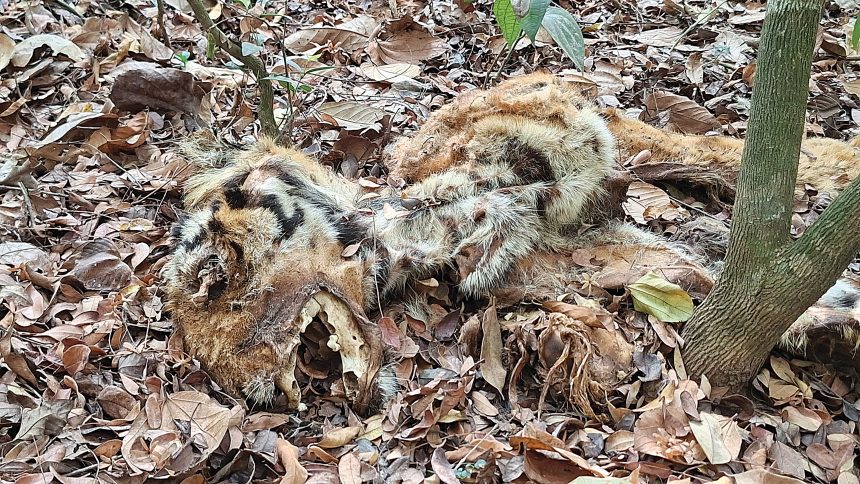
The carcass of the Royal Bengal Tiger was recovered from Aglote village near Sacorda under the Collem forest range.
The Chief Wildlife Warden constituted a post-mortem committee comprising veterinary experts and forest officials. An authorised representative of the National Tiger Conservation Authority (NTCA) was also present during the examination.
According to the report submitted by the North Goa Forest Division, the carcass was estimated to be more than a month old and was found in a heavily decomposed state. The remains had been scattered across three different locations in the forest. During follow-up searches, forest personnel recovered nails, bones, teeth, fur and skin fragments.
Veterinary experts stated that the condition of
the carcass made it impossible to ascertain the precise cause of death. Several body parts had dried up, while others were infested with maggots.
No traps, snare wires, firearm evidence, poison containers or suspicious objects were found in or around the recovery site. Forest officers also found no indications of struggle, injuries caused by weapons, or any direct human involvement.
The department further stated that the carcass was discovered in
a private property covered with dense vegetation and situated away from human habitation.
Samples including bones, skin and other remains have been sent to the Wildlife Institute of India, Dehradun, for forensic, toxicology and DNA analysis.