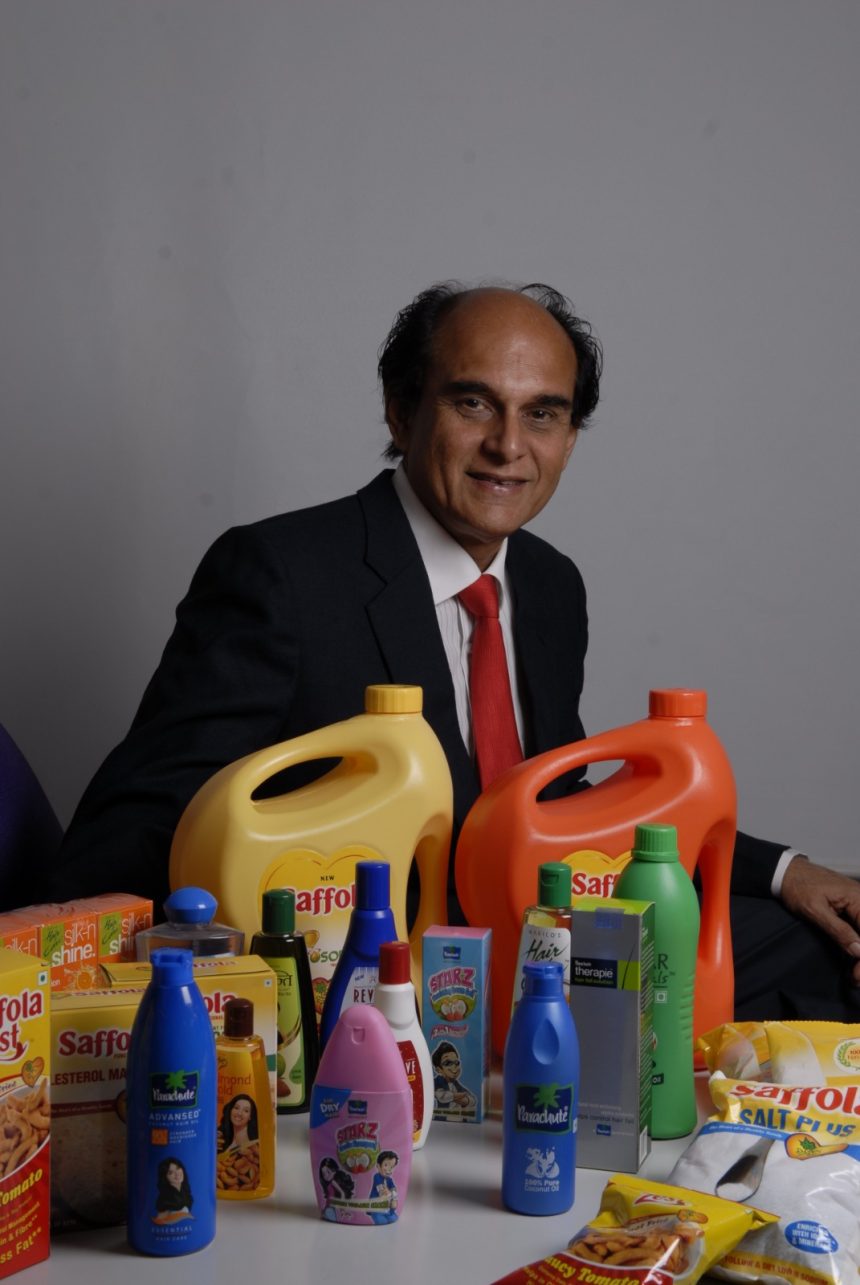
Harsh Mariwala is the Founder and Chairman of Marico, a Fortune 500 consumer goods company behind household brands such as Parachute and Saffola. He is also the founder of the Marico Innovation Foundation and ASCENT Foundation, reflecting a longstanding commitment to innovation, entrepreneurship, and institution-building in India.
HARSH MARIWALA believes the marker of real success becomes: what purpose gives you true satisfaction? In a conversation with PALLAVI DEMPO, he shares his insights on taking a family business and building it into a company with focus, innovation, and purpose
Let’s start from the beginning, from the 1990s to an FMCG major with a presence in about 25 countries and to becoming a Fortune 500 company in a. What was the key factor behind that journey?
HM: Fundamentally, we are an extremely focused organisation. We were clear from the beginning that we would be in beauty and wellness. When you are focused, it brings depth, and depth brings excellence. I have always believed in doing things in a focused manner, and that depth and excellence have helped us grow.
It also suited my strengths because, in any business, you must enjoy what you do. If you enjoy your work, the idea of work-life balance changes. You are not dividing work and life into separate compartments. It also matched my strengths. I do not like dealing with bureaucracy or day-to-day regulatory issues, so I built a business that did not depend heavily on regulatory approvals. In fact, throughout that journey, I hardly had to visit any government offices.
That path can also become difficult if it requires compromising on your values, which I did not want to do.
It was a natural fit. I am not particularly strong in technology, but I am good at understanding consumer insights and consumer preferences. So, the second factor was that the business leveraged my strengths, and that is what made the journey enjoyable.
The third factor was identifying consumer needs and building categories around them. When we started, we realized that coconut oil was largely sold loose and often lacked consistent quality. We believed that if we could convert the market from loose to branded, there would be a strong opportunity. Coconut oil was used across the country, so the potential was significant.
When we entered the category, branded products accounted for only about 10% of the market. Because of sustained efforts to convert the market, today about 90% of coconut oil is sold in branded form. Parachute is now a household name, and we hold a strong market share.
Portfolio choice also played a key role. We focused on categories where we had a strong right to win, and deliberately avoided categories like shampoo and conditioners, where multinational players already had a much stronger presence.
We chose the right categories, starting with coconut oil, then hair oils, premium edible oils, and select food products. That discipline played a vital role in driving growth. But growth can only come if you have strong talent and a culture that helps retain it.
From day one, I believed in hiring high-quality talent, and whenever there was an opportunity to fill a vacancy, we tried to upgrade the quality of the team. That ongoing talent upgradation became another crucial factor in our journey.
We also spent a great deal of time building culture. Innovation plays a key role in differentiation, and differentiation leads to higher market share.
For example, converting the coconut oil market from tins to plastic packaging increased our market share. Another principal factor was governance. If you take shortcuts, you build a culture of shortcuts across the organization, and that can haunt you later. It is important to comply with the law and maintain high standards of governance.
Another factor was a growth mindset. Growth is like oxygen. It energizes all stakeholders—shareholders, owners, employees, and associates. We have always pursued growth options, but in a focused manner.
Initially, we spent time increasing market share. Once we became market leaders, we focused on expanding the category by converting consumers from loose to packaged products. Then came brand extensions, geographical expansion within India and rural markets, international growth, and finally acquisitions. Over our history, inorganic expansion has also played a critical role in growth. But growth must be sustainable and profitable. It cannot be a cycle of one year of growth followed by a year of decline. Over time, growth must translate into profits.
PD: What role did your early experience in the family business in the late 1970s play in shaping your approach?
HM: When I joined the organization at a young age, I was the first person from the next generation to enter the business. At that time, it was completely family-managed, and when my father gave me a free hand to explore, there was no one to guide me.
I started traveling to factories and meeting clients, and I realized that the oils division—coconut oil crushing and oil refining—was not doing particularly well because it operated like a commodity business with thin margins. It was a B2B business supplying other industries.
At that point, I realized that if we could convert the business from unbranded to branded, it could become far more sustainable and profitable.
So, I began traveling into interior markets, appointing distributors, and building the brands. It felt like creating something of my own within the family business.
PD: Innovation and smart brand building have played a major role in Marico’s success. Can you share examples of innovations that made the biggest difference?
HM: Take the example of converting coconut oil packaging from tins to plastic. It may seem simple in hindsight, but it was difficult because there was resistance from the trade. We persisted because plastic was cheaper, more convenient, and more attractive for consumers.
We invested heavily in advertising the new packaging and helped shift the market from tins to plastic. That alone increased our market share from about 15% to nearly 50% within three to four years.
Coconut oil is used extensively across India and across income and age groups, so this innovation had a major impact. It was not a dramatic technological innovation, but it offered meaningful differentiation that made sense to consumers and helped us grow significantly.
Another example of innovation came after we acquired Mediker, an anti-lice shampoo brand. We realized that shampoo usage at the time was lower than oil usage, especially in smaller towns and rural areas.
Soon after the acquisition, we launched Mediker Anti-Lice Oil. Sales doubled because the product was now available in a format that matched actual consumer habits.
This shows how understanding consumer behaviour and identifying unmet needs are critical to successful innovation, especially in consumer products.
Not every innovation succeeds. Many innovations have failed for us as well. For example, 15 to 20 years ago, we launched Saffola snacks in a baked format because we believed consumers were becoming more health conscious.
The product was healthy, but the marketing team prioritized health over taste. In a category like snacks, taste comes first, so the product failed.
Later, when we launched Saffola Oats, we learned from that experience. In oats, we saw an opportunity to differentiate by creating a range of masala oats tailored to regional taste preferences.
We studied taste profiles across states and developed products accordingly. Snacks failed, but we applied those lessons to oats and created a new category in which we now hold a strong market share.
PD: What do you specifically look for when hiring professionals across levels—from entry roles to senior leadership?
HM: Internal motivation matters a great deal. I look for what drives a person—their desire for excellence, growth, and aspiration. We want people who are self-driven.
I do not believe motivation can be outsourced to workshops. Real motivation must come from within. Everyone faces setbacks, but people with internal drive find ways to recover, persist, and keep moving forward.
That is where grit matters—a combination of passion, perseverance, and determination. That is important at every level.
The second factor is cultural fit. We have a strong culture that is open, participative, democratic, and built on trust. Especially at senior levels, we look for people whose beliefs about working with others align with that culture. Of course, domain expertise also matters, and at senior levels we pay close attention to leadership style.
I also believe people should enjoy their work. My role is to create an environment that is empowering, plays to their strengths, and allows them to collaborate with colleagues they respect.
There will be periods of pressure when people may need to put in extra time. The key is that this should not become a permanent pattern.
PD: The FMCG sector depends heavily on retailers and distributors to stay close to consumers. What strategies did Marico adopt to build consumer trust?
HM: Consumer trust comes from consistently delivering products that satisfy real needs and provide a high-quality user experience. It is not just about product quality. Packaging matters, and so does the emotional connection consumers have with a brand.
Consistency is critical. Consumers should know that the product will meet the same standard every time. And when there is an opportunity to improve the product or packaging, companies should do it.
Continuous improvement, staying ahead of competitors, and minimizing quality-related complaints are all essential to building trust over time.
PD: What is your long-term expansion plan across health, wellness, and related categories?
HM: We see growth across several areas. First is our core business in edible oils, coconut oil, and hair oils. Second is premiumization, especially in urban markets where demand for higher-value products is rising.
Third is foods, where we started small and are steadily expanding the portfolio. Fourth is growing the D2C brands we have acquired in recent years. And fifth is international business, where we see room to deepen our presence in existing markets and add new ones over time.
PD: How do you exercise oversight over a professionally managed organization?
HM: The key is to understand the competencies required for each role and make sure you have the right people in the right positions, especially at the CEO level and among direct reports.
Once you have strong talent, there must be clarity about where the organization is headed and what each leader is expected to achieve individually and collectively.
Good people need empowerment, freedom, and a clear sense of ownership. The challenge is making managers behave like owners. They should understand the organization’s long-term direction, feel free to question the owner when needed, and act in ways that prevent waste and improve outcomes. Ownership mindset is reinforced through empowerment, risk-taking, rewards, and wealth creation opportunities.
Leaders also need ongoing support through coaching, development, and role movement where appropriate. These efforts help retain talent and ensure people operate at their best.
PD: What is your view on the role of innovation and research in India’s future?
HM: We started the Marico Innovation Foundation nearly 20 years ago because innovation had played a crucial role in Marico’s journey, yet it was not top of mind for many CEOs in India. We believed that strengthening innovation in India would support the country’s long-term growth.
You can see the transformative power of innovation in sectors like telecom. Over a relatively brief period, it changed access, affordability, and everyday life.
I see similar opportunities in agriculture, education, healthcare, and other social sectors where innovation can improve access and outcomes without requiring enormous infrastructure investment.
There is tremendous scope for innovation to help drive India’s growth in practical and inclusive ways.
PD: Would it be fair to describe Marico’s success as a combination of entrepreneurship, values, and professionalism?
HM: Yes. At the core, it has been focus, portfolio choice, strategy, ethics, and values.
PD: How do you view the current state of manufacturing in India?
HM: Manufacturing’s contribution has remained relatively stagnant over time. There have been ambitions to increase its share meaningfully, but that has not yet happened. We need stronger manufacturing capability, better ease of doing business, faster infrastructure development, and greater global competitiveness.
India is still not competitive enough in exports compared with countries like China. To change that, we need structural improvements in cost, policy, and productivity.
This is a long-term challenge, but making India more competitive at a global scale is essential for manufacturing-led growth.
PD: In an AI powered era, what should young professionals and entrepreneurs do to remain future ready?
HM: India has historically been stronger in services than manufacturing, and AI fits naturally into that strength because of the country’s talent base.
There are different views on whether India should focus more on manufacturing or build further on services, where it has already been more successful. In AI, India has the talent, but it still needs a stronger roadmap and much greater ambition to become globally significant.
PD: What would be your words of wisdom to budding entrepreneurs, especially those entering family businesses?
HM: In the last five to ten years, there has been a growing interest in entrepreneurship, including among people from non-business families and smaller towns. That is a positive development.
More entrepreneurs are entering businesses by leveraging technology and taking calculated risks. If they have a strong idea, they are often able to find funding in ways that were much harder a decade ago.
Many ventures will fail, and that is part of the process. But India needs more entrepreneurs to drive growth because government alone cannot do it. The country’s progress depends on people building innovative businesses that create long-term value.
PD: Do you see Indian brands establishing a strong international presence?
HM: We have not yet seen the emergence of a truly global Indian brand that cuts across countries in a major way. There are several possible reasons, including limited investment in R&D and the fact that India itself is such a large market that many companies focus inward first.
To succeed globally, Indian companies need stronger differentiation—through innovation, technology, or unique strengths that can travel across borders. India should think more deeply about what distinctive strengths it can take to the world in the way other countries have done with culture, food, or design.
PD: How would you summarize your key achievement and the purpose that drives you today?
HM: It is the effort to build a purposeful life and organization. Early on, success may be defined by money. Later, it may shift to recognition. But after a point, the more important question becomes: what purpose gives you real satisfaction? Purpose means trying to make a difference. It is about giving back in ways that involve not just money, but also thought, time, emotional commitment, and active participation.
Whether it is supporting farmers, contributing to mental health, or encouraging entrepreneurship, the goal is to do something that genuinely creates value for society. That brings a deeper sense of fulfilment than wealth or recognition alone.