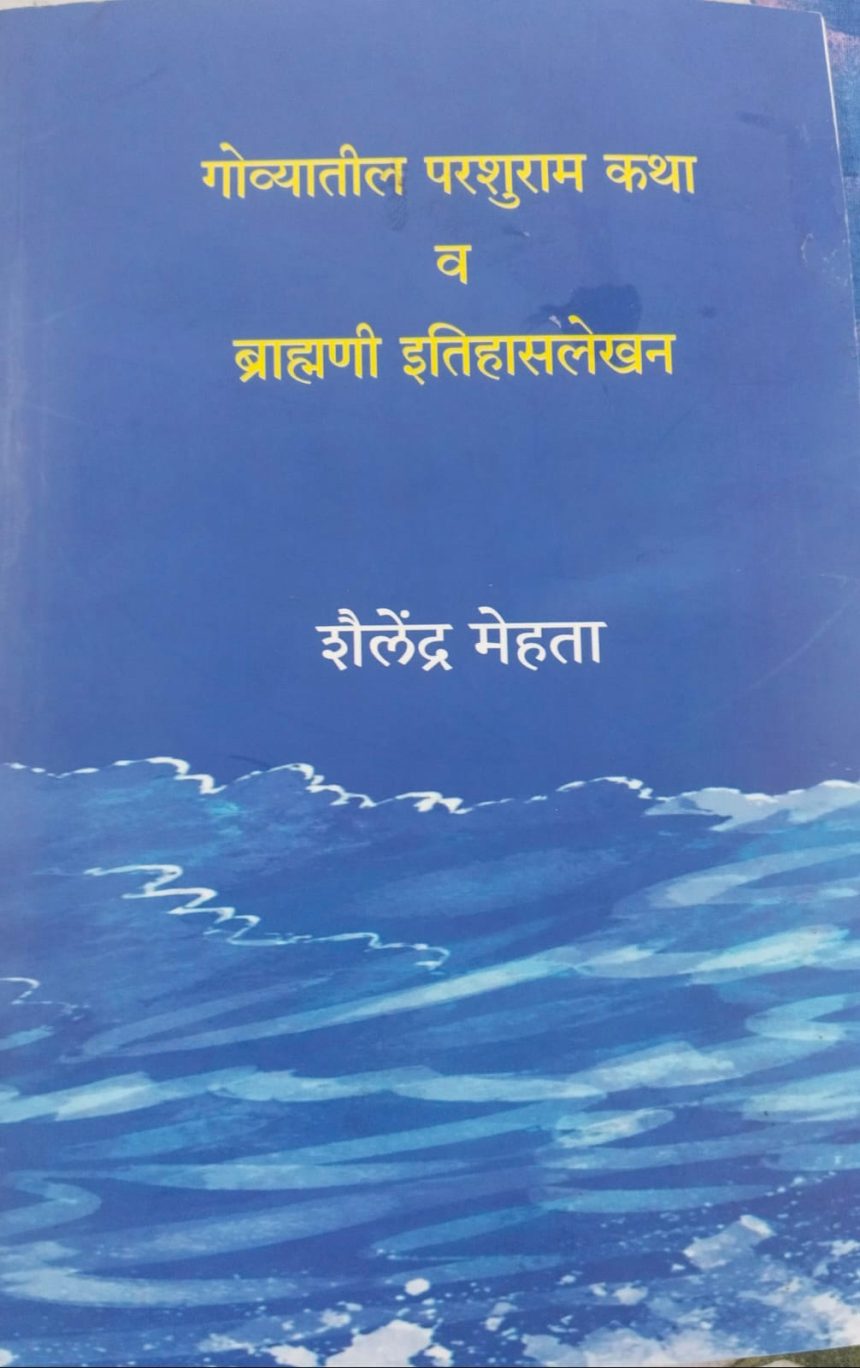
In his new Marathi book ‘Govyatil Parashuram Katha va Brahmani Itihaslekhan’, researcher
and writer Shailendra Mehta challenges the legend of Parashurama creating Goa
KALYANI JHA | NT BUZZ
For centuries, the story of Parashurama creating Goa by pushing back the Arabian Sea has been accepted as the origin of the Konkan coast.
According to this legend, a warrior-sage named Parashurama—revered as the sixth avatar of Lord Vishnu—reclaimed this land by shooting an arrow from the Sahyadri mountains into the sea. This territory subsequently came to be known as Gomantak (Goa). Furthermore, the legend posits that Parashurama invited Brahmins from North India—specifically the Saraswat Brahmins—to settle in this newly created land and to establish its religious and social institutions.
But in his latest book, ‘Govyatil Parashuram Katha va Brahmani Itihaslekhan’ (The Parashuram Legend in Goa and Brahminical Historiography), Shailendra Mehta argues that the legend belongs to mythology—not history—and that confusing the two has profound social and political consequences.
“Such myths must be examined not merely as cultural tales, but rather as ideological instruments embedded within systems of power,” he says adding that Parashurama myth is not merely an innocuous tale regarding the origin of the land.
“This myth forms part of a broader Brahminical historiography that sought to legitimise caste hierarchies, justify control over land, and erase the existence of indigenous communities that had inhabited Goa long before the emergence of these mythological narratives,” he explains adding that myths are created with a purpose, often to perpetuate the rule of certain groups. “These myths give a kind of divine legitimacy over the rights to land and nature to a certain community. Once people believe something is a divine right, they stop questioning it. That goes against the Indian tradition of
questioning everything.”
Mehta, in his book, attempts to differentiate between mythology and history. “History is a discipline based on evidence, while mythology carries cultural meaning. They are not the same,” he explains.
Mehta has his arguments aligned with ideas of scholars like D. D Kosambi, Dr. B. R Ambedkar, and Jyotirao Phule.
“I begin with D.D. Kosambi and his method of differentiating myth from history and explaining why myths are created. I have referred to Dr B.R. Ambedkar’s writings on how myths safeguard the interests of a particular class. I have also drawn upon Jyotirao Phule’s analysis of Indian history through mythology and the work of Gail Omvedt, who examined how history has been manipulated,” he shares.
Placing these ideas in Goa’s context, Mehta argues that the region’s history predates the Parashuram legend.
“Even before the Parashurama myth was created, Goa had its own ecosystem developed by communities such as the Velips, Gawdas, Dhangars, Kunbis and others. The Khazan lands, sluice gate systems and traditional water management reflect an extraordinary understanding of tides, monsoon cycles and agriculture. These systems required coordination between people living in the coastal belt, the plateaus and the Western Ghats. This was the result of centuries of collective wisdom,” he explains
Examining the historical evolution of the Parashurama narrative, he says, “The Parashurama story appears in the Sahyadri Khand of the Skanda Purana, which was written much later. Over time, these narratives were inserted into history in ways that made people believe they were not the original owners of Goa and the Konkan, but that someone else came from outside and created this land.”
The research for the book took nearly a year, says Mehta
”I worked in libraries and also used digitised archival material available online. I started with the basic premise of how and why myths are created, how they affect ordinary people, and how people who have nothing to do with these myths still accept them as divine truth,” he says.
Mehta says the book seeks to provide readers with a historical perspective rather than challenge personal faith.
“The book does not trivialise faith or religious belief. It simply clarifies the distinction between mythology as a source of cultural meaning and history as a discipline grounded in critical inquiry and evidence,” he says. “It encourages readers to reflect on how myths become accepted as historical truth and how they shape collective memory and public discourse.”
For Mehta, the debate is not about belief but about historical responsibility. “When societies fail to distinguish between myths and history, myths become dangerous. They cease to be mirrors of the past and become manuals for the present. Then ancient grudges are reborn as modern hatred. Statues become battle lines. Festivals become assertions of exclusion. Heroes become excuses,” says Mehta.
The book is intended for scholars, researchers, students, social activists, and general readers interested in Goan history, caste studies, South Asian historiography and cultural politics. It is organised thematically, allowing readers to engage with individual chapters independently. Every chapter is fully referenced.
Although the book has been published in Marathi, an English edition is already in the works.
“I deliberately wrote this book first in Marathi because I wanted to reach the people who have traditionally been the victims of this myth,” he says. “My effort is to awaken them from the Stockholm Syndrome the myth has created and help them understand their true place in shaping Goa›s history.”
(The book will be released on July 25, 4 p.m. at the conference hall of Institute Menezes Braganza, Panaji)