Dr. Nandkumar M. Kamat
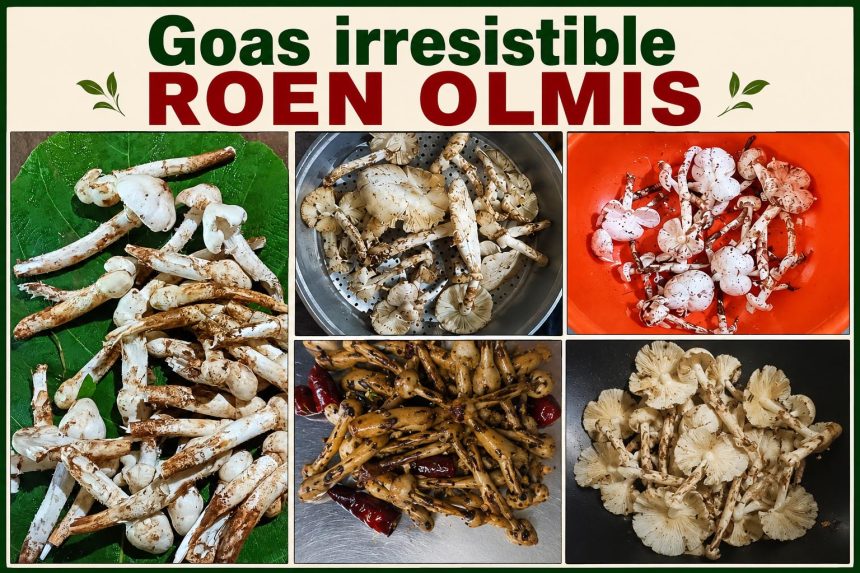
This article aims to investigate the biochemical basis of the strong craving observed among Goans willing to pay any price to taste local wild edible Termitomyces species or roen olmi.
Every monsoon, the first serving of roen olmi leaves even experienced mushroom lovers wondering why this wild delicacy tastes so satisfying. The answer lies in a sophisticated combination of natural chemicals that interact with specialised receptors on the tongue and neural circuits in the brain. Among edible mushrooms, the species of the genus Termitomyces possess one of nature’s most fascinating flavour systems, built around umami, the fifth basic taste. Unlike sweetness, sourness, saltiness, and bitterness, umami was recognised scientifically only in the 20th century. Umami is the pleasant savoury sensation associated with protein-rich foods such as meat, aged cheese, tomatoes, seaweeds, and mushrooms.
In Termitomyces, umami arises from the combined action of free amino acids, flavour-enhancing nucleotides, recently discovered taste-active peptides, and a rich bouquet of volatile aroma compounds—molecules that work together far more effectively than any single compound alone. The principal umami molecule is free L-glutamic acid or glutamate, an amino acid central to nitrogen metabolism and protein synthesis. Only its free, dissolved form stimulates umami taste; glutamate locked within proteins contributes little until digestion or cooking releases it.
The second contributor, L-aspartic acid (aspartate), produces a milder umami sensation. Although far less potent than glutamate, its presence broadens the savoury profile. The taste buds of the tongue contain receptor cells expressing a protein complex called T1R1-T1R3, which is the principal umami receptor. When free glutamate dissolved in saliva binds to this receptor, it triggers a change in the receptor structure, activating intracellular signalling involving G-proteins, phospholipase C, inositol triphosphate, and calcium release. The resulting increase in calcium levels prompts ATP release, which excites nearby sensory nerve endings. Signals travel via the facial, glossopharyngeal, and vagus nerves to the nucleus tractus solitarius of the brainstem, then through the thalamus to the gustatory cortex. Higher centres, including the orbitofrontal cortex, integrate taste with smell, texture, and memory to produce the perception of deliciousness. This entire cascade, from the first touch of saliva-dissolved glutamate on the tongue to the conscious awareness of flavour in the cortex, unfolds within a fraction of a second, illustrating how tightly evolution has coupled chemistry to sensation.
One clarification is that glutamate is the brain’s principal excitatory neurotransmitter, but dietary glutamate from mushrooms does not cross the blood-brain barrier and directly stimulate neurons. The pleasure of eating roen olmi comes from glutamate acting on taste receptors in the mouth, not from any neurological effects after digestion. Glutamate alone cannot explain the exceptional flavour of mushrooms; otherwise, many foods would taste equally rich. Termitomyces owes its distinctive quality to the accompanying flavour nucleotides, particularly guanosine-5’-monophosphate (5’-GMP), along with inosine-5’-monophosphate (5’-IMP), xanthosine-5’-monophosphate (5’-XMP), and other ribonucleotides in smaller amounts. These produce a striking biochemical synergy: individually mild, but together with glutamate, they dramatically increase the umami receptor’s sensitivity, so a small amount of glutamate yields an outsized savoury impact. This synergy explains why mushroom extracts enrich soups and sauces far beyond what their quantity alone suggests.
Recent research adds another layer to this discussion. Scientists studying Termitomyces intermedius and a related Chinese species isolated 10 naturally occurring peptides capable of stimulating umami perception, as confirmed by electronic tongue analysis and molecular docking studies that showed interactions with the T1R1-T1R3 receptor. This finding expands the classical view that mushroom umami depends solely on glutamate and nucleotides; peptides are now recognised as a third class of flavour-
contributing molecules.
Taste, however, is only part of the story: nearly 80% of the perceived flavour comes from smell. As roen olmi is chewed, volatile compounds travel retronasally to olfactory receptors, and the brain merges these signals with taste into a unified perception. Chemical analysis has identified numerous volatiles in Termitomyces, notably eight-carbon compounds from linoleic acid oxidation, including 1-octen-3-ol, the classic “mushroom alcohol”, as well as 3-octanone, 3-octanol, and related ketones, lending earthy, woody, and nutty notes. Metabolomic studies have also found terpenes—alpha-pinene, camphene, and D-limonene—contributing resinous, herbal, and citrus nuances, respectively.
Cooking further transforms this chemistry. Heat breaks down chitin- and glucan-based fungal cell walls, releasing soluble glutamate, nucleotides, and peptides. Proteins hydrolyse to release additional amino acids; and RNA degrades to release additional flavour nucleotides. Amino acids then react with reducing sugars via Maillard reactions, generating pyrazines, furans, and aldehydes responsible for roasted, nutty, and caramel-like notes, making cooked roen olmi substantially richer in flavour than the raw mushrooms.
Texture also plays a role. Young Termitomyces biomass is both elastic and tender. Continuous cell rupture during chewing gradually releases flavour compounds rather than in one burst, prolonging sensory stimulation and enhancing flavour persistence.
Beyond taste, Termitomyces has drawn interest from natural product chemists for its unusual bioactive molecules, most notably cerebrosides called termitomycesphins, first isolated from Termitomyces albuminosus. These glycosphingolipids induced neurite outgrowth in cultured PC12 nerve cells, and their biological activity was linked to the hydroxylation patterns of their sphingoid bases. This discovery reflects the biochemical sophistication of Termitomyces, rather than a proven therapeutic benefit. Like many mushrooms, Termitomyces contains polysaccharides, sterols, phenolics, and antioxidants that exhibit antioxidant, antimicrobial, or anti-inflammatory activities in laboratory studies. However, these typically involve concentrated extracts under controlled conditions and cannot be assumed to translate into health benefits from regular cooking and eating.
Sound science requires distinguishing promising laboratory findings from clinically demonstrated outcomes. Neuroimaging shows that pleasant flavours activate reward-related brain regions—the orbitofrontal cortex, anterior cingulate cortex, and limbic structures—that evaluate a food’s biological significance. Umami-rich foods trigger strong activation because they signal amino acids and proteins, which are essential nutrients throughout vertebrate evolution. Thus, the human nervous system has evolved to respond positively to molecules abundant
in Termitomyces.
The extraordinary flavour of roen olmi is, in this sense, a remarkable example of evolutionary convergence between fungal metabolism and human sensory biology. Mushrooms produce glutamate, aspartate, nucleotides, peptides, and aroma compounds for their physiological needs; human senses, shaped to detect nutrient-rich food, interpret this combination as deeply rewarding. Neither organism evolved for the other, yet their chemistries align to create one of nature’s finest
culinary experiences.
It is worth remembering that roen olmi is not merely a laboratory subject but a living thread in Goa’s ecological and cultural fabric, gathered seasonally from termite mounds through knowledge passed down across generations of foragers who had no knowledge of its ecology, diversity, biology, or biochemistry. My student, Dr. Rosy Agnes De Souza, made the pioneering discovery of melanin in these species and characterised it. This edible fungal melanin has numerous useful properties. Before her, nobody knew the origin or chemical nature of the dark pigments in the roen olmis of Goa or the rest of the world.
Advances in metabolomics, sensory neuroscience, molecular docking, and AI-assisted flavour prediction continue to reveal chemical interactions previously unknown only a decade ago, and future research will likely uncover additional flavour-active molecules in Termitomyces. What was once simply called delicious is now understood to be a highly sophisticated biochemical system in which metabolites communicate directly with the receptors in the human tongue and nose. Roen olmi, then, is far more than a seasonal wild mushroom—it is a naturally engineered chemical factory of amino acids, nucleotides, peptides, and volatiles engaging one of the body’s most refined sensory networks. Every mouthful illustrates how evolution, biochemistry, and neuroscience converge to create flavour: the irresistible taste of roen olmi is the harmonious interaction of hundreds of natural molecules with exquisitely sensitive receptors and neural circuits shaped over millions of years. No doubt, Goans have been addicted to these species for generations.