NT Reporter
Panaji
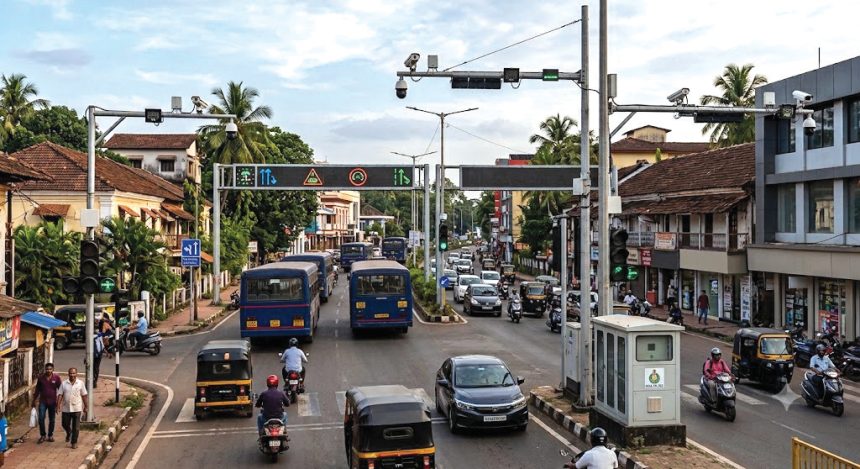
After months of public awareness campaigns, software calibration and repeated extensions to its trial phase, Goa on Saturday formally launched AI-based traffic enforcement, with automated cameras across state beginning to issue electronic challans to motorists violating traffic rules.
The rollout marks a significant step towards technology-driven policing aimed at improving road safety and reducing human intervention in
traffic enforcement.
The AI-enabled cameras, installed at 26 key junctions and road stretches, will automatically detect violations such as riding without a helmet, driving without wearing a seat belt, using mobile phones while driving, overspeeding, wrong-side driving, dangerous overtaking, illegal parking, triple riding, carrying passengers in goods vehicles and vehicles displaying non-standard
registration plates.
Once verified, the system generates an electronic challan linked to the vehicle owner’s registration details. Every challan is backed by photographic or video evidence captured by the AI cameras, reducing the scope for disputes while ensuring uniform enforcement across the state.
Although the project was originally expected to begin penalising violators earlier, the government repeatedly postponed enforcement, choosing instead to keep the system in
observation mode.
Officials said the decision was taken to allow motorists sufficient time to familiarise themselves with the new technology, while engineers fine-tuned the AI software to minimise errors and improve the accuracy of vehicle and
violation detection.
Transport Minister Mauvin Godinho had earlier maintained that the objective of the project was not to impose penalties immediately but to bring about a behavioural change among road users through awareness and voluntary compliance before enforcement commenced.
During the trial period, the cameras recorded tens of thousands of violations every day, underlining the extent of traffic indiscipline on Goa’s roads. According to the Transport Department, the number of daily violations declined sharply during the awareness phase, prompting authorities to describe the exercise as a success.
Transport director Arvind Khutkar said the two-month trial achieved nearly 80 per cent compliance, giving the department confidence to activate the automated challan system.
“The purpose of AI enforcement is to instill road discipline and save lives. The encouraging response during the trial phase showed that awareness alone can significantly reduce violations. Now that motorists are familiar with the system, enforcement has begun,” Khutkar said.
He said data collected during the trial revealed that tourists and out-of-state vehicles accounted for the highest number of traffic violations, followed by taxis and rent-a-cars, while only around five to 10 per cent of offences involved locally registered vehicles.
Goa currently has over 14.5 lakh registered vehicles, making manual enforcement increasingly challenging.
Officials said another reason for extending the trial period was to ensure seamless integration between the AI cameras, the central enforcement software and the VAHAN vehicle registration database so that challans could be generated accurately and delivered without technical glitches.
Authorities also used the period to verify the precision of the cameras under varying traffic and weather conditions before activating automated enforcement.
The AI surveillance system is expected to complement the work of the traffic police rather than replace it. While cameras will automatically detect and process routine violations, on-ground personnel will continue to manage traffic, respond to accidents and enforce offences that require physical intervention.
With the grace period now over, authorities have appealed to motorists to strictly follow traffic regulations, emphasising that the initiative is intended to reduce accidents and promote safer roads rather than serve as a revenue-generating exercise.