At the Museum of Goa, ‘A Voyage to Permanence’ invites audiences to experience cinema through images, sound, silence, and stillness
VINIKA VISWAMBHARAN
NT BUZZ
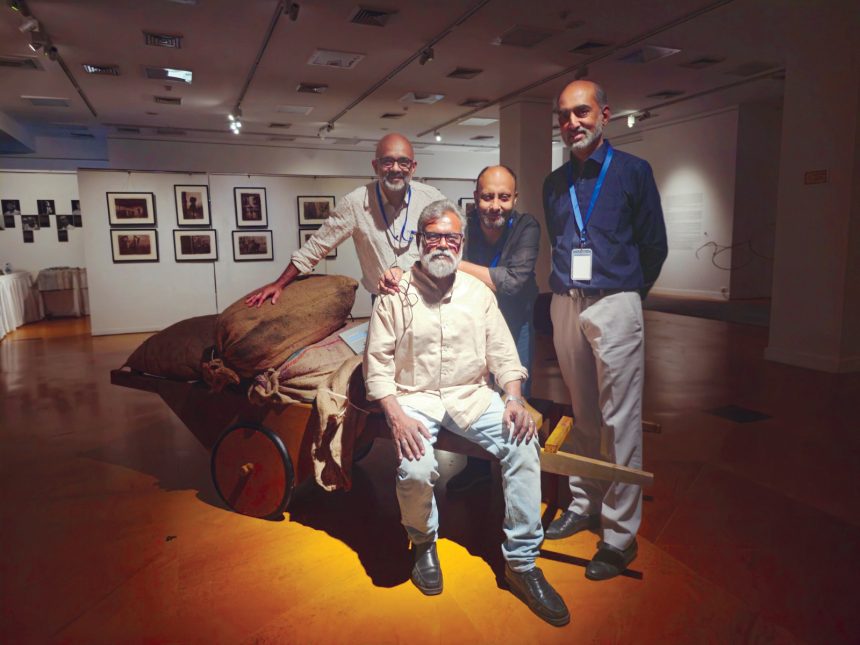
What happens when cinema moves beyond the screen? ‘A Voyage to Permanence’ explores that question through film, photography, sound and visual essays, bringing the work of independent filmmaker and multi-disciplinary artist Purandar Chaudhuri to the Museum of Goa, Pilerne, from August 12 to 14.
Conceived by Jooby Yohannan and curated by art critic and curator Johny ML, with exhibition visuals by Prakash Braggs, the exhibition centres on three of Chaudhuri’s experimental films, ‘Impressions of Mingling’, ‘Tremors’, and ‘Dhushor’. While the works deal with migration, labour, displacement, survival and impermanence, they do not approach these subjects through conventional documentary storytelling. Instead, Chaudhuri works with monochromatic imagery, silence, abstraction and stillness, creating films that occupy a space somewhere between cinema and visual art.
For Chaudhuri, this approach comes from a desire to strip away visual distractions. “I believe monochromatic imagery helps us to de-clutter our minds, lending a certain depth to our thoughts and emotions,” he explains.
Rather than presenting the films as isolated screenings, the exhibition places them within a larger visual environment where audiences can move between images, prints, and moving pictures.
The conception of taking the films into an exhibition space began with Yohannan. After being introduced to Chaudhuri through their common friend Akumal Ramachander, Yohannan was sent ‘Dhushor’, Chaudhuri’s first film, with a specific instruction to watch it in a dark setting. What struck him was the visual quality of each frame. “Each frame was a photograph by itself,” recalls Yohannan. That experience led to the idea of showing the film alongside photographic prints of its frames.
According to Yohannan, the exhibition format changes the relationship between the viewer and the film. “Presenting the work as an exhibition allows audiences to spend time with the ideas surrounding the film, engage in conversation with Purandar, Prakash, Johny and share the experiences in a broader artistic context,” he says.
After being introduced to Chaudhuri’s work, ML began to see the films as something that could exist beyond the cinema hall. “I felt that these were not ‘films’ in the conventional sense, but extended forms of video art that demanded more than a traditional projection space,” he says.
His curatorial approach is consequently designed to give viewers greater freedom. Rather than requiring audiences to sit through a film from its opening frame, the works can be entered at different points and experienced at the viewer’s own pace. “This creates a form of viewer-led editing,” ML explains.
The three films also represent different facets of Chaudhuri’s concerns. Although he does not consider them a deliberately planned trilogy, he says they are connected by his core sensibilities. “Each film acts as an empathetic bridge to a different form of human isolation,” he says. “Whether navigating historical ruins, the silent agony of old age, or the invisible lives of the marginalised, I tried capturing the quiet, often overlooked realities of existence.”
Those concerns are rooted partly in Chaudhuri’s own observations of movement and displacement. Watching people at railway stations, bus depots, markets and narrow roads made him think of the struggles of his ancestors, who were forced to move to a new city following the Partition.
“Displacement continues,” he says. “People cross borders, move into new places, endure great physical and emotional pain, out of desperation but also with hope; hope of better and safer life and a fair world.” He was also influenced by the works of Satyajit Ray, Ritwik Ghatak and Mrinal Sen.
The exhibition will unfold differently each day. On August 12, ‘Impressions of Mingling’ will be screened continuously alongside photographic works and alternative prints. On August 13, ‘Tremors’ will be presented in the exhibition space. The final day will feature ‘Dhushor’ in the museum auditorium, followed by an interaction with members of the creative team.
The exhibition will include the launch of the Goa Cyanotype Notebook. The project celebrates alternative photographic processes, with Braggs’ experience in cyanotype and kallitype printing contributing another layer to the exhibition’s exploration of how images can survive beyond the screen. A conversation around the photobook will feature journalist and writer Jayanth Kodkani and visual artist, curator and INTACH Mangaluru founding member Nemiraj Shetty.
Ultimately, the collaborators hope visitors will resist the impulse to rush through the exhibition.