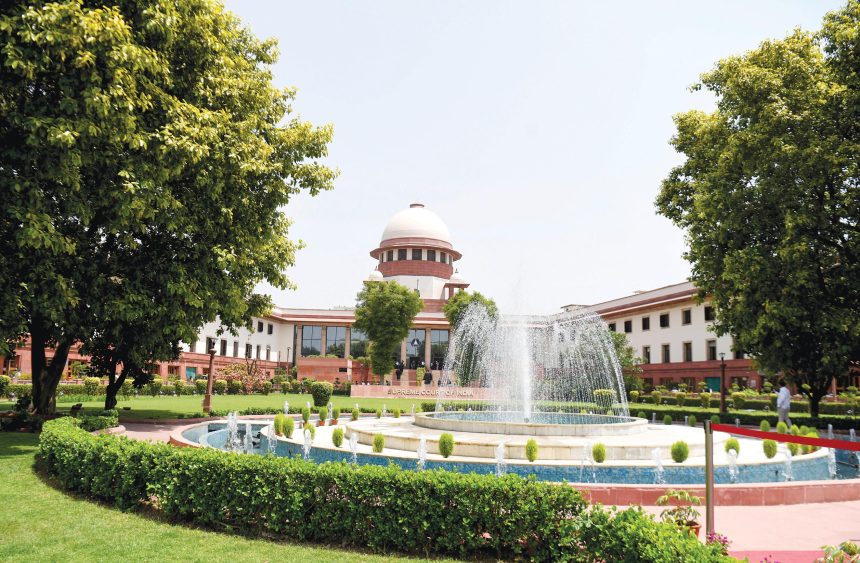
PTI
New Delhi
A “conscientious objector” should not be punished for refusing to sing Vande Mataram, the Supreme Court told the Centre on Tuesday while asking it to keep in mind a 1986 judgment protecting children who said no to singing the national anthem on grounds of conscience.
The bench headed by Chief Justice of India Surya Kant was hearing a petition by Carnatic vocalist T M Krishna challenging the law mandating singing of all six stanzas of Vande Mataram, arguing that the last four verses violate the secular character of the nation.
Seeking the Centre’s response on the plea, the bench, also comprising Justices Joymalya Bagchi and V Mohana, said it would expect the principle laid down by the apex court’s 1986 judgment in the Bijoe Emmanuel vs State of Kerala to govern the amended law.
In that case, the court protected schoolchildren who respectfully declined to sing the national anthem on grounds of conscience.
“… We are not inclined to issue notice. But we would expect that the law of the land, as declared by this court in Bijoe Emmanuel, will govern the (amended) Act,” Justice Bagchi observed orally while addressing Solicitor General Tushar Mehta.
“What is the national song is not in dispute. The declaration of law in the Bijoe Emmanuel is not yet questioned. It is for the democratic state to decide what is the national song, whether two stanzas or four stanzas. But nobody who feels an infraction of Article 25 and 26 rights (fundamental right to freedom of religion) or a conscientious objector would be subjected to (penal consequences),” Justice Bagchi said.
Krishna’s petition challenges Section 3 of the Prevention of Insults to National Honour Act, 1971, amended in 2026, along with Ministry of Home Affairs orders dated January 28 and July 9, 2026.
The amended Section 3 provides for imprisonment of up to three years, or fine, or both, for anyone who intentionally prevents the singing of the National Anthem or national song, or causes disturbance to an assembly engaged in such singing.
Justice Bagchi said it is not the remit of the court to second guess what are the national sentiments or aspirations associated with Vande Mataram. That, he said, is for the state to decide.
The bench also indicated that it is not for the court to determine what constitutes the national song, saying it would examine whether the rights of a “conscientious objector”, particularly one who declines to sing on religious grounds, are protected under the law.