‘Phytoplankton World’ opens up a larger story about oceans, climate, and our relationship with nature
VINIKA VISWAMBHARAN
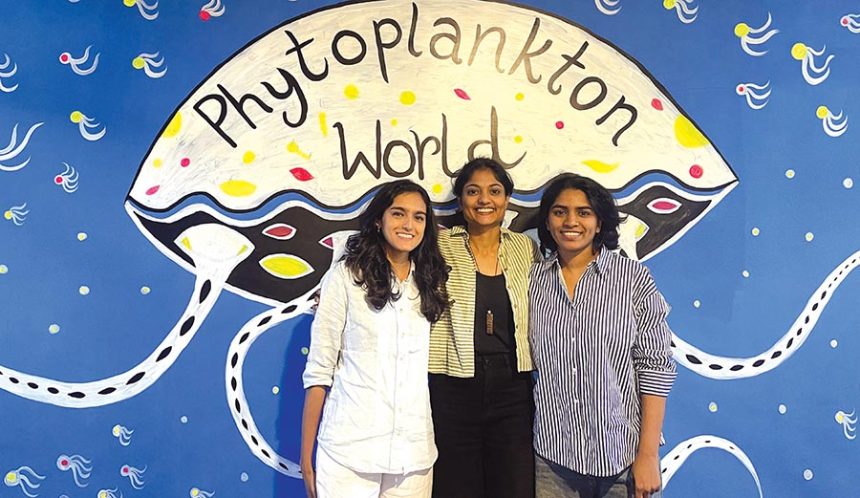
An immersive installation in Panaji is inviting viewers to explore a world that is usually invisible to the human eye. ‘Phytoplankton World: The Unseen Heroes of Marine Life – Edition 2’, created by the Children’s Art Studio at the Museum of Goa, Pilerne, is on at the Old GMC Complex until October 4 from 10 a.m. to 5 p.m.. Through glow-in-the-dark artworks, coral-like structures, storytelling and hands-on activities, the free installation introduces visitors to phytoplankton and their role in marine ecosystems.
For the director of the Museum of Goa and co-founder of the Children’s Art Studio, Sharada Kerkar, the idea began with an unexpected sight on the water. Three years ago, while kayaking at night in Vasco, Kerkar noticed the sea glowing green and blue as she disturbed its surface. “That experience left me with a deep sense of curiosity,” she recalls. “I had suddenly encountered something that was invisible to me but was very much alive and essential to the world around me.”
The more she learned about these tiny organisms, the more she was struck by how far they travel. “They go wherever currents and winds take them, crossing oceans and borders without passports. They are natural wanderers and global citizens,” she says.
Their importance, however, extends far beyond their size. “They contribute around 50% of the oxygen we breathe, form the foundation of marine food webs, help sustain ocean biodiversity, and play a role in regulating the Earth’s climate,” Kerkar explains.
Her learning gradually became ‘Phytoplankton World’, an attempt to introduce children to this invisible world through art, imagination, and experience rather than a textbook or lesson.
While the first edition was part of the Serendipity Arts Festival last year, the second edition takes the idea further, nearly doubling the size of the first, going beyond phytoplankton to explore their place in the marine food chain, with a larger coral environment and a wider range of phytoplankton forms. Discarded materials also take on new life. Plastic bottles collected from Goa’s beaches have been painted and cut to resemble coral, while textiles, pipe cleaners and fibreglass waste have been repurposed across the installation. “If visitors look closely, they can recognise the bottles within the artworks,” says Kerkar. The aim, she adds, is to show how waste can be transformed into something that sparks curiosity.
Creating the underwater world began with research into the forms and structures of phytoplankton as seen under a microscope. Kerkar worked with architect and educator Tincy Paulose and illustrator and artist P. S. Soorya to translate those tiny forms into a space children could enter. Through sketches, 3D visualisations and architectural models, the team worked out how the space would flow before experimenting with glow-in-the-dark materials and tactile surfaces.
The biggest challenge was making something invisible feel tangible without reducing it to a science lesson. “We did not want to simply make large versions of phytoplankton and present them as scientific diagrams,” says Kerkar. Instead, art, light, texture, movement and storytelling were used to encourage children to explore and imagine.
The team working on the project was trained in storytelling for different age groups, while the information panels were deliberately kept simple. “Science can become complex very quickly, particularly when you are talking about microscopic organisms, ecosystems and climate,” she says. “Our approach is to keep the information simple, relatable and connected to things children can see, imagine and experience for themselves.”
The second edition has also been shaped by what the team observed during the first. Visitors now move through the installation in timed slots with guided tours, allowing the experience to be accompanied by conversation and storytelling. They can also draw in a glow sand pit, paint marine creatures at a glow-painting station and add their work to a growing wall of artworks.
She notes that responses from children to the first edition offered some clues about what stayed with them. “Many go back wanting to see the bioluminescence in the ocean for themselves,” says Kerkar. Some surprised the team by sharing scientific names of phytoplankton they already knew, while others spoke about scuba diving or wanting to learn to swim so they could see colourful corals.
“And then there are children who simply leave excited by the realisation that we live in such a cool world,” she says. That sense of wonder is central to how Kerkar sees the exhibition. “I don’t want children to enter an experience feeling that they are being taught a lesson about environmental damage,” she says. “I want them to first experience wonder. To see something, ask questions, make connections, and develop their own curiosity.”