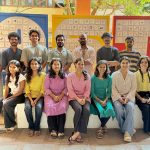
Four artists bring ancient myths, family tales, and cultural memories into conversation in their new art show
VINIKA VISWAMBHARAN
What makes a story survive generations? At ‘Fable Horizons: Framing Myths’, four artists examine how myths and fables shape the way we see, understand, and organise the world around us.
Presented by Camões-Centro de Língua Portuguesa and the Consulate General of Portugal in Goa, the exhibition brings together Run Jiang, Luís Almeida, Ryan Francis Abreu and Karishma D’Souza, with works rooted in Chinese mythology, Portuguese visual narratives, current global events, and Goan stories and memories.
The project was collectively proposed by the four artists, who wanted to explore mythology through different cultural perspectives. It is this meeting of ideas that makes the exhibition particularly interesting for the director of Camões-Centro de Língua Portuguesa in Goa, Delfim Correia da Silva.
“There are no borders or frontiers for art or music,” he says, describing the exhibition as an opportunity to bring different traditions and mythologies into conversation. “Although we are living in different continents, speak different languages and have different religions, probably, the traditions and cultures are quite similar.”
That similarity is something Jiang began noticing while working on her series drawn from a famous ancient Chinese text of of mythic geography and beasts, ‘Classic of Mountains and Seas’, also known as ‘Shan Hai Jing’. Comparing its stories with myths from other civilisations, she noticed recurring flood narratives and human-serpent figures. The parallels made her question how firmly myth and fiction can be separated. “Could they, in fact, be different civilisations’ varying accounts of the same event or figure?” she asks.
Her interest in mythology began with the illustrated books she read as a child. “I have maintained a skeptical yet open-minded attitude toward mythology,” she says. Using Chinese ink, watercolour and calligraphy as her main expression technique, she aims to make the mythical figures feel almost real. The choice of these mediums also connects the series to the visual traditions of her own culture while bringing the ancient figures into a contemporary setting.
If Jiang is interested in whether myths might contain traces of reality, Almeida turns the fable into a way of looking at power in the present.
His drawing began with a giant figure, wearing a Machiavellian sneer, crushing smaller people beneath his finger “as if they were ants”. “They were carrying their homes on their backs,” he says, as the artwork is influenced by the situation of Palestinians in the Gaza Strip and the disproportionate power some individuals hold over the public.
For the ending, Almeida flips the balance of power, with the giant pausing to listen as the smaller figure begins to tell a story.
“I felt I should invert the power dynamic between them, mediated through the gift of words and storytelling,” he says. Almeida believes, storytelling itself can be a form of power. “Often, we convey meaningful messages about the world around us not in a literal way, but through fantastic, absurd, emotional, and other types of narratives.”
Stories also carry memory, humour and family history. D’Souza draws on all three, bringing Goan folk tales, family stories, Biblical parables, Kabir’s dohas and tales from her father’s career as a master mariner into her paintings.
There is humour in many of these memories, especially the exaggerated family stories she grew up hearing. But D’Souza is also interested in how stories evolve into accepted truths. “The works are about the politics of myth making, to what end has a myth been made?” she asks, exploring the line between fact and fiction.
Abreu looks at that process through “the everyday”. Working with drawing, lithography and etching, he draws from stories and memories he has carried with him. “I am interested in beliefs, death, rituals, people and animals, as well as the darker or humorous side of these stories,” he says.
His works, he says, are visual fables based on familiar stories and experiences. But he does not want to dictate what viewers should find in them. “I leave some space for the viewer to find their own in them,” says Abreu.
Across the exhibition, the four different artistic approaches look at old stories becoming entry points rather than subjects to simply reproduce. For da Silva, this exchange also expands the role of the centre beyond language and literature. “With only one country, you don’t have the same inter-cultural dialogue,” he says, seeing the meeting of different artistic traditions as a way to create conversations that language alone cannot. “The dialogue is interesting, and culture can help to establish a better relation between all the countries and all the cultures.”
(‘Fable Horizons: Framing Myths’ is on view at Camões-Centro de Língua Portuguesa, Casa Basílio Dias, Panaji, until November 7, from 10 a.m. to 1 p.m. and 3 p.m. to 6 p.m.)