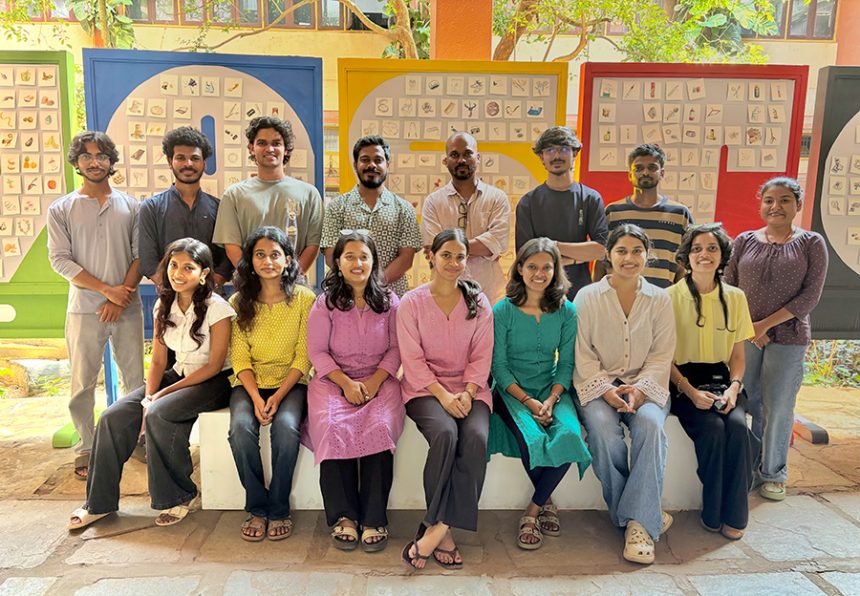
A waste segregation installation titled ‘Discard Decoded’, at the Goa College of Art, Altinho, welcomes visitors to participate in a hands-on learning experience that combines art, education, and environmental activism
KALYANI JHA | NT BUZZ
In alignment with Gandhi Jayanti’s principles of sustainability and community responsibility, the masters students of Goa College of Arts, Altinho, have put up an installation that transforms waste segregation from a mundane practice into an engaging, artistic dialogue.
“‘Discard Decoded’ is an attempt to convert responsibility into action through creativity. By learning and realising to separate waste correctly, each visitor contributes to a cleaner campus and a healthier environment,” says assistant professor Dattaraj Naik who guided this project.
His vision was to create a platform where students could engage with real-world environmental challenges through their artistic practice. “It was a mini project in my master’s programme, where students were given different topics to work on community engagement practise. One of them was waste management. After discussion, we thought instead of making posters, we could make installations and involve all the college students,” says Naik, a specialist in graphic design, street art, and community engagement art activities. He has done multiple public art projects with St+art India Foundation.
To ground this project in real-world understanding, the students also visited a local trash collection and segregation centre. “This ensured that the installation was not merely theoretical but rooted in practical, lived experience,” he says.
As part of the installation which opened to the public on Gandhi Jayanti, the students have put up five panels with the five alphabets – W, A, S, T, E. “W is for wet, A is for arid, that is dry waste, then S is for sanitary waste, T is for toxic waste and E is for electronic waste,” explains Naik. The students, he says, collectively sat together and made about 300 drawings on small paper, cards, which visitors then have to put under the right category.
Through interactive stations and guided activities, participants learn the importance of waste segregation while understanding its direct impact on environmental preservation and the labour of sanitation workers.
“There are also the display of posters created in collaboration with the Goa State Pollution Control Board (GSPCB) and Act for Goa which were originally unveiled during Climate Week India 2025,” shares Naik.
There are now plans to expand documentation, including behind-the-scenes content, video reels, and participant testimonials which will be shared on digital platforms in the coming weeks. Naik adds that the project underscores the role of art education institutions in fostering civic responsibility and environmental consciousness among common citizen.
Student project collaborators : Aditi Nagesh Komarpant • Ashlesha Abhinay Naik • Farah Anjali De Souza • Gunjan Pritam Naik • Mudrika Eknath Chari • Saidyna Shashikant Malekar • Jostan Fernandes • Mohit Kamlesh Vishwakarma • Pradnya Shridhar Parab • Sneden Francis D’souza • Sonia S Maulingkar • Sejal Anant Parsekar • Amisha Vijay Harmalkar • Harish Ladu Kudaskar • Eerawati Kulkarni • Shubham Dinesh Gaude
(The installation is open to the public until October 9 from 10 a.m. to 5 p.m.)