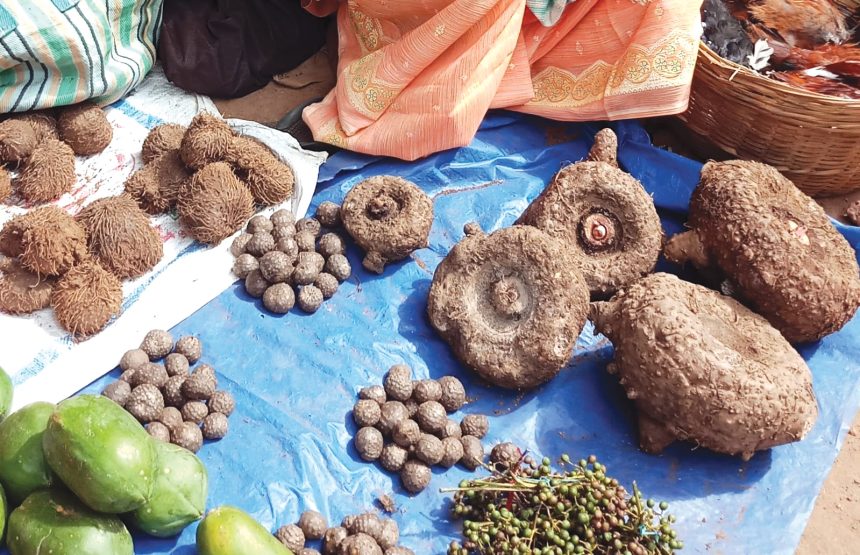
Deficit monsoon has not affected the tuber crop in the state much to the relief of farmers dependent on them for livelihood, writes Bhiva P Parab
This year the rains are less, however tubers being a hardy crop have withstood the adverse climatic condition, according to farmers.
They said that, the 31.7 per cent rain deficit this year is a cause of worry however, the tuber crop does not spoil easily in too much rains or during a dry spell. The only condition for a good yield is proper care of the seed so that it is available for cultivation in the next season. As such farmers said that, they have to ensure their own seed supply for growing tubers.
In the state tubers have begun appearing in the markets several days back and will continue to arrive in larger numbers in the coming weeks. Vendors disclosed that demand for the locally grown tubers is good among residents. They revealed that, tubers also arrive from outside states from neighbouring districts.
Tubers which are good for health have been eaten for generations by Goans. There are various varieties of tubers such as maddi (colocasia tuber) and churana (elephant foot yam).
An elderly consumer Radhika Naik said, “Tubers in general are good for health and I feel local tubers are even better as they are grown without any chemical fertilisers. Unfortunately tuber cultivation is decreasing due to urban development as fields are getting destroyed. In the past during our younger days at this time of the year we were dependent on wild vegetables and tubers. In recent years the tuber supply is from outside Goa.”
It may be noted the price of the tubers generally depend on the size and quality and also the market demand. Generally churana is priced at around Rs 100 to 150 a kg depending on the quality. In some localities where the churana is of small size, the cost is somewhere between Rs 80 to 100 per kg. Large sized churna is priced at around Rs 350 to
Rs 500 per kg.
Among tubers the demand for Kate Kange (hairy potatoes) is robust, according to farmers. Vendor Shakuntala said, the selling price of the Kate Kange depends on its size. Usually the bigger Kate Kange have better taste and 8 to 10 bigger ones are sold at Rs 100, while around 10 to 15 smaller ones are sold for Rs 100. Some vendors even sell Kate Kange in kg., and price it at around Rs 80 to Rs 100 a kg.
The rates vary according to the demand and supply, said vendors. Another vendor said, “In the city markets the tubers are little costly than the local village markets due to
transportation cost.”
Another favourite tuber in the state is maddi which is sold at Rs 80 to Rs 250 depending on the size. There is another variety of tubers called the karanay muna, which is also priced at around Rs 80 to 100 a kg.
There is scope for commercial cultivation of tubers in the state and the government is also supportive to the farmers cultivating the tubers and it is the younger generation who should come forward and take interest in the farming activities and work in the agricultural field and if they come forward the tuber cultivation could be done on large tracks of land.
Tubers in Goa are grown across upland (Morod) soils and forest fringe areas. They are highly suitable for cultivation in the state’s lateritic soils.
Tubers are relished by Goans, and they are also a source of income for farmers. Their cultivation needs to be promoted as they combine nutrition with taste. A major advantage of tuber cultivation is that they give more yield in less space and less time. According to agricultural scientists, tuber crops are unique in themselves because they provide more food in
a small space.
More spotlight is needed on tubers in the state through food festivals, etc.
The Government College of Arts, Science & Commerce, Sanquelim, in February this year had held an exhibition on Tubers of Goa, showcasing indigenous varieties and traditional knowledge. The exhibition highlighted the rich diversity of indigenous tuber crops of the state. It aimed to create awareness about their nutritional value, traditional uses, and importance in sustainable food systems. Students gained valuable insights into Goa’s agricultural heritage at the
tuber exhibition.