PTI
Jerusalem
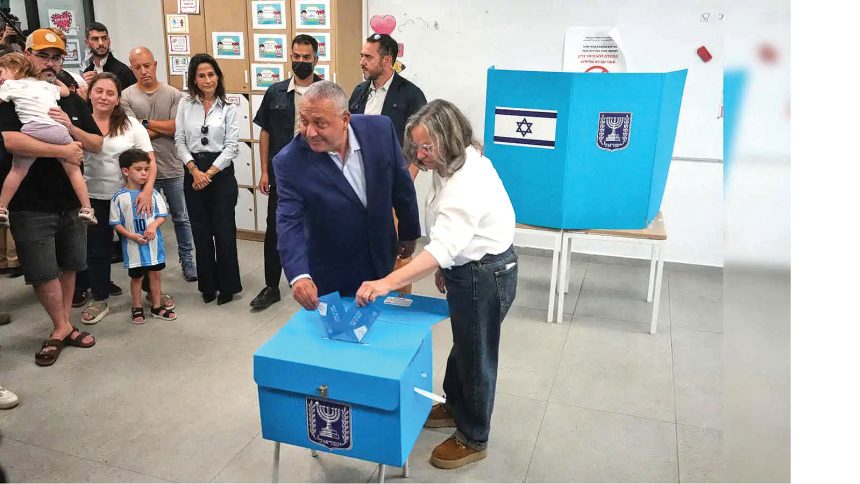
Israel faces three possible scenarios, including formation of a national unity government, if neither Prime Minister Benjamin Netanyahu nor his main challenger Gadi Eisenkot gets a majority in Tuesday’s crucial parliamentary polls, according to experts.
A political party or coalition of parties must secure support of 61 lawmakers needed for a majority in the 120-member Knesset, Israel’s parliament.
Senior Israeli journalist and political commentator Yaron Deckel outlined three possible scenarios, saying the outcome would depend on the final seat tally and the ability of rival camps to secure support from smaller parties, including Arab-led groups.
With 34 parties contesting the election, Deckel says the result may hinge not only on the seats secured by the main blocs but also on post-poll negotiations.
A party must secure at least 3.25 per cent of the vote to enter parliament. The threshold encourages smaller parties to form pre-poll alliances, while the proportional system allows multiple parties to win seats.
Netanyahu, the leader of the right-wing Likud party, is seeking another term after a period marked by the October 2023 attack that led to the killing of around 1,200 people, the subsequent Israeli military campaigns in Gaza, Lebanon and Iran, and a long-running corruption trial.
Netanyahu, 77, faces charges of fraud, breach of trust and bribery, which he denies. The International Criminal Court issued an arrest warrant for him in 2024 over alleged war crimes and crimes against humanity.
His main rival, 66-year-old former army chief Eisenkot, has previously served as an observer in Netanyahu’s war cabinet but resigned after criticising the government for lacking a clear war strategy. Naftali Bennett, a former premier, is another prominent opposition figure. He is leading an alliance with centrist Yair Lapid. Bennett, a right-wing politician, has also criticised Netanyahu’s handling of security and governance.
Bennett served as prime minister in 2021 under a power-sharing arrangement with Lapid.
Other political players include Yair Golan’s Democrats, Avigdor Liberman’s Yisrael Beiteinu and Arab-led parties such as Ra’am and the Joint List.
Netanyahu’s potential partners include far-right parties led by Itamar Ben-Gvir and Bezalel Smotrich, along with ultra-Orthodox parties.
Deckel said neither the opposition camp nor Netanyahu’s bloc appeared positioned to reach the 61-seat threshold on its own.
The figures leave both sides dependent on smaller parties and potential coalition partners. Arab parties could play an important role in determining whether an opposition candidate can secure the parliamentary backing needed to form a government, Deckel told reporters in Jerusalem.
The first possible outcome is a political deadlock in which neither side can assemble a viable coalition.
Deckel said competing commitments made during the campaign could make it difficult for parties to reach an agreement, warning that prolonged uncertainty would be damaging given Israel’s security situation.
After the results are in, President Isaac Herzog will consult political factions and appoint a lawmaker considered to have the best chance of forming a coalition.
The nominee has up to 42 days to assemble a government with the support of at least 61 lawmakers. If the attempt fails, another candidate may be given the opportunity; if no government can be formed, the country may have to hold another election.
A second possibility is a minority government. Arab parties could recommend a candidate to the president without formally joining the government, helping the candidate receive the mandate to attempt coalition formation, according to Deckel.
Deckel said such a government could still fall short of a stable parliamentary majority. While Israel has experienced minority governments after coalitions collapsed during a parliamentary term, forming one immediately after an election would be unusual.
A government without dependable majority support could face pressure to call another election, he said.
The third scenario is a national unity government bringing together major rival parties.
Deckel said the security situation could provide a reason for the main political camps to consider such an arrangement, although it would require agreement on leadership and policy.
“There is no bad blood between Netanyahu and Eisenkot unlike other opposition leaders,” he said.
A rotating premiership, under which rival leaders serve successive terms, is another possibility within a national unity government. Deckel described it as unlikely but not impossible, pointing to the difficulty of ensuring that a leader would hand over office as agreed.
Pavan Chaurasia, an assistant professor at Delhi University, said Eisenkot’s military background and lack of previous public office had become important parts of the debate around his candidacy.
“For his supporters, he is considered to be the right choice to lead the country owing to him being an outsider to the political dispensation of Israel and holding no public charges of corruption,” Chaurasia said in Jerusalem.
“They also believe that he would understand the security of Israel far better than others as he has led the IDF in the past,” he said.
Chaurasia agreed that the election could lead to a deadlock, a minority government or a national unity arrangement, saying Netanyahu retained considerable support among sections of the Israeli electorate and remained a contender to form the next government.
The final tally of the polls is expected by October 30, with official results scheduled for publication on November 4.
Even after the count, coalition negotiations could take weeks, with smaller parties potentially playing a decisive role in determining who forms the next government.