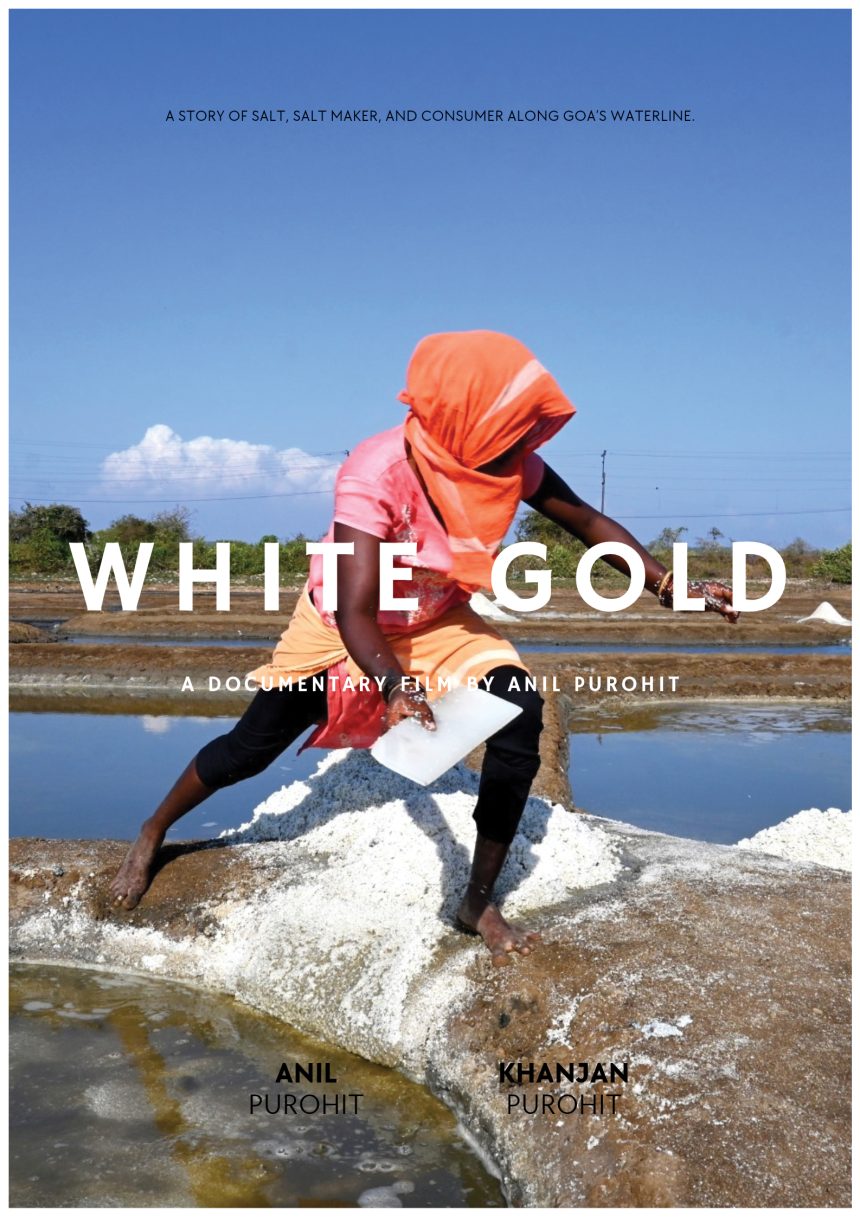
Filmmakers Anil Purohit and Jay Amonkar won Best Documentary and Best Film of Goa, respectively, at the 13th Goa Short Film Festival in Pune for ‘White Gold’ and ‘Medium Piece’
RAMANDEEP KAUR | NT BUZZ
The sights and sounds of Goa’s traditional salt trade have stayed with Anil Purohit from childhood.
He recalls, “I remember watching tempos laden with heaps of Goan salt, with women seated at the back calling out ‘mith zairey’ (want salt?) as they travelled through villages. It is a memory I would revisit every now and then.”
His travels across Goa with his late father also gave him an opportunity to see the state’s traditional salt pans.
These memories have now inspired ‘White Gold’, a documentary on the history and practice of traditional salt-making in Goa. The 12-minute documentary traces the making of Goan coarse salt, known as ‘motey mith’ (big salt), in ‘mithagars’ (salt pans), as well as its sale and use in local kitchens. “I realised that salt was closely tied to Goan life, from its food and livelihoods to the traditions of villages built around the salt pans. I felt this was worth documenting, especially as traditional salt-making faces increasing challenges,”
says Purohit.
Those challenges include pressure from development on scarce land and the growing use of commercially available iodised salt. “The decline in the number of Goans working in the salt pans has also made it difficult to find people who can speak about the occupation and its history.”
Purohit says, ‘Very few Goans are now engaged in working the salt pans. Seasonal labour from outside Goa, usually from coastal regions in Karnataka, has largely taken over production duties. With this, the cultural and historical memory specific to villages that were once home to traditional salt pans is weakening further.”
He researched the history and spread of Goa’s salt pans, production methods and trade networks. He also spoke to people with first-hand knowledge of the occupation. The documentary was filmed over three years, mainly in Curca-Batim, with additional footage shot in Talailim and Durbhat.
The salt-making season, he says, generally runs from December to May, although the timing varies from one pan to another. “I had to shoot in phases to capture the different stages, from the monsoon period and active salt production to the eventual use of salt in homes,” he adds.
Purohit considers ‘White Gold’ an ongoing project and plans to expand it with his spouse, Khanjan, who is also the producer. The documentary made its festival debut at the Goa Short Film Festival. A shorter version had earlier been screened at NIV Arts Centre in Delhi.
He dedicates the Best Documentary Film award to his late father. “I wish my father was alive to see this. I dedicate the award to him,” he says.
The recent award was also recognition of the subject he had chosen to document. He says, “To have a Goan story at a film festival and that too on such an important subject as our salt pans, in a world that seems to be in a hurry to leave this tradition behind, brought a sense of fulfilment. For it to win is a validation that the story of our salt pans and their role in Goa’s khazan ecosystem matters.”
He is currently working on three other documentaries: one on Goa’s khazan ecosystem in the context of food and tradition, another on an elderly artist in Old Delhi who continues to make traditional signboards and a third on the traditional occupations of Brahmin priests along the Ganges in Haridwar.
An absurd tale with
a human twist
Jay Amonkar’s comedy short ‘Medium Piece’ revolves around an unusual premise. A butcher finds that the chickens in his shop keep escaping. Believing they may be bored, he decides to install a television to keep them entertained.
Amonkar says, “I wanted to explore how technology and entertainment can influence our everyday lives, sometimes without us even realising it. I chose to tell the story through humour and absurdity but also wanted to leave the audience with something to think about.” He adds that beneath the comedy lies a certain sadness about the human condition and the constant desire to escape reality.
The title plays on the idea of the medium as a source of entertainment and distraction, which becomes a form of entrapment.
Despite the absurd storyline, Amonkar wanted the village and the butcher’s shop to feel realistic and lived-in. “I first tried to understand the world and the characters. The story is quite unusual, so it was important to ground the absurdity in a recognisable reality. I also wanted the humour to emerge naturally from the situations rather than forcing jokes,” says Amonkar from Taleigao.
The film took approximately 20 days to complete, from development to the final edit. However, working with chickens, managing the location, and coordinating the production presented practical challenges.
Amonkar directed the film, with Gaurav Gokhale handling cinematography and editing and Taran Dsouza responsible for sound design. Big Banner Entertainment and Media LLP and Satvik Productions produced the film, which stars Vardhan Kamat and Sayali Bandkar.
“It was a collaborative effort and the film wouldn’t have been possible without the contribution of the entire team,” says Amonkar.
On winning Best Film of Goa, Amonkar says, “You always hope that your work connects with an audience but receiving recognition like this is incredibly encouraging. Independent filmmaking involves a lot of effort, uncertainty and personal investment. To have the film recognised in this way was both rewarding and humbling. I’m grateful to the jury and everyone who supported the film.”
‘Medium Piece’ has also been screened at other film festivals in India and abroad, including the Bollywood International Film Festival in Mumbai and the Budapest Film Festival.