

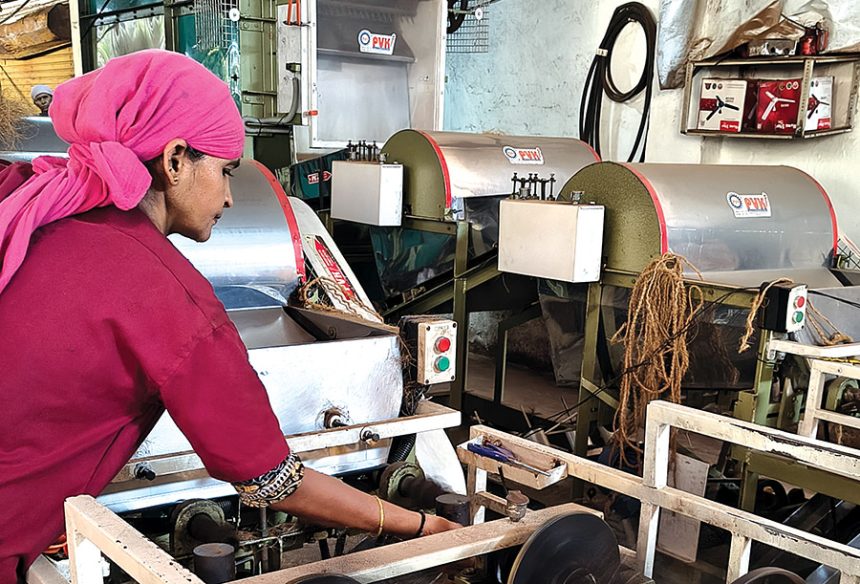
Diakon Coir based in Nessai industrial estate, and founded by entrepreneur Komal Khaparde Pritto, makes cocopeat and a host of value-added products from coconut dust making it one of the sustainable businesses of Goa, writes Shoma Patnaik
Coconut trees are plentiful in the state with the coconut palm considered as the state tree of Goa. There is ample coconut waste generated locally, yet there are few Goan industrial units utlilising the waste productively.
Diakon Coir, a MSME registered unit in Nessai industrial estate, Margao, turns coconut dust in cocopeat. The unit perhaps is the only producer of cocopeat in the state and the market leader in supplies to local plant and flower nurseries.
Diakon Coir also makes coir ropes which are sold to hardware stores in the state. Lately the company has renewed its focus on value-added products such as coir pots, coconut bowls, ladle, mats, cups, etc., made out of discarded shells. The company uses agro-based raw material and employs women. It is sustainable in operations since profit making is balanced with being environmentally positive.
A natural entrepreneur who runs several businesses, Pritto says that, she established Diakon Coir, during the pandemic when her main business of organising destination weddings and running an event management company in partnership with her husband (Diakon Events) came to a halt due to the pandemic.
“The event company was flourishing and we were getting lot of orders, but when Covid struck all destination weddings stopped and our 50-odd workers employed in the warehouse had nothing to do. We had some cash reserves but with the mainstay wedding business closed all our other businesses started shutting,” says Pritto, who toyed with several ideas for small business such as agarbatti, flower cultivation, etc.
She decided to work in the coir products since coconut trees are found widely across the state. “I decided to manufacture cocopeat, a product of which I had limited knowledge apart from using it in my home flower pots,” she says.
Pritto visited a pilot project in coir in Kundaim industrial estate, conducted by the Coir Board of India, Kerala. “At the project site I saw a huge pile of cocopeat- tons of it. The officials had no need of the cocopeat and urged me to take it away for free since they wanted to clear out the area. I took all of the abandoned material and transported it to my warehouse. From there we started packing the cocopeat in 25-kg bags and selling to nurseries.”
With plant nurseries in Goa, not making their own cocopeat and importing it from Vengurla, Maharashtra, Pritto sold 14 tons in a week which she had sourced for free. “I sold the cocopeat at Rs 5 per kg., which was the same price the nurseries were getting from Vengurla. Presently I sell cocopeat for Rs 7 per kg, and have monopoly over it to local nurseries,” says the young entrepreneur.
Pritto explains that, her cocopeat venture was feasible due to fact that her event management company had at its disposal vehicles, manpower, and warehouse space to pack the cocopeat which is a bulky material.
Having decided to continue with cocopeat trade, Pritto approached the Coir Board once again to learn manufacturing of the product. The cocopeat machines were purchased very cheaply since it was under government scheme and subsidy.
For the raw material she contacted the Goa Bagayatdar and other coconut dealers who had waste coconut shells in the stockyard. Most were too eager to give away the empty shells for free since they did not want to spend money on collection contractors to get rid of the waste.
“The money generated from the coir business helped in paying the unit rent, salaries to workers, etc. Coir made us survive the slump in the event management industry during Covid. In the lockdown our cocopeat business came to life and now it is six years since we are in operations,” tells Pritto.
Post Covid the wedding industry revived once again and all the workers who were packing cocopeat in the factory were needed in the events business. A savvy business woman, Pritto convinced the workers who stayed nearby to allow their wives to join the coir factory. “We presently employ 35 women who make cocopeat, ropes and all the other products. This year our goal is to foray into exports. However the Goan market itself is fulfilling as demand for cocopeat is strong and always outstrips the supply. Further cracking the export market is tough since the competition is from large coir units in Kerala and Coimbatore,” divulges Pritto.
Diakon Coir, presently sells about 12 tons of cocopeat per month to 50-odd nurseries who prefer to purchase from a local supplier instead of procuring it from outside vendors. “Our cocopeat business came out of nowhere and took off smoothly. Getting the raw material at no cost in the early years made things easy. Now we buy the raw material because we need more of it. The unit makes 100, bundles of coir rope per month,” she mentions.
Pritto says that, cocopeat is a labour-oriented business and although low in profit, helped to sail through difficult times. To keep the coir venture viable her plans are to keep pushing more and more value-added products.
“From Covid we realized the value of diversifying into several businesses. An entrepreneur cannot survive on one business alone,” says Pritto, who since the pandemic has started a play school cum day-care for toddlers in Chicalim, Vasco
“The wedding event business is doing very well. But in next 20 years you never know where it would be because the coming generations may not be interested in even marrying or spending huge sums of money for lavish weddings,” opines Pritto, who believes that sustainable businesses that are good for long-term survival are in sector such as education, agriculture-based, pharma, etc. Pritto adds that as a working woman she has received invaluable support from her mother and mother-in-law. “Women are too overwhelmed with all the expectations and responsibility that people expect from them. They need to have own occupation,” she says.

