

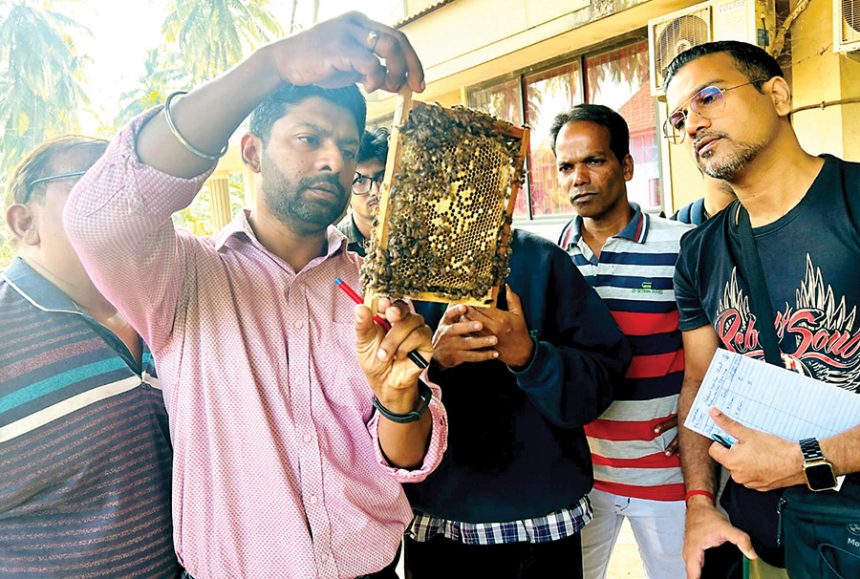
Software engineer turned beekeeper, Suprajit Raikar, founded Raika Honey- a home grown honey brand which has an online presence and is also available in stores, writes Shahin Bepari Lambe
What began as a career change for an IT professional has grown into a community movement that is promoting beekeeping supporting rural livelihoods and producing natural forest honey across the state.
Over the last decade Suprajit Raikar, founder of Raika Honey, has distributed more than 1,000 bee boxes and trained local communities to build a market for honey produced by villagers.
Today, the honey brand works across the state with a focus on forest areas including Netravali, Sanguem, Canacona, Sattari and Valpoi, where natural and organic honey is produced. Raikar personally manages around 100 bee boxes, while more than 1,000 bee boxes have been distributed across the state over the last ten years.
Raikar, who holds a Master of Computer Applications (MCA) degree began his career in the IT sector. After leaving the profession he wanted to work for the local community and came across an ICAR training programme on beekeeping. The training introduced him to the importance of bees in improving pollination and producing pure local honey without adulteration. Inspired by the course and the learning experience he decided to take up beekeeping.
“I wanted to learn more about beekeeping so I joined another course at the Central Bee Research and Training Institute, Pune. During the training I observed successful beekeeping practices in Punjab, South Tamil Nadu and Karnataka. I realized that Goa’s native bee, Apis Cerana Indica, locally known as Sateri, could be reared commercially,” he says.
The beekeeping journey began with just two bee boxes. The first harvest produced five to ten kilograms of honey which was sold under the brand name Raika.
The journey was fraught with challenges. “Unlike many other states Goa does not have migratory bee colonies. Therefore, I had to work with local bee species such as Sateri, Poya and Burgulya, which are found only in the wild. It took nearly two to three years to study tree locations and successfully domesticate these bees in bee boxes,” he explains.
Using his technical background, Raikar started to work with farming communities and women’s self-help groups in thickly forested villages such as Netravali, identifying tree species suitable for pollination before placing bee boxes there.
“When I started in 2013-14, there were no agriculture department schemes supporting beekeeping. I have invested nearly Rs 3 lakh to gain knowledge and purchase bee boxes.”
The support came later through the Goa Khadi and Village Industries Board, which provided bee boxes. After completing advanced training at the Central Bee Research and Training Institute I started training others. In 2016, Raika was registered under MSME (Udyam) portal and honey began to be sold in small batches.
As honey production from Goa’s forest areas increased the enterprise aligned its work with the central government’s Honey Mission, also known as the Sweet Revolution.
The Khadi Board’s beekeeping scheme has also made it possible for even people without land to take up beekeeping. We follow a buy-back policy, purchasing honey produced by local beekeepers after quality testing. This provides a ready market for rural producers while ensuring a supply of locally produced honey,” says the apiarist- entrepreneur.
Speaking further he points out that honey production depends greatly on location. Farmers with well-maintained orchards can produce three to five kilograms of honey from one bee box while, forest-rich areas such as Netravali and Canacona can produce up to 12 kilograms of honey per box.
Beekeeping: A sustainable livelihood
Beekeeping as a small scale activity can easily be a supplementary income in Goa, where the local flora comprising a variety of bee attracting trees supports robust honey production. The six talukas which are ideal for apiculture in the state are Dhanbandora, Sanguem, Canacona, Sattari , Valpoi and Bardez.
Bees and other pollinators play a critical role in the agri-food systems and in the health of environment ecosystems. More than 200 000 animal species are pollinators, of which bees are the best pollinators since they are the most prolific in honey production.
The Honey Mission initiative of KVIC- Goa, educates rural communities and encourages self-employment opportunities through beekeeping activities. The mission creates awareness about the importance of honey bees, beekeeping, and honey production as well as promotes honey production through financial assistance schemes. Through modern beekeeping practices, KVIC helps create sustainable livelihoods, additional income, and self-employment opportunities- especially for local artisans, farmers, and traditional communities while supporting eco-friendly and village-based entrepreneurship in the state.

