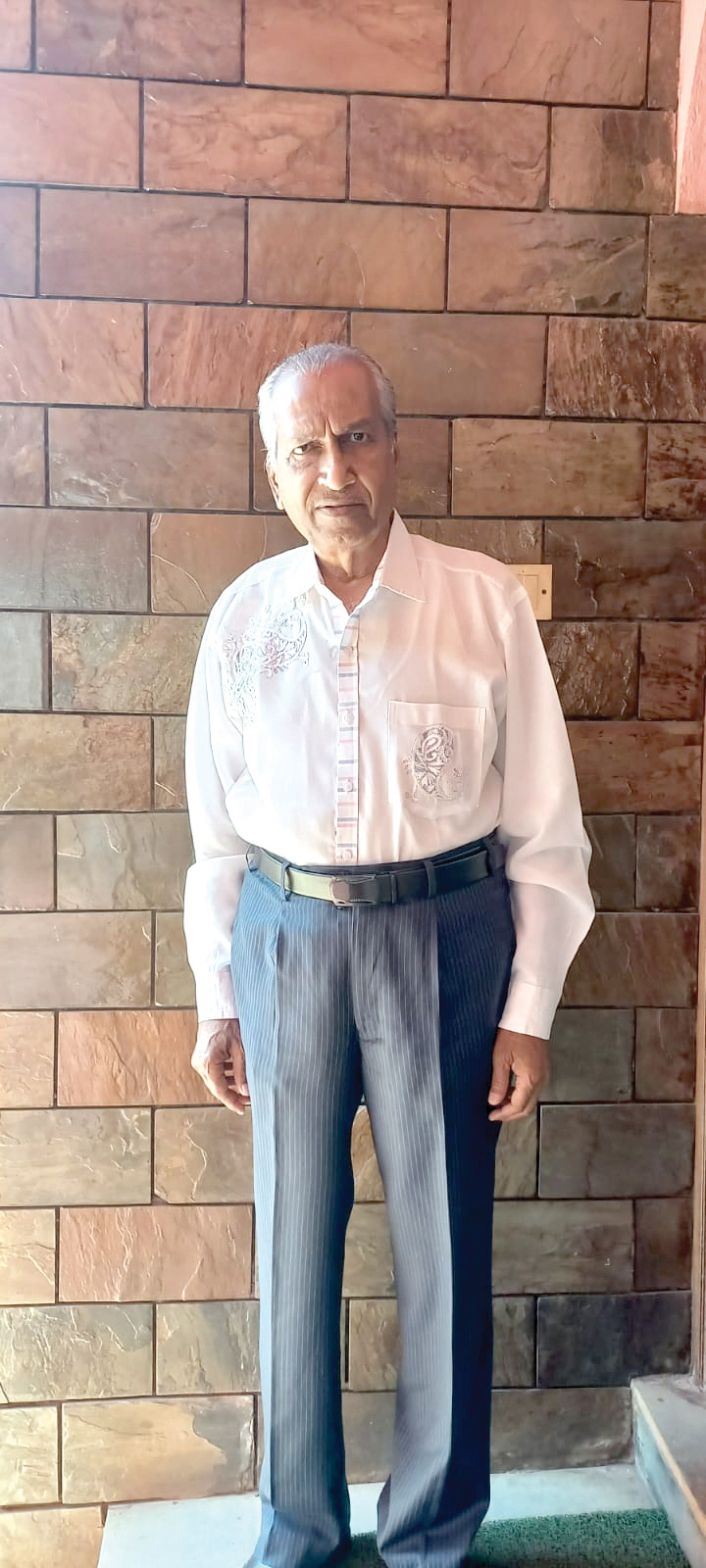
Today, as Tomazinho Cardozo turns 80, the many roles he has held, teacher, sarpanch, speaker, writer and tiatrist, seem less important than the journey itself, where one phase led into another, not always planned but always taken seriously
RAMANDEEP KAUR | NT BUZZ
Born in Pomburpa in 1946, Tomazinho Cardozo’s life was almost immediately marked by tragedy when his father passed away just one month after his birth. Facing severe financial hardship and the daunting prospect of raising a family alone, his mother initially struggled with the decision of whether to leave their ancestral home. When he was six months old, his maternal uncle brought them to Candolim, where he grew up.
His elder brother, João, left school at 10 to work in a bakery in Mumbai, earning Rs 15 a month and sending most of it home. “That was our lifeline,” he says. His mother and aunt sold fish to support the household, while an uncle working in Mozambique contributed what he could.
His schooling followed the transitions of the time. He began at a church school that focused on basic literacy but did not offer formal certification. He later moved to a Portuguese primary school before shifting to English-medium education, which his family saw as essential for employment opportunities in Mumbai. He studied at Pupils English School in Verem and completed his SSC through the Institute of Instruction in Panaji.
His path to higher education was somewhat serendipitous; he followed his friend Nevis Machado into the science stream at Dhempe College, though he admits he lacked a clear career plan at the time. By then, his brother had returned to Goa and set up a bakery, taking on the responsibility of funding Cardozo’s education.
In 1971, Cardozo began his career as a teacher at St Theresa’s High School, Candolim, later teaching in St. Xavier’s High School, Moira, St Bartolomeo High Schoo, Chorao and St Joseph High School, Arpora. For him, education extended beyond textbooks. “Education is for the all-round development of a child,” he says, recalling how he encouraged sports, writing and extracurricular activities in schools that had limited resources.
His approach delivered results. Schools in village areas that typically saw pass rates of around 50% began achieving 100% success in SSC examinations under his leadership. In 2002, his work was recognised with the State Award for Best Teacher. He is perhaps the only Goan to hold three state awards: Education, Panchayati Raj and Culture.
Cardozo’s entry into public life was a natural extension of his popularity in village sports and cultural activities. At age 25, he contested and won his first election. Though he initially intended to serve as sarpanch of Candolim for only three months while waiting for a visa to Dubai, the visa never arrived and he stayed in the role for 22 years, winning five consecutive elections.
As sarpanch, he built a reputation for accessibility and decisiveness. He backed local residents in their efforts to benefit from the growing tourism economy, issuing 175 building licences to allow families to construct rooms for tourists. The move drew objections from authorities but Cardozo stood his ground, arguing that the permissions addressed basic livelihood needs.
When the government threatened him with a notice to remove him from the office of the sarpanch, he pointed to large establishments built close to the shoreline. He then called a Gram Sabha attended by thousands and the pressure eventually forced to a withdrawal of action. He also led efforts to prevent Candolim from being merged with Calangute for converting it into a Municipality, saying it would dilute the village’s identity.
Cardozo maintains that effective governance begins at the village level. “If panchayats are supported, change can start there and move upward,” he says. He also points to waste management as an issue that needs more attention, suggesting smaller, localised systems as a practical solution.
In 1994, Cardozo entered state politics, winning election as an MLA on a Congress ticket. Despite being a first-time legislator, he was elected speaker of the Goa Legislative Assembly owing to the trust reposed in him by the then-Chief Minister Pratapsingh Rane.However, Cardozo describes his five years as speaker as “horrible” compared to the satisfaction as sarpanch. He was thrust into a political environment where ethics were often discarded for personal benefit. His greatest professional regret involves a decision to disqualify 10 defecting members including Dr. Wilfred de Souza, without giving them adequate time to argue their case. The High Court eventually overturned the decision. “I knew that it was not a correct decision,” admits Cardozo, reflecting on how party loyalty clouded his judgment. After losing his seat in 1999 by a margin of 325 votes, he chose to step away from politics altogether.
Outside politics, Cardozo’s contribution to Goan culture has been equally significant. He has written around 50 tiatrs, beginning in 1964, with his first play staged in Saipem, Candolim. “It came from personal thoughts at the time,” he says. His early work included detective-style plots influenced by films but his writing shifted after he entered the panchayat. “Later, most of my tiatrs were based on social and political issues. Many stories came from what people brought to the panchayat office,” he says.
Among his works, he pointed to ‘Novi Dixa’, which explored the idea of rejecting candidates in elections and ‘Mhonvall Vikh’ (Sweet Poison), which dealt with the effects of tourism on local youth in Candolim. “These were issues we were seeing around us,” he says.
Cardozo says he did not face pressure to tone down his work, even while in public office. “I staged plays on corruption and governance even when I was speaker. People often see theatre as entertainment but it can say much more.”
He was also an innovator, introducing technological advancements like flashbangs, shadow play and complex light effects to the Konkani stage, inspired by the high production values of Marathi drama.
Kala Academy, he says, played a key role in organising tiatr competitions that improved standards, particularly in stagecraft and production. He also stresses the need to preserve work through documentation. “I printed my tiatrs and recorded them so they remain,”
he says.
Besides this, he has published 36 books in English, Devanagari and Roman Konkani, covering poetry, essays and short stories. He believes the act of writing keeps the brain sharp and protects against the mental decline often associated with aging. Since 2006, Cardozo has also been a regular columnist, writing more than 700 pieces on social and political issues. To support his work, he built a personal library over the years using second-hand books collected during visits to Mumbai.
His contributions extend to music as well. His mando group, ‘Kandollechim Kirnnam’ from Candolim, has participated in 17 mando festivals and won the top award 11 times, a record that stands to this day.
On language, Cardozo speaks candidly about the Konkani agitation and its aftermath. He believes that those who supported the Roman script played a crucial role in the movement but were later sidelined when Konkani was granted official status in Devanagari. Recognising both scripts, he argues, would have been a more inclusive approach.
Looking back, Cardozo is clear about what has defined him. Teaching, he says, brought him both purpose and respect.
He also expresses concern over the National Education Policy (NEP), labelling it a “mess” implemented without proper teacher training or infrastructure. He argues that effective education requires classes of no more than 25 students. He also points to demographic changes as a challenge to literacy. “It was possible in the 1990s. Now it is much harder,”
he says.
When asked for a message for the next generation, Cardozo returns to the principles that guided him through the halls of the Assembly and the classrooms. “If you want to succeed, you have to work hard. Your work should be sincere.” He adds that honesty and a focus on the betterment of others are the only true paths to success.