At Studio Yakisoba, Jayashree Sanzgiri, known as Yaya, reflects on her shift from academia to art and the many mediums shaping her evolving, playful practice
VINIKA VISWAMBHARAN
NT BUZZ
In a small studio in Margao, Jayashree Sanzgiri, better known as Yaya, is shaping a creative practice that resists neat definitions. At 28, she is the artist behind Studio Yakisoba, a mixed media venture which she runs with her friend and business partner Shane Wylmer Vaz. What began as a return to drawing and painting during a difficult period has since evolved into a growing body of work grounded in emotion and an unapologetic embrace of variety.
“I was in the U.K. pursuing masters in molecular medicine when the COVID-19 pandemic disrupted my plans,” says Yaya. After completing her dissertation, she returned home to Goa, where a period of ill health made it difficult to begin a PhD. “I was diagnosed with ADHD and autism,” she says. “Everything seemed to be falling apart and that’s when I started drawing and painting again.”
Art was familiar territory for Yaya. “I had a natural talent for it as a child, and my aunt took notice and helped me nurture it,” she says. Even so, it stayed in the background for years as something personal rather than professional. “I didn’t really consider it as a career until I realised I could pivot from academia to art and be just as fulfilled,” she explains.
Initially, she says, she painted without any proper business plan or strategy. The structure came later, with Vaz stepping in to shape the business side. Together, they formalised the practice as Studio Yakisoba, previously known as Atorie Yakisoba. Their shared aim is simple but distinct. “We wanted to make art and products that are functional and whimsical because the world can do with a bit more whimsy in it, especially right now.”
That openness extends to her audience. “Our demographic is honestly just people that resonate with my art,” says Yaya.
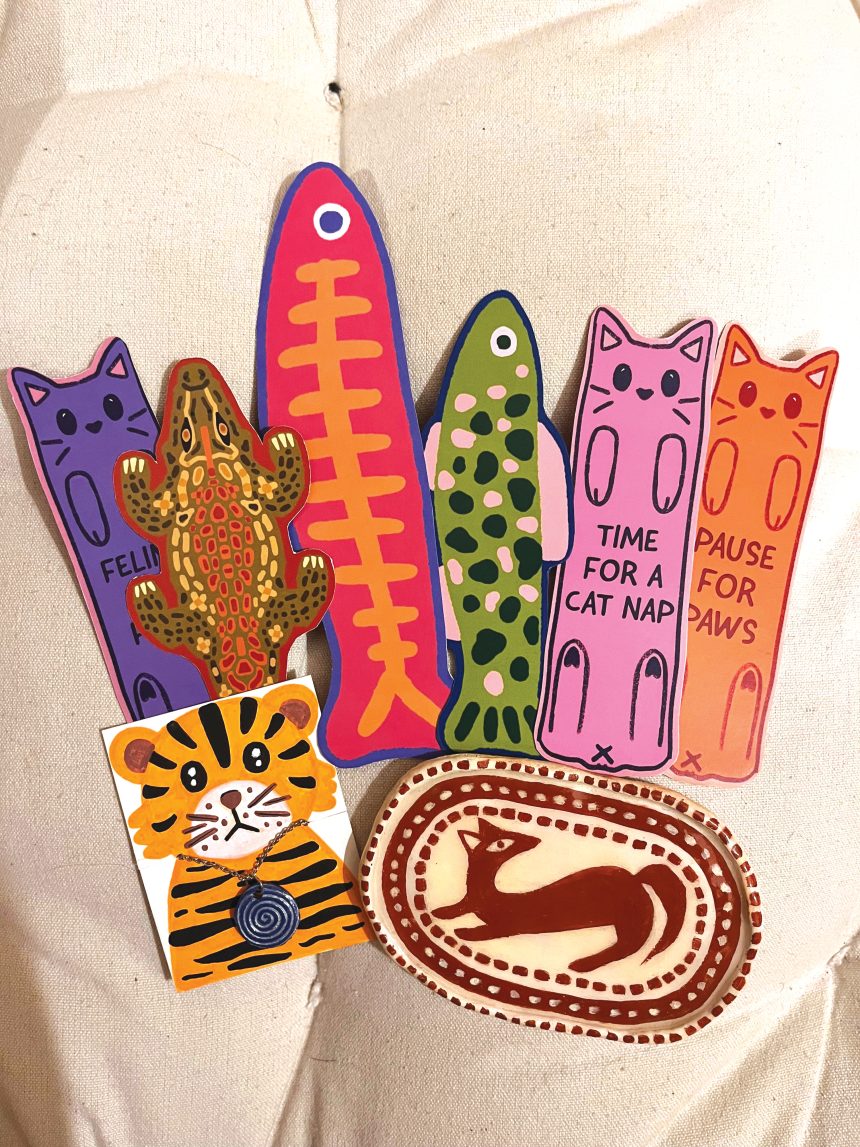
Studio Yakisoba sells and takes commissions for traditional paintings in oil and acrylic as well as digital art. Alongside these are ceramic jewellery, totes, bookmarks, postcards, stickers, pins, coasters, calendars, posters and canvas prints. “The list is always growing and changing,” she says. Recurring motifs thread through the variety. “Cats, fish, mental anguish and inner turmoil, Goan culture, and pop culture,” she lists.
If there is a defining feature of the studio, it is this refusal to be boxed into a single style or medium. “From oil paintings to murals to digital art to linocut printing to ceramics and pottery to stained glass and crochet, I do it all. The mix of art styles and media definitely makes us distinct,” she says.
Goa remains both backdrop and influence. “I have grown up here and it inspires a lot of the work I do,” she says, adding that she plans on incorporating more Goan culture in her art because “it just feels right”. The pace of life helps too. “The susegad philosophy works great for my AuDHD. I get to pace myself, relax and work in the comfort of my home,” she says.
Like many small businesses, visibility remains a challenge. “Without investing significantly in marketing, it is hard to reach an audience,” she says. Word of mouth and physical stalls have helped, but not enough to scale. “They don’t provide the traction we are seeking to expand.”
But there have been affirming moments along the way. She points to her first stall at Serendipity Arts Festival in 2025 as a turning point. “We went in with zero experience and expectations and the response was overwhelmingly positive,” she says. “It was a great motivator and we met so many people who appreciated my art.”
For now, Studio Yakisoba continues to grow organically. Orders come in through Instagram, email and WhatsApp, with an online store in the works. Beyond that, she hopes her work leaves a mark. “I want my art to impact people and I hope to leave behind a lasting art legacy.”