Miguel Braganza
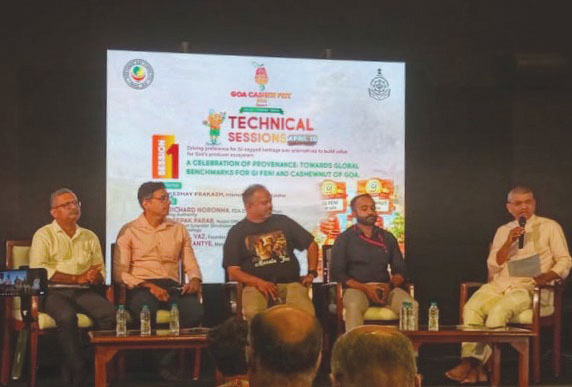
On the weekend after Easter, the Goa Forest Development Corporation (GFDC)’s ‘Cashew Festival’ had its season four at the Dayanand Bandodkar Grounds, Campal-Panaji. It has become a popular festival over the last three years and has a dedicated set of fans. Shubhra Sankhwalker, the artist who designed the logo for the ‘Konkan Fruit Fest’ in 2003, is now a much sought after MasterChef who has created a menu of cashew-based recipes with cashew nuts, and with mature to ripe ‘cashew apples’, which are actually the swollen hypothalamus and not technically ‘fruits’ at all. Hansel Vaz has curated the cashew-based drinks, both traditional and a range of cashew juice mocktails and feni-based cocktails. Real niro is for the privileged. What is bottled is generally a turbid cashew juice that is good enough for someone who has never drunk the nectar of the gods.
Botanically speaking, the cashew ‘apple’ may not be a fruit but the cashew nut is. The nuts are separated from the cashew apples, which are then juiced and fermented with native yeasts before distillation of the spirits. We call it urrak. Towards the end of summer, the balance stock of urrak is blended with fermented juice and distilled again to obtain feni. The traditional Lavnni is the best method till date and the only method for conformity with the G.I tag. It is the best practice in the trade for urrak and feni. The first Geographical Indication or G.I. in favour of Goa State was for the feni in 2009. Currently, non-conforming feni distilled with a metal coil condenser forms the bulk of the bottled feni. The artisanal feni distillers are also not in the G.I. loop though their distillation stills are compliant with the specifications.
The GFDC has obtained the conformity with the ‘G. I.’ for authentic ‘Goan Cashew nuts’ under its brand name ‘Sylvan’. It is marketing it on a regular basis through its outlet at the Children’s Park in Campal. There is a proposal to set up retail outlets at GTDC’s hotel chain and also at the airport and railway stations. Once done, locals and tourists alike will be able to access real ‘Goa grown and processed’ cashew nuts instead of eating spurious product from raw cashew nut imported from neighbouring states or African countries.
The three G.I tags for cashew apple, nuts and feni are helping to build a quality consciousness. Grafts are being planted by GFDC, feni distillers and cashew nut processors alike. The Mavalnakar -1 is a gold standard for cashew nut quality but Vengurla -4 is till the most common grafted variety in Goa. That is bound to change as superior varieties are being identified and propagated by grafting. Organised plantations are becoming essential because of largescale land conversion to ‘settlement’ zones. Without cashew plantations, the G.I. tags and export promotion will become non-starters. Cashew is Goa’s
cash crop.