‘We, The Rivers of Goa’ invites communities to gather through art, storytelling, walks, poetry, and shared acts of care for Goa’s living ecosystems in a
month-long confluence
KALYANI JHA | NT BUZZ
Rivers are not distant landscapes but deeply entwined in our lives. They are living entities deeply tied to memory, belonging, and survival. Yet, this awareness does not always permeate. Thus, with the aim of changing this scenario, artists, activists, writers, ecologists and local communities have come together for a month-long activation ‘We, The Rivers of Goa’.
Having begun recently at The Shop in Sangolda, through poetry, textiles, walks, food, films, and conversation, the rivers are remembered as living presences — shaping the land, and in turn, shaping all those who
belong to it.
For artist Miriam Koshy, who has brought the confluence together in collaboration with The Shop and Saraya, the project is not simply an exhibition or a curated programme.
“It’s an engagement with the rivers, with the purpose of activating a sense of intimacy with the rivers of Goa,” says Koshy who resists describing herself as a curator or organiser of the confluence. Instead, she frames the work as stewardship.
That sense of stewardship lies at the heart of the activation, which invites people to gather, listen, learn and create together around the ecosystems that shape Goa’s land and life.
The Shop also has on display some thought-provoking installations. These include ‘Mhadei’che Rakhanda’r, a textile-sculptural series created by Koshy in 2023 in response to the accelerated attempts at diverting the Mhadei River. The rakhandars in this series are ‘Tu ani Hanv Udik’, ‘Rann’che Rakhandar’, ‘Khazan’che Rakhandar’, ‘nhoi’che ugam Rakhandar’, ‘Kandal’cho Rakhandar,’ ‘Dobdobo’che Rakhandar’, and ‘Nhoi’che Tonn Rakhandar’.
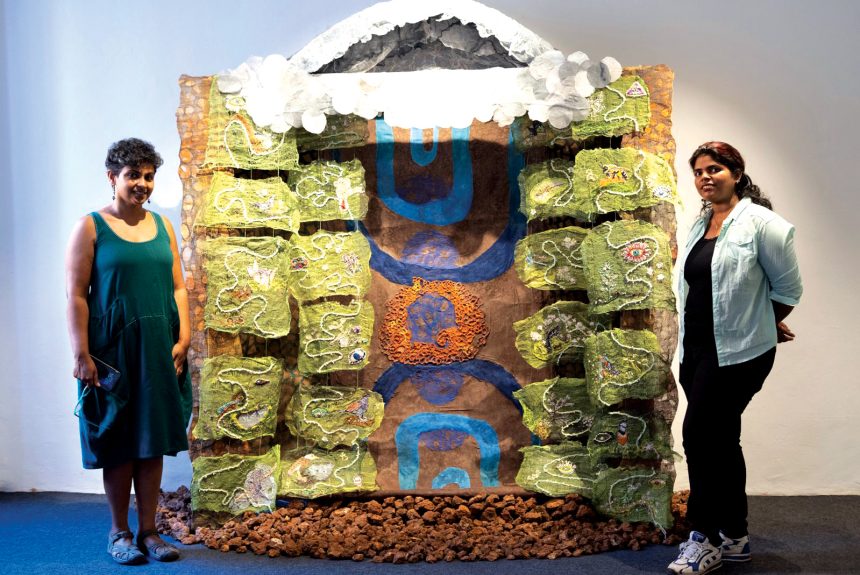
Alongside these are two new collaborative installations – ‘Altar to the Rivers of Goa’ and ‘Altar to the Sada: Laterite Plateaus of Goa’ – created in 2025 with Stitch for Goa, a collective initiative founded by Koshy. “Stitch for Goa, as a group go on site visits, explore these ecosystems together and then we come create work in the studio together,”
explains Koshy.
Participants study flora and fauna encountered during these journeys, and transform observation into stitched drawings and embroidered forms. “The finished works, the altars, become devotional spaces — textile altars shaped through shared labour and reflection,” says Koshy adding that the group has around 111 members and is open
to all. “We’re not looking for perfectionism of stitching. We are just encouraging the act of using your hand and heart in this whole exercise of coming closer to the ecosystems,”
she says.
‘Altar to the Rivers of Goa’ is a woven tapestry. Strips of repurposed sarees, dupattas, and garments become a living cartography, integrated with crocheted granny squares contributed by The Mango House Trust. On this textile landscape, the rivers claim their own presence. They emerge as plaited streams of cotton, their paths flowing across the fabric. A single, couched line of yarn follows each plait—a stitched echo of their current. This is the first of four installations. As the project travels and grows, it will include further layers from riverine communities, folklores and
personal narratives.
“By threading the rivers into being, we do more than depict them—we honour their essence. This altar stands as a collective testament: that to love a place is to witness its wounds, and to stitch for its healing is to believe, fiercely, in its flow. Your presence and reflection become part of its next incarnation,” says Koshy.
‘Altar to the Sada:The Lateritic Plateaus of Goa’ is a tribute to the ancient, biodiverse plateaus that recharge Goa’s aquifers. Here, the artists have embroidered the flora and fauna they encountered. These individual embroideries are integrated into an abstract landscape of layered gauze by Koshy. This material serves as a poetic metaphor: a fragile yet tensile weave that mends broken bones, representing both the delicacy of the ecosystem and the resilient strength found in interconnection.
Besides the installations, each weekend leading upto June 27 will feature two events, including zinemaking workshops, textile art sessions, talks on the fish of Goa, book readings, film screenings, picnics by the river, and more.
One of the recurring conversations during the confluence will examine the idea of granting rivers legal personhood.
For Koshy, the project is ultimately about creating lasting shifts in how people relate to the rivers and ecosystem depending on rivers
around them.
“My work is to create sensitisation, a sense of community and a sense of intimacy with these works and with the land that we live in and therefore to foster a sense of guardianship and stewardship,” she says.