

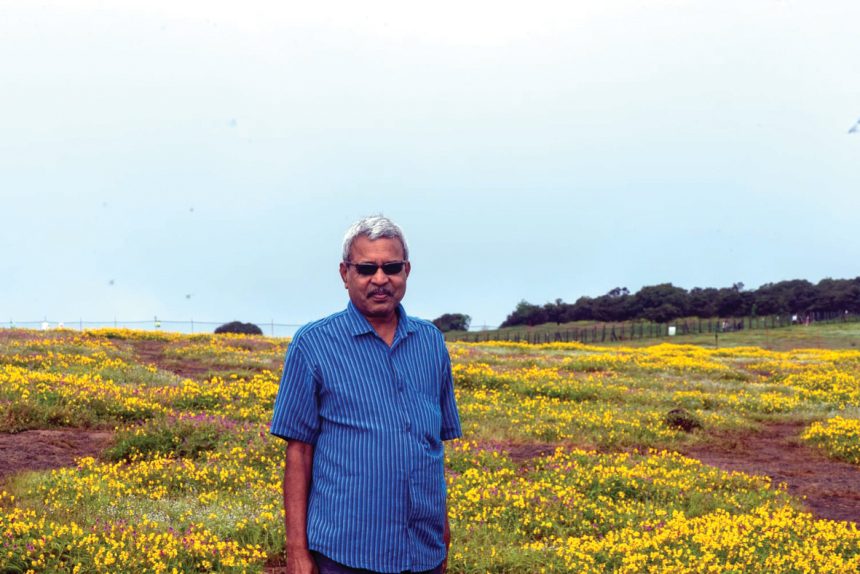
In ‘Natural Wonders of Goa’, environmentalist Rajendra Kerkar documents lesser-known geological and ecological sites across Goa
RAMANDEEP KAUR | NT BUZZ
Rajendra Kerkar, who comes from a family with a freedom fighter background, grew up in the Western Ghats–Mandovi river landscape. This inspired his work in the field of environment conservation.
Having previously published many enlightening books, the manuscript for this new book was completed in 2025. Around the same time, he was approached by managing trustee Green Ray Foundation, Tomazinho Cardozo and member Pravin Sabnis, who suggested taking the book to schools and colleges through educational programmes.
The book, his sixth one in English, includes material from field visits to limestone formations between Vaiguinim and Ivrem-Curdo of Sattari, traditional water systems in Sanguem, and other geological and ecological sites across the state.
Excerpts from the interview:
How did the idea for ‘Natural Wonders of Goa’ come about?
While writing the book on ‘Natural Heritage of Goa’ about five years ago, I realised that I had covered only a very small part of this heritage. Goa has such a bewildering range of biological and natural heritage that needs to be documented. When I came across the ‘Gazetteer of the Union Territory Goa, Daman and Diu: District Gazatteer’ edited by Dr. V.T. Gune, I found that it does not cover geological or natural wonders of Goa in detail. So I decided that I should write about it.
Which discovery or field experience during your research was the most memorable for you?
In the geology of Goa by geologist A. R. Gokul, there is mention of a limestone stretch from Vaiguinim to Ivrem-Curdo. But there is no detailed account of it. I went to explore this entire region. When I reached these sites, I saw the limestone caves in Goa and the large boulders that are believed to be the sticks of Bhima from the Mahabharata. I documented the myths, folklore, and belief systems connected to these places and studied their geological significance. This journey helped me document aspects that were not recorded earlier in Goa.
What are some of the major natural aspects and themes covered in the book?
It includes details about Nanda Lake, a Ramsar site and the 75th wetland of India. The book explains why it has been given this status as an important wetland. It also tells the story of how the water-scarce region of Kale in Sanguem received water from the Dudhsagar River through an ingenious system of canals and channels created generations ago. What seems impossible today shows the engineering skills of local communities and how it transformed the region.
The book also covers Goa’s geology and biodiversity, including how the coconut became the state tree, why the gaur is the state animal, why the ruby-throated yellow bulbul is the state bird and why the Malabar tree nymph is the state butterfly.
What were some of the challenges you faced while researching and documenting Goa’s natural heritage for this publication?
Visiting these areas meant dealing with leeches, ticks, and wildlife like tigers and sloth bears. One has to understand their footprints and behaviour before entering such regions. I have been going into forests since childhood, so I am familiar with the terrain and these creatures. There were also challenges from mining mafias and local troublemakers. In some areas, mine owners would discourage or restrict access but it was local people who helped me reach these places.
Having spent decades studying and documenting Goa’s environment, what major changes have you observed in the state’s landscapes and biodiversity?
Tourism is increasing, mining interests are active, and even wetland notifications are often opposed. These are major challenges for conservation. Although many of these areas are protected under the Wildlife Protection Act of 1972, unauthorised activities still take place without the knowledge of the forest department. These continue to pose threats, so there is a clear need for stronger protection strategies to safeguard Goa’s natural heritage. Within this, the most urgent issue today is land protection. We must protect whatever land is left in Goa from concretisation. If we continue using scarce land resources for unchecked development and urbanisation, it will pose a major threat to Goa’s existence as we know it. Freshwater rivers, the Western Ghats, wetlands, mangrove forests, and evergreen forest patches are among the ecosystems facing the most pressure.
At a time when Goa is witnessing increasing debates over development and conservation, what message does this book convey to policymakers and the public?
My book aims to draw the attention of policymakers to identify such areas and declare them as heritage monuments, similar to archaeologically
protected sites.
There is also a need to educate local communities through schools and colleges and build a generation of youth dedicated to conservation. Sustainable tourism can also be developed. Students can be trained as guides, which can generate income. If these places are visited responsibly, without plastic or waste, tourism can become both scientific and sustainable.
What role can citizens, particularly young people, play in safeguarding the ecosystems and biodiversity highlighted in the book?
Education is very important. My earlier books ‘Sacred Flora of Goa’ and ‘Sacred Groves of Goa’ are already included in college syllabi. Some autonomous colleges have even designed special courses based on them to create awareness among students. Through ‘Natural Wonders of Goa’, I hope to further this awareness. If students learn about these places, they will visit them and understand their importance. Citizens should also share this knowledge with their children and communities, which will help preserve Goa’s rich natural heritage.
If a reader were to visit just one natural wonder featured in the book, which would you recommend and why?
They should visit the limestone caves, because they show how thousands of years ago Goa was under the sea. When the sea retreated, limestone formations were left behind. These formations are truly mind-boggling. Many Goans travel to Andaman and Nicobar Islands or the Northeast to see such wonders, while similar geological heritage exists within Goa itself, largely unknown.
Are there aspects or regions of Goa’s natural heritage that remain under-documented and require further research and public awareness?
There are several coastal areas like Pernem and Anjuna that still need to be explored and properly documented. In the coming days, I plan to visit these places and study them further. I want to continue documenting as much as possible about Goa’s natural, geological, and geographical assets.
(‘Natural Wonders of Goa’ will be released by the chief guest, Dr. Pradip Sarmokadam, Member Secretary of the Goa State Biodiversity Board. Victor Hugo Gomes will deliver a talk on the book. The event will be held today, June 4. 5.30 p.m. at the Multi-Purpose Hall, Sanskriti Bhavan, Patto, Panaji.)

