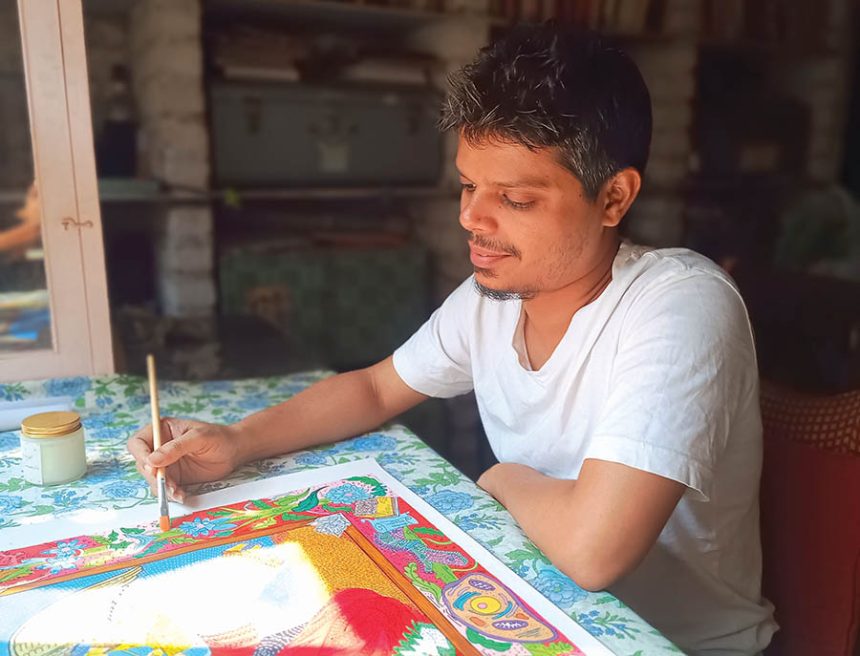
Theatre artist and educator Omkar Bhatkar has reinterpreted Spanish mystics in the Indian gond art style at his ongoing debut painting exhibition in Spain. NT BUZZ speaks to the artist
KALYANI JHA | NT BUZZ
The Indian tribal Gond art style has made it to Spanish shores this April.
For years, artist, filmmaker and writer Omkar Bhatkar has worked on translating mystical poetry into theatrical experiences. On his tour to Spain last year, he did a solo theatre performance titled ‘The Sacred Bride: Verses of St. John of the Cross’, which integrated verse with Sufi whirling.
“It is a rare, mystical experience and a privilege to perform a saint’s poetry in his birth place Fontiveros—and where he passed—Ubeda. Following an invitation to perform at the Convento e Iglesia de San Miguel and in Fontiveros, I felt a deep desire to revisit that experience through a different medium,” says Bhatkar, who has his roots in Sanquelim.
This has culminated in his debut painting exhibition ‘Painted Poems: The Spanish Mystics through the lines of Indian Gond Art’ which commemorates the 300 years of canonisation of St. John of the Cross. It is being exhibited at the Museum of St John of the Cross, Ubeda; Espacio San Juan de La Cruz, Fontiveros; and Museu Carmus, Alba de Tormes.
“Eight months ago I submitted two samples to the curators in Spain, proposing a fusion of Spanish mysticism and Indian Gond Art. They embraced this cultural dialogue immediately. All 12 paintings in this collection were created exclusively for this tricentenary,” he shares.
Besides St John of the Cross, Bhatkar has also focused on St Teresa of Avila. The works in this exhibition range from the Transverberation of St. Teresa to the Cantico Espiritual. Each piece is a specific meditation on their lives and verses, sized to create an intimate dialogue with the viewer. “I encountered these two mystics a decade ago and have since immersed myself in reading up on them in the available English translations, including St. Teresa’s autobiography,” he shares.
Painting for Bhatkar has always been a private practice. “About eight years ago, my style began to gravitate naturally toward the intricate, rhythmic patterns of Gond art. I began incorporating it into my professional life subtly—designing themes for conferences on women’s rights, inter-religious conclaves, and education seminars. It became a way to visualises complex subjects through a folk aesthetic that feels both ancient and contemporary” he explains.
Elaborating on this, Bhatkar shares that when depicting St. Teresa of Avila founding the first Discalced Carmelite monastery of St. Joseph with her original four nuns, he chose to clothe them in Kunbi weaves. “For me, the Kunbi represent the indigenous, humble soul of India. Just as Mother Teresa adopted the simple blue-bordered sari of the poor in Kolkata, St. Teresa of Avila returned the clergy to a life of radical poverty and prayer. Using the Kunbi habit was my way of honouring that shared spirit of humility,” he says.
“The process of painting them was not one of hurry or worry, but of profound tranquility. ‘Transitus of St. John’, depicts his passing from the earthly realm to the divine. The very bed he died on is preserved here in the museum. To paint that bed, surrounded by a celestial bloom of daisies, and then to exhibit it in the same space where he took his last breath is, for me, an ethereal experience,” he explains.
Bhatkar shares that his work is also deeply influenced by Angelo de Fonseca. “A print of his ‘Annunciation’ hangs in my room. I don’t consciously try to copy or separate myself from him. Instead, his work has stirred my soul so deeply that he has become part of my artistic DNA. Whether the audience sees the similarities is for them to perceive; for me, he is a guiding light in how one bridges faith and indigenous form,” he shares.
Being an educator and theatre artist, Bhatkar faced time constraints in completing the paintings. “Unlike theatre, which is collaborative and social, painting demands loneliness, a total immersion that requires cutting oneself off from the world. I didn’t have the luxury of painting for months on end in isolation. I had to balance my teaching and theatre schedules, often painting for 72 hours straight during gaps in my schedule,” he says.
This being Bhatkar’s international debut as a painter, he feels he is merely an instrument. “This collection belongs to St. John of the Cross, St. Teresa of Avila and the spirit of Andalusia. To have three Spanish cities host these works is a grace I never expected,” he says.