

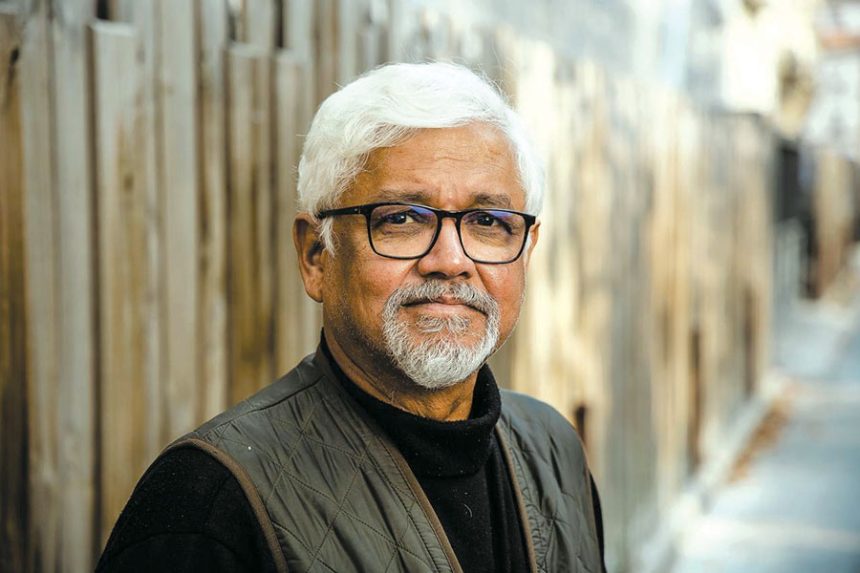
Ahead of the Goa launch of his new book ‘Ghost-Eye’, acclaimed author Amitav Ghosh speaks to NT BUZZ
CHRISTINE MACHADO | NT BUZZ
‘Ghost-Eye’ has a Native American lore attached to it. What drew you to choose this for your novel?
I have long been interested in Native American thought, particularly as it concerns landscapes, places and memory. The Native American thinker Vine Deloria Jr has argued that space is to Native American thinking, what time is to Western thought. In this, as in much else, Native American thinkers offer vital counter-narratives to the modern, extractivist view of land as a mere resource.
Some of the main characters in this book also appear in your previous book ‘Gun Island’. What made you decide to return to them?
‘Gun Island’ was a story about this age of planetary crisis. That story was not finished. By returning to the characters from the earlier books, I have been trying to understand how these immense, planetary shifts continue to unfold in personal lives and relationships. It allows for a deeper, more layered exploration of how individuals adapt, resist and find meaning when the very ground beneath them, both literal and metaphorical, is in flux.
The book also focuses on reincarnation. What fascinated you about this idea?
What fascinates me about reincarnation is its challenge to ideas of linear, individualistic time — the idea that a life is a discrete, self-contained story. In many cultural expressions, reincarnation proposes a web of interconnectedness across time and provides a framework to think about how the past affect the present and how today’s crises may echo older patterns.
How much do you think people today are turning to ancient wisdom to understand the world?
I believe people are turning to earlier paradigms of thought not out of nostalgia but out of a desperate and pragmatic need. The dominant ideas of modernity, endless growth, human separation from the environment and the privileging of the measurable, have brought us to the brink of collapse. Alternative belief systems begin from very different premises: reciprocity, kinship with the non-human world, and cyclical rather than linear time. People are looking to them now because the modernist paradigm has clearly failed to respond to the planetary crisis. The time has come to search for different ways of asking questions and to look for narratives that can accommodate mystery, tragedy, and wonder in ways our mechanistic and materialist frameworks often cannot.
You have a special fondness for Goa, with a few of your book events being held here, especially at Literati. What do you love about the state?
Goa holds a very special place in my heart and Literati in particular feels like a rare sanctuary. What draws me to Goa is its layered, syncretic culture, shaped by complex histories that have somehow created a place of extraordinary openness.
At Literati, one finds a community of engaged readers and thinkers who approach literature with both seriousness and joy.
Where past and present collide
When three-year-old, Varsha Gupta, who comes from a vegetarian family, demands fish for lunch and claims to remember a previous life, her family is left baffled.
Dr Shoma Bose, a psychiatrist investigating what are known as “cases of the reincarnation type”, is called in and her understanding of the world is changed by Varsha’s revelations.
Half a century later, the case file catches the attention of environmental activists. As Shoma’s nephew Dinu becomes involved in the search for Varsha, buried memories from his own past begin to surface.
Moving between late-1960s Calcutta and present-day Brooklyn, the novel explores family, fate and our fragile planet.
(The book will be launched on January 17 at 6 p.m. at Literati Bookshop and Cafe, Calangute.)

