Samrudhdi Kerkar
Whenever we pass by Virdi village of Sankhali, the area surrounding the Sateri Temple never fails to grab my attention. Around the colourful temple stretches a vast wetland, an open theatre where nature displays its vibrant artistry. On one side, the wetland is lined with skyscraping coconut trees, standing tall against the evening sky like obedient schoolchildren assembled for a welcome song. The silhouettes of these trees rise in quiet elegance, creating a spectacle that feels almost divine.
Below, the wetland silently imbibes the changing colours of the sky, holding them close and mirroring the resplendent beauty in its tranquil waters. The reflection seems so perfect that one wonders where the sky truly ends and the earth begins.
That day, as I was passing along the road, I noticed tiny pinkish dots blooming across the wetland, as though large lotuses had suddenly blossomed upon the water. For a fleeting moment, I truly believed they were flowers. Looking closer, I realised they were not lotuses at all but a large family of beautiful birds called the Painted Storks. I do not know why this bird is called the Painted Stork, but true to its name, with its soft pink hues, long beak and graceful stance; it appears like a living painting brushed carefully against any landscape.
Whenever I see this bird now, I remember the first time I spotted one in a field.
“Look! There is a Painted Stork!” I had cried out in excitement. “Where is it?” Aai and Didi asked with equal surprise, almost amused at the thought of finding a ‘painting’ in the middle of an open field. I pointed eagerly and they searched for a framed artwork until they realised it was nature’s own living masterpiece standing before us.
This time there were many Painted Storks; babies, parents and older ones, as if all had gathered for a family trip to Goa. Unable to resist the sight, we parked our vehicle by the roadside and stood watching.
As it was early spring, the leafless trees of Gliricidia sepium (Undirmaari) were in full bloom, their delicate pink blossoms transforming the landscape. They looked like Japan’s cherry blossom trees, softly colouring the atmosphere. Watching these pink birds beneath the pinkish glow of those blossoms was surreal.
To our delight, the wetland was not home to the storks alone. It felt like a grand gathering ground for many other birds, almost like a lavish feast hosted especially for them.
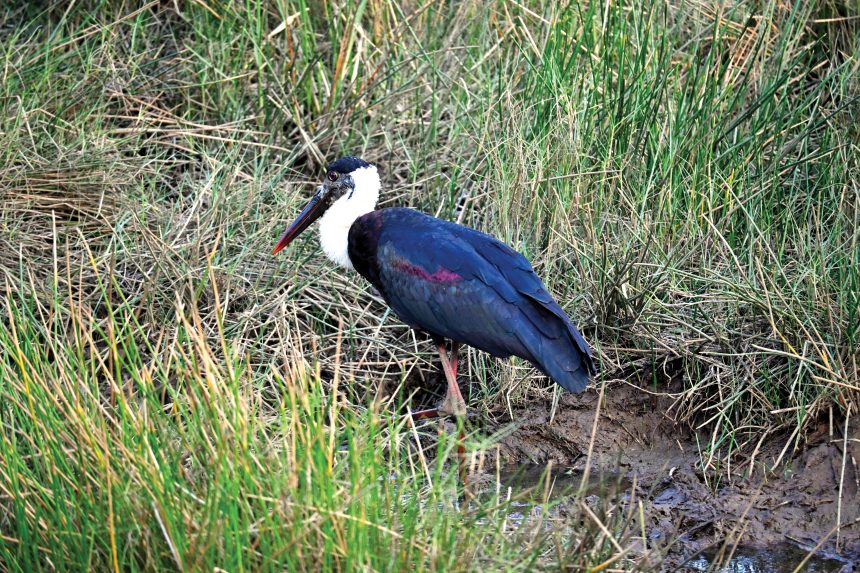
As I moved closer, carefully pushing through a thicket, a Woolly-necked Stork stood startled. It looked at me with wide, alert eyes, as if I were an intruder in its quiet world. Feeling sorry for interrupting its rhythm of pecking, I quietly retreated and moved towards another large flock.
There were Black-headed Ibises with their distinct curved beaks and different herons slyly peeping their heads above the pale grasses. A Grey-headed Swamphen waddled about, adding bold strokes of resplendent blue to the mostly black and white world of wetland birds. Nearby, Openbill Storks held what looked like snails in their slightly open bills. Cattle Egrets and Water Egrets appeared like tiny attendants beside these larger birds.
Similar to them was another striking bird, the Eurasian Spoonbill. True to its name, its beak resembled a spoon, giving it a curious, almost whimsical appearance.
Many birds appeared alike at first glance, yet each was unique. They were engrossed in their pecking rituals but playful at times. Some dipped their curved beaks into the shallow waters while others stood perfectly still. Some fixed their gaze inquisitively into the water; others preened their feathers or occasionally teased their companions. Each bird was distinct in posture and behaviour, yet all were united in a shared rhythm of foraging.
Watching them silently from a distance was a feast for the eyes. I felt as though I could stand there forever, observing them as long as they chose to remain.
With me stood another distant spectator. It was quiet, old and removed from the lively bustle of the flock. It was a lone Lesser Adjutant Stork, standing apart like an ascetic lost in meditation. It watched silently as life unfolded around it. Sometimes, after standing in the field, it would fly up and perch atop an electricity pole, as if seeking a higher vantage point to observe everything
below.
I too was lost in this unfolding world. After some time, as I continued clicking photographs, I realised the birds had sensed my presence. I felt a quiet pang of guilt and understood that it was time to leave. I often see this wetland as a scenic place as I pass by, like a painting by nature meant only to be glanced at. In that moment, I realised wetlands are not barren lands. They are the last breathing spaces of the wild, living worlds that still survive alongside us and something we must conserve.