Typeface designer, lettering artist and typographer Pooja Saxena who has been documenting striking public lettering on Indian streets is all set to launch her book ‘India Street Lettering’ this weekend in Goa
CHRISTINE MACHADO | NT BUZZ
We see them all around us. Signages announcing different kinds of businesses, nameplates offering up clues on the inhabitants of a home, or even words in various fonts painted on the sides of buses. Yet, how often do we pause to reflect on the artistry behind these and how they can be signifiers of a particular era
or culture?
Having studied communication design and later typeface design at the University of Reading (United Kingdom), typeface designer Pooja Saxena was intrigued by the typography she was surrounded by and began documenting these almost 15 years ago, leading to the founding of Matra Type.
In 2015, on one of her trips to Goa to visit family, she decided to expand her project to the tiny state as well.
“I find that photographing street lettering in any city is so much more rewarding when I do it as a person who is familiar with the place rather than merely as a tourist. I’ve been lucky to visit Goa whenever I can for almost a decade photographing signs. That has allowed me to see how signs may have changed, if they have been repaired or been taken down,” she shares.
Another thing, that has always fascinated her about a lot of signs in Goa is that you don’t see a dominance of hand-painted signs. “A lot of different materials are used. Of course, there are the azulejo tiles which speak very directly to the Portuguese colonial heritage of the state. But also you see beautiful wooden signs and of metal. I think when signage is made out of dimensional material, it allows for experimentation in lettering, which may not be possible if you’re working with a flat medium like paint,”
she says.
Over the course of her years of documentation, Saxena has come across signages with lettering done with various mediums. “In Goa apart from the azulejos, you also see it used in mosaic form. One such sign is visible at a hotel in Altinho, Panaji. In Delhi, a lot of public work signage is in the form of mosaic,” she explains.
She has also come across signs which are rendered in concrete in the facade of the buildings themselves. “A lot of buildings in Delhi also have signs that are rendered in colourcrete, which is a form of coloured concrete,” she shares.
Signs can also be carved in stone as observed in cemeteries and old colonial buildings. “Sometimes you also come across really unique material usage, like of flowers. I’ve seen that a fair amount in Bengaluru, where signs for weddings or for religious purposes or even movie release announcements are done in flowers,” says Saxena.
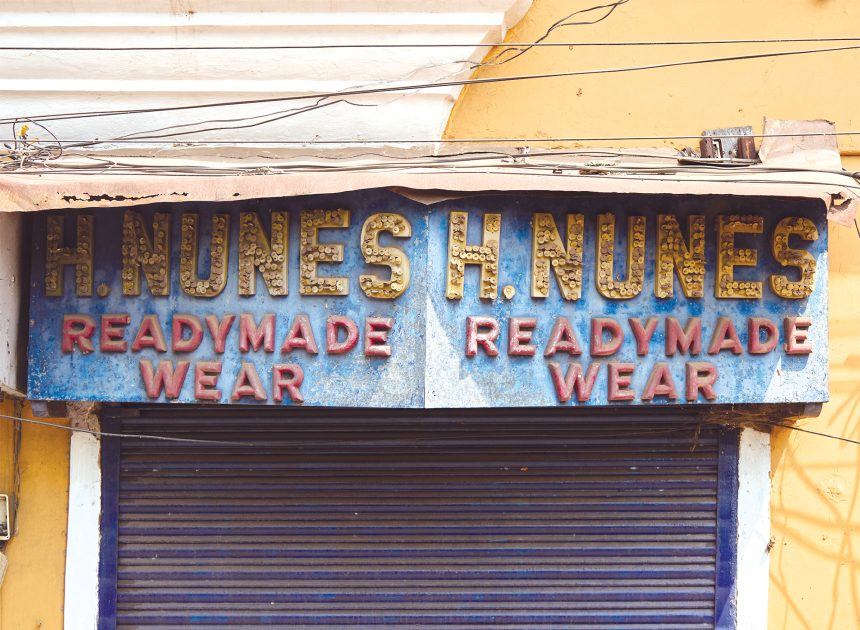
Yet another interesting material is sequins. “I’ve seen them being used on top of wood or painted signs and a good example of that from Goa is a now defunct clothing store called H. Nunes in Panaji, where there are sequins attached to the sign and it looks quite glorious,” she says. Saxena adds that she has also come across signs which are in plastic and acrylic.
Her work has now been put together in a new book ‘India Street Lettering’ published by Blaft Publications. Sharing how it came about, Saxena states that after the COVID-19 pandemic, she returned to her street lettering project with renewed zeal and started publishing zines based on the patterns and the various interesting slivers of design and cultural paradigms that she could find in her archive and in the cities that she
travelled to.
It was then that Blaft reached out to her with a book proposal which she quickly hopped on to.
But the making of a book came with its share of challenges. “There is this kind of expectations that all of us have as readers that a book is comprehensive and complete. But with this project, that is not something that one can strive for since I don’t think I or any other person documenting street lettering can ever claim to have documented everything,” she says.
Thus, she adds, she struggled in drawing the boundaries of what the entire book would include. Post this; she then had the challenge of going to some cities or some language communities where she hadn’t photographed signs yet.
Deeper research was also made slightly difficult by the fact that a lot of archival material resides in British institutions given that India was a former colony of Britain. “For a time, the British library was a depository library. So everything that was being printed in India, a copy was sent there. As a result of it, a lot of things that were published before India became independent from the British, tend to be in archives in England,” she states.
But the book and the project so far has taught her important learnings. One of these is understanding the design vocabulary of how lettering on signs look like. “It has taken me over a decade to understand that this in fact valid and a universal design language as any other language that gets popularised,” she says.
Her documentation has also enlightened her about the craft and labour behind the making of these signs and learning to view them as designers, artists and business people in their own right who change their offerings with the times.
In Goa, she spoke to two sign makers – Prabhakar Sawant who ran a family run woodworking business called Cafetaria Sawant in Panaji and Orlando de Noronha who runs Galeria Azulezos de Goa in Panaji. “In talking to signmakers I got to learn a lot about how they approach their craft, what kind of relationships do they have with letter forms, how they learned their craft and lettering and how they have negotiated the change in trend towards digital signs,” she says.
As for her favourite sign from the book, she selects one from Chennai of a really old pen shop called Gem and Co. “It’s an art deco sign which plays very beautifully with the abstraction of the Latin alphabet and the result is absolutely stunning and memorable,”
she says.
And as she takes her book to different cities around the country, including a Goa launch on February 7 at the Champaca Pop-Up at No Nasties in Panaji and a talk at Museum of Goa in Pilerne on February 8, Saxena has plenty of more locations on her bucket list for documentation.
“I’ve never travelled to Odisha and I am keen to photograph their signs there. Also, while I have lived most of my years in Noida, there are many nearby cities like Meerut that I am yet to explore,” she shares. In Goa, she adds, she would love to explore the
southern area.
“More than anything,” she says, “I enjoy going back to the cities which I have been photographing for years to see how the city is changing the signs and how lettering and visual culture in our cities have been changing over the years.”
(The February 7 book launch will be preceded by a type walk at 4 p.m. from No Nasties, Fontainhas, Panaji)