The recently inaugurated Sanctuary of Mary Help of Christians
at the Don Bosco Vocational Training Institute, Quepem,
is said to be the first-of-its-kind exposed laterite Gothic vault. The OSustain Studio team which executed the work tells
NT BUZZ how it came about
AAKANSHA CHARI
Located at Quepem, the new Sanctuary of Mary Help of Christians at Don Bosco Vocational Training Institute is more than an architectural landmark; it is shared act of faith and cultural investment etched into the Goan landscape.
While many modern structures rely on impersonal, pre-fabricated systems, this project, which celebrates local laterite stone, was brought to life through the contributions of numerous benefactors, giving the local community a deep sense of collective ownership.
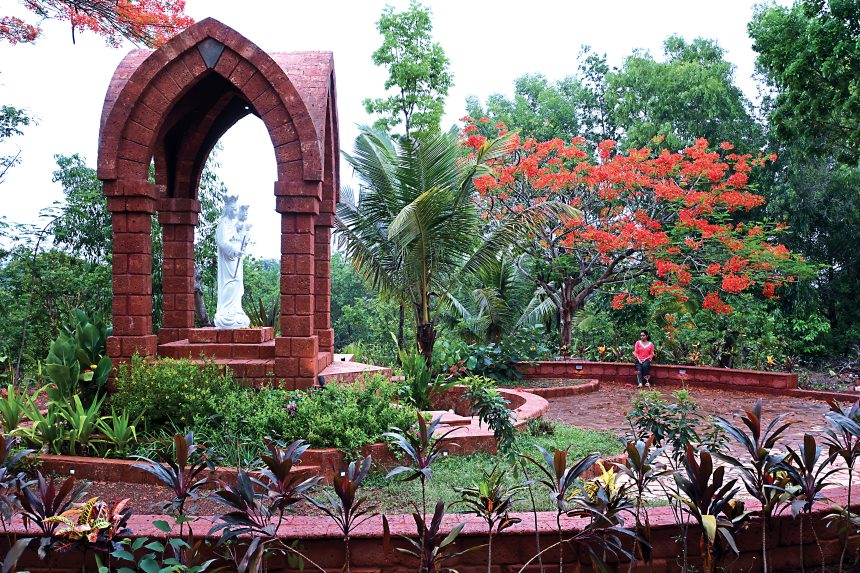
Executed by OSustain Studio, the sanctuary was inspired by the standing Gulmohar tree in the background. “The intention was not to mimic the Gulmohar tree, but to make the structure feel as though it belongs to its landscape itself. In organic architecture we design forms that submerge within the surroundings. Hence, the structure is kept as the integral part of the landscape,” explains co-founder of OSustain Studio Alilia Silveira Souza, adding that what drew them to the project was the opportunity to create something that was not only functional but also emotionally and spiritually engaging. “As designers, we aim to bring spaces to life through thoughtful design, storytelling, and sensitivity to the people who experience them,” says Silveira Souza.
The sanctuary is composed of a sequence of contemplative and devotional spaces that unfold within the natural landscapes. At its core lied the vaulted sacred space housing the marble statue of Mary Help of Christians, which forms the spiritual focal point of the structure. Adjacent to it, a floating podium accommodates prayers, addresses, and small devotional gatherings. In front of the sanctuary, an open gathering space allows larger assemblies to take place within the openness of nature. Surrounding the structure are uneven landscaped zones designed to slow movement and encourage reflection. A feature below the podium introduces sound, motion, and sensory calmness into the space.
Rising to a height of 19 feet, the sanctuary houses a six feet handcrafted marble statue, whose smooth surface deliberately contrasts with the warm, porous texture of the laterite. “The contrast was intentional. Laterite is earthy, rough, and deeply tied to the Goan landscape, while the six feet marble statue has an almost luminous quality. This juxtaposition creates a strong spiritual focus,” says co-founder Kaustubh U. Konde.
The statue, he continues, appears lighter and “almost eternal” against the 19 feet vaulted stone backdrop. During sunrise, sunset and evening illumination, the contrast becomes even more dramatic, allowing the figure of Mary to visually emerge from within the darker laterite structure.
“We wanted the architecture to respond sensitively to the site and landscape. Our practice at the studio strongly believes in organic approach that adds value to the land rather than harming it,” explains Silveira Souza., adding that the Gothic vault was chosen because its structural language allowed them to create a spiritually uplifting space using load-bearing laterite stone. The pointed arches also echo the verticality of the surroundings trees, helping the structure feel rooted within the landscape.
“The intention was not to reject RCC entirely, because every material has its appropriate application. However, the project does question the assumption that concrete is the only viable contemporary building method. It demonstrates that local materials like laterite can still play a serious structural and architectural role when combined with thoughtful engineering and craftsmanship,” says Silveira Souza., who is hopeful that this will encourage future public architecture in Goa to engage more deeply with regional materials, climate and construction knowledge rather than relying on standardised systems alone.
But executing the project had its challenges. The biggest of these was executing a contemporary load-bearing stone vault with precision using a natural material like laterite, where each block behaves slightly different. The hilltop terrain, drainage management, monsoon considerations and construction sequencing also required careful coordination. Since much of the work depended on craftsmanship rather than prefabrication, the process demanded patience but the project evolved gradually over several months through design refinement, mock-up, and on-site experimentation.
“We were attempting something unconventional, so there were moments of caution and technical scrutiny. But when the key stones were placed and the vault held itself entirely through compression, it became a moment of collective trust in traditional building
intelligence,” says Konde.
The sanctuary also aims to expose students to architecture as an expressive and detail-oriented discipline, says Silveira Souza. “Through its exposed laterite Gothic vault, integration with landscape, and carefully articulated detailing, the sanctuary encourages the students and visitors to observe, question, and appreciate how architecture can create meaningful spaces beyond mere functionality.”