Naguesh Sardessai
January 25 is celebrated as National Voters’ Day to commemorate the birth of the Election Commission of India. The country became a republic subsequently on January 26, 1950. Millions of countrymen got the benefits of universal adult franchise. The day has been celebrated annually on January 25 since 2011, as per the decision of the Union Council of Ministers.
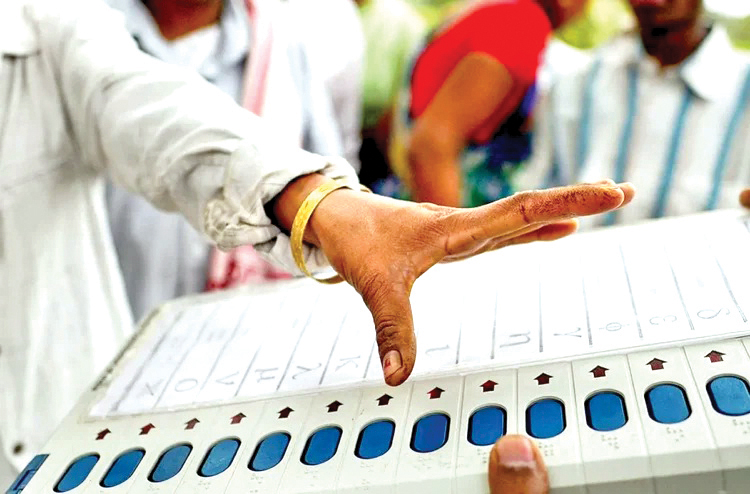
The Election Commission is vested with the onerous task of holding elections to the Lok Sabha, Vidhan Sabha, and the offices of the President and Vice-President. Indian democracy is deeply entrenched, as the country has a strong balance of powers between the three organs, as also a smooth transition of power from one government to another. Over the course of the last seven-and-a-half decades, the Election Commission has made a lot of headway, moving from the ballot paper to the electronic voting machine.
India also has the unique distinction of providing adult franchise to all Indians who had completed the age of 21 at the beginning of the first elections in 1952. The voting age has since been reduced to 18 years to include millions of young and enthusiastic voters. Initially, there used to be a lot of impersonation in voting as there were no adequate documents supporting the identity of voters. However, since the time of T N Seshan, Electronic Photo Identity Cards (EPIC) have been provided to all electors. The ECI, which was earlier a single-member body, has now become a multi-member body with one Chief Election Commissioner and two other Election Commissioners. Over the course of 18 general elections to the Lok Sabha, numerous reforms have been introduced to make the process more transparent and accountable, thereby leading to greater confidence among the citizenry.
Today, voter turnout witnessed in elections has increased considerably with the launch of SVEEP — Systematic Voters’ Education and Electoral Participation — leading up to elections. The programme caters to different stakeholders, including youth, women, Divyangs, senior citizens and the third gender. The main purpose behind holding free and fair elections is quintessential to the functioning of a healthy democracy, and the entire process is carried out as per the Representation of the People Act, 1950.
India’s elections have been a great boon to a number of countries, especially emerging democracies, which take a leaf out of India’s experience of conducting elections as a festival of democracy. This boosts the healthy functioning of the largest electoral exercise held periodically in a peaceful manner, with nearly 100 crore voters.
The ECI has introduced unique reforms to conduct elections, including pink booths where all polling personnel are women, as well as Divyang booths to ensure inclusive elections. Polling booths have also been decorated with the aim of preservation of biodiversity, along with arrangements to facilitate voting by persons with disabilities.
An error-free electoral roll is the main crux of the election machinery. To further this cause, the recent introduction of SIR — Special Intensive Revision — to improve upon earlier systematic voters’ revision has yielded tangible results, as a lot of irregularities have been done away with and a large number of states have streamlined electoral rolls.
Booth Level Officers are considered the eyes and ears of the ECI, as they comprise personnel who stay within designated polling booths and help facilitate better coordination with new voters, as well as ensure proper upkeep of the electoral roll in their respective areas.
The Election Commission of India, with its humongous activities, helps in catering to a large electorate. For this purpose, several officials from government and semi-government bodies are engaged to ensure a smooth process. The Election Commission deserves praise for conducting this massive exercise in a flawless manner. Many new and innovative measures may still be on the anvil to ensure 100 per cent voter registration and improved turnout. Ultimately, an enlightened voter is an empowered voter.
(The writer is a senior faculty at the People’s HSS, Panaji)